State of Belief
Lessons in Empathy from an Unlikely Rabbi: Angela Buchdahl
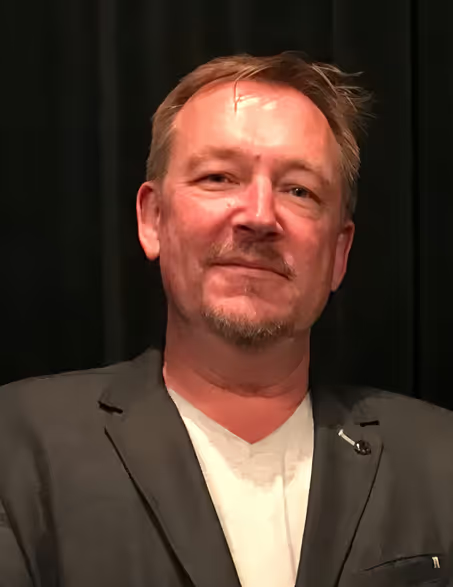

Rabbi Angela Buchdahl’s journey of faith, identity, and belonging teaches us the value of embracing the strangers among us—and our inner strangers, as well. In our increasingly divided world, the struggle to find belonging often leads us to question our identities. A cantor as well as a rabbi, she brings the experience of coming to a strange land, and the joy of leading Central Synagogue in New York City, one of the largest Jewish congregations in North America, to the conversation—as well as to her memoir Heart of a Stranger: An Unlikely Rabbi’s Story of Faith, Identity, and Belonging.
Rabbi Angela has been a trailblazer in the Jewish community since 1999, when she became the first East-Asian person to be invested as a cantor anywhere in the world. In 2001, she became the first East-Asian American to be ordained a rabbi in North America. She came to Central Synagogue in New York as senior cantor in 2006 and was appointed senior rabbi in 2014. Her book was an instant New York Times best-seller.
Newsweek and The Daily Beast have included Rabbi Angela Buchdahl in their lists of America's "Most Influential Rabbis."
Read the Interfaith Alliance Marriage Equality White Paper by Dr. Guthrie Graves-Fitzsimmons that Paul introduces at the top of the show.
Transcript
REV. PAUL BRANDEIS RAUSHENBUSH, HOST:
Since 2014, Rabbi Angela Buchdahl has served as senior rabbi of Central Synagogue in New York City, the world's largest Jewish congregation. She is the first woman leader in Central Synagogue's almost 200-year history. She's also the first Asian American ordained as a rabbi in North America. Rabbi Buchdahl was named to Newsweek Magazine's list of America's 50 Most Influential Rabbis.
In October of last year, Rabbi Angela Buchdahl released a book titled Heart of a Stranger: An Unlikely Rabbi's Story of Faith, Identity, and Belonging. In it, she goes deep into the journey she has walked and challenges she has faced as a person of mixed background, as a woman, and as an immigrant in pursuing her vocation - and also the empathy and strength that comes out of seeing oneself as an outsider. Heart of a Stranger was an instant New York Times bestseller, both a memoir and a spiritual guide for everyday living. I am so happy that it brings the author to The State of Belief.
Rabbi Angela, welcome!
RABBI ANGELA BUCHDAHL, GUEST:
Thank you. It's so wonderful to be back with an old friend. Our paths had been much more connected back in the days when I was on the board of Auburn Seminary and you were there as well, but I am a fan of your work and so grateful to be speaking to your community here.
PAUL RAUSHENBUSH:
This book is a gem. It is so beautiful. I love the way you structured it. I don't think I've ever seen something quite like that. It is a memoir that brings in kind of – well, correct me if I'm wrong, but the way I saw it, it is a memoir that brings in really important moments in your life, but also a lesson from which you can gain understanding of the deep spiritual gifts of Judaism that you kind of bring out in each of the chapters. And you read through the chapters and you get to know you and get to know your family and get to know your journey. And it was such a beautiful, beautiful book. So congratulations on that.
ANGELA BUCHDAHL:
Thank you. Well, that structure, I do think I've not really seen it before, but I took a nod from my own tradition. Originally, I wanted to write a book of accessible Jewish spiritual wisdom for Jews and non-Jews alike, in the same way that there are some beautiful spirituality books written by Deepak Chopra or Puma Chodron that take spiritual wisdom of Eastern religions and make it accessible for people who aren't of those religions. And I thought, I'd love to do that for Judaism.
And then I think I was told by an early agent that that was going to be a hard book to sell and that I would actually do better if I actually started from a place of memoir since my background is more unusual. And at first I was very hesitant because I wasn't really wanting or thinking that my story was worthy of making a book. But interestingly, I had in my head both the teaching of Rabbi David Ellinson of blessed memory, who was also a friend of Auburn, and who said, “All theology is autobiographical”, in the sense that our understanding of our own spiritual traditions come from our lived experiences and our suffering and our joys and all of that.
And the model I actually thought of, not to compare my life to this, but we have the model where we have a Torah reading which comes from the first five books of Moses every week on the Sabbath. And then there's also a Haftarah reading, which is something selected from the prophetic texts. It's always thematically linked. Sometimes it's very obvious to tell how they're linked and sometimes it's not. But the idea that you would have a kind of storytelling Torah piece and then a kind of sermonic piece that was thematically linked became sort of my model.
So you have 31 narrative chapters that are relatively short that kind of go through in chronology. But then every chapter has a Dvar Torah or a word of Jewish teaching that is thematically linked - sometimes very obviously and sometimes you have to do a little work to figure it out, or I'm sure that people could come up with different reasons why it's linked for them and not not what I originally thought, but that's the beauty of it. And so I get my spiritual Jewish teachings book in after all.
PAUL RAUSHENBUSH:
You certainly did. And in a beautiful way. And I always think spiritual teachings embedded in life are always in some ways more meaningful. And so I just really appreciated that.
Maybe we can start just with the title, Heart of a Stranger. Where did that come from and how did you land on that? I could imagine a lot of titles for this book, but that one seems like the perfect one.
ANGELA BUCHDAHL:
Thank you. Well, it's not original, as I know you know. It comes from our shared biblical text. And in Hebrew, the words are nefesh hager, the soul of a stranger. Actually, for a good three and a half years, the working title of the book was Soul of a Stranger. And the idea is, we are told, especially in the chapters around when the Hebrews are enslaved in Egypt, do not oppress a stranger. You know the heart of a stranger. You were slaves in Egypt. And so this is sort of the master narrative of the Hebrew people. And it doesn't just start with enslavement in Egypt, although that's obviously a master narrative of the Bible, but it actually begins with the very origin of the Hebrew people themselves.
If you think of Abraham and Sarah who start this people, God calls them to leave their home, their birthplace, their family behind and to go to a place they do not know. So here they're called in order to start this new people. They can't do it from the safety and security of home. They have to actually become strangers, and when they leave all that security and comfort and knowing behind to go to this place of uncertainty, when they cross over the river Euphrates, the boundary of their land, in Hebrew the word to cross over, Ya'avor, is where the word Ivri comes from - and Ivri is a Hebrew.
So to be a Hebrew is literally to be a boundary crosser. That was actually the first title I had for the book, was Boundary Crosser. But I think that Heart of a Stranger is better. But the idea is that to be a Hebrew is someone who knows what it is to leave our places of comfort and home in order to follow a call, because we understand in some way that when we do that, even though it's risky and it feels uncertain and we do not know exactly where we're going, that there's going to be blessing on the other side of that crossing.
And the fact is that's not just a Hebrew story, that is a human story. And I think every single one of us have moments in our lives where we are called to leave some place of familiarity and comfort behind. And it might be about our own family expectations or the box that people want to put us into or our cultural norms or professional dreams, or it could be about our own identities. And at some point we have to have the strength to cross over. And so in a sense, this book is also an invitation for our own boundary crossings, for each one of us to have the courage to do that, to understand that there's blessing on the other side.
PAUL RAUSHENBUSH:
That's so beautiful. One of the things that was lovely about this book is actually being introduced to your parents and your sister. But your parents, in particular, really, talking about boundary crossers. To start with, meeting in South Korea at the time and then your father, a Jewish man from the Northwest, which is, Northwest is not known as the hub, I would say, of Judaism in America. And then to be there and then for them to become familiar with one another enough so that he returns to Korea. And then eventually she decides to come to the United States and this marriage of Korea and Buddhism and then with American Judaism, I just found it very moving.
And what's beautiful about it, it is so uniquely yours, but not a unique experience. Many of the American experience is that kind of boundary-crossing. I think lifting it up is so beautiful, because it almost gives space for the rest of us to think about that way. This is in some ways the germ of how you, as someone who has a Korean heritage and a Jewish heritage, became Jewish growing up. I think that that was also very counter-cultural in a way, but there was a part of Judaism that was really welcoming that. Talk to me a little bit about that. And I would say, honestly, that has been a throughline - the question of, who is Jewish? Are you Jewish enough? I think we still wrestle with that. And you know, I'm from a mixed, interfaith background, and what does it mean, who are the Jews, it's a contested question, still. And you've been living it for as long as you've been alive.
ANGELA BUCHDAHL:
Well, I appreciate what you said about my parents. I mean, I do think in many ways this book is a love story to my parents and I dedicated it to them and they did teach me from the very beginning, not only the power of what it is to do their own boundary crossings - which they each did and traversed really vastly different worlds to fall in love with each other and to create a sense of home - but they taught me how to embrace what it is to be a stranger. I think that we all, as you said, the most human experience is to feel like you might be a stranger within your own communities. And I think everyone has experienced that at one point or another. And it's not a comfortable feeling, and at times it can be deeply painful and destabilizing.
And yet my parents both taught me to learn to embrace that feeling as a source of like, what does it have to teach us, essentially? Yes, you might feel really on the outside. So how does that build your empathy for other people who felt that way? How does it actually build your sense of resilience in the face of challenge? How does that actually make you more creative? Because if you can't take the straight path, you might have to figure out a way that goes around the side.
And I think that that's been the gift of what it is to embrace the heart of a stranger as opposed to just rejecting it. And we all know, and are seeing right now in our own country, that there are a lot of people who feel like they're strangers, including - there are now articles and books being written about how White men in America are feeling misunderstood and marginalized - here in America!
And one response to feeling like a stranger is to say, we're gonna make this about us and them. We're gonna build the walls higher. We're gonna demonize the other.
And I'm proposing the exact opposite, which I think our biblical text teaches us. No, you know what it's like to be a stranger. So especially you need to not oppress the stranger. Especially you need to find a way to draw them in, to see yourself in them. And so that is a message for America for today that I deeply appreciate and learned from my parents.
PAUL RAUSHENBUSH:
Just to continue your story a little bit, I think, again, you had to constantly come up against people who were like, you're doing it wrong, and your very persona as someone who has patrilineal Judaism is wrong, and you're saying the wrong prayer and you're doing the wrong thing. And all of those moments - it's one of those things where people are very eager to say you're doing it wrong.
But there's another way to do it. And I just want to lift up your rabbi in Tacoma, who, all of a sudden said to you, maybe you should be a rabbi. And I think that I've been concentrating a little bit about the people who have kind of stood in your way, but I also, there are way-makers in all of this. And I think that that's another lesson: do we want to be standing in the way, or do we want to be way-makers who are allowing people that path? And I think people like your rabbi, Rosenthal, who said, you know, maybe you should consider being a rabbi. They might not even realize the radicality of what they're doing, but they're just saying, hey, I'm opening this conversation. But what that did for you is just like, my God.
I remember when I was working at Princeton as a Dean of Religious Life and I would kind of say to everybody: have you considered going to seminary? Have you considered going to Divinity School? I would say to everyone, they could be whatever major. And so many times they were like, my God, how did you… Why did you say that to me? Because no one had given them the permission even to imagine that that might be them, you know? And so talk to me about that moment. I just think it must be so, so cool.
ANGELA BUCHDAHL:
I think it is such a funny thing. And in particular - and you probably know this well - I think in particular the Jewish community, maybe because we have been such a minority in America, we do draw really strict boundaries of who gets to be in or out. And I don't really understand that. And it's partly because we see ourselves not just as a religious group, but as a peoplehood, as a kind of a tribe. And we, you know, kind of famously don't proselytize.
So if someone wants to come in, we're suspicious, we're supposed to turn them away three times. And if you come from mixed lineage, there's a lot of question marks about your authenticity. And sometimes it even gets framed almost as a racial thing, like you're only 50 % Jewish, you're not 100 % Jewish, as if this is just about a DNA bloodline. And I've made a strong
pitch that Judaism is not a race - and that doesn't mean that having Ashkenazi DNA is not a real thing. It just means it's just one of the strands of Jewish identity, and it's not the exclusive one, certainly. And, certainly, you go to Israel and you see that more than 50 % of Jews in Israel are Brown Jews and from Middle Eastern or African or Asian countries, and so you know it is not just an Ashkenazi bloodline.
But I think when we think about what makes belonging, I would say that I would structure this as thinking of our community as a family. And a family, you can be born into a family, and then it's just your birthright. You can also be born into a family because of adoption. And you can also be born into a family, or you can create family, maybe one of the most powerful ways we create family that is as thick as blood is through covenant.
If you think about the idea of marriage, which is a sacred institution, my husband and I share absolutely no DNA, but we made a covenantal promise and now we are family that is thick as anything. And so I think this is not just a model for the Jewish community. We could think about this in the context of America, as well. So yes, if you are born here, you've got a birthright citizenship, at least for right now that's still holding, please God. You can also adopt this country as your own.
My mother is a naturalized citizen. She is now fully American and I would hope we would not question that, just as we would not question an adopted child as being fully part of a family. She's American and you can do it through covenantal promise. This idea that if we want to uphold the aspirations of our country as written in our Declaration of Independence and in all the documents that our founding fathers - we have still yet to fully live up to, but we know what we're aiming for - if we want to live up to that covenantal promise, we should all be able to be part of this larger family. And I think that that's what we want to think about.
And I think you're absolutely right that while much of my story is about people along the way who pushed me away or who closed doors, there were obviously more people who also opened those doors for me, who said, you do belong here. And that was immensely powerful. And I think that that's why I'm a rabbi today. In fact, I know it's why I'm a rabbi today. And I think we should think about that now. What's our responsibility to other people who feel even more on the outside than we do? And I think what you'll find is when you reach out to those, whether they are the refugee on our shore or the person in our community that really doesn't feel like they belong, not only will it help them radically at a time when people feel so alone and on the outside, you will find that it transforms you, as well, when you become the welcomer.
PAUL RAUSHENBUSH:
When we talk about Interfaith Alliance, one of our roles is to make people feel less alone. And I do think right now people feel isolated, they feel divided. There's a sense of there's no way, us and them, there's no way even me and my neighbor, you know, almost like there's a sense of fracturing and also a sense of like… You know, it's very analogous, this idea of the presence of what we're now calling White Christian Nationalism of, these are the people who really get to belong. These are the people for whom this country was really made. And then there's the rest of us who maybe get to stay here if we adhere to totally every rule that they get to set.
I want to read something that I know you know probably by heart, but in this conversation, it's such a great voice to bring in, which is George Washington's letter to the Hebrew congregation of Newport. He says, “It is now no more that toleration is spoken of, as if it was by the indulgence of one class of people, that another enjoyed the exercise of their inherent natural rights. For happily the Government of the United States, which gives to bigotry no sanction, to persecution no assistance, requires only that they who live under its protection should demean themselves as good citizens, in giving it on all occasions their effectual support.”
And I just think that idea of George Washington - this is, I don't know, 1796 or something like that, 1790 - that's what I hear you saying around, to take it almost from the particular of the Jewish faith, which, by the way, I'm not singling it out, just as the example that we're talking about today, to the wider context of our country, what does it mean to be welcoming and to acknowledge that there will be difference, that no one gets to say to the other: I will allow you to be here. And I'm sure that that is something that you must be really thinking about in your position, in such an important leadership position in this moment.
ANGELA BUCHDAHL:
I think that we have lost sight of the fact that we are a country of immigrants. Aside from the Native people who were indigenous to this land, pretty much every other group that's here came here at one point or another as immigrants. And it is actually the beauty and possibility of this country that you could actually become fully American.
Someone else wants to move to Korea, you can't become Korean. It's really even, even I, as a half, one Korean parentage, I'm not a Korean citizen and I didn't get that automatically by being born there, either. And so it's a unique American ideal; but that's the ideal that, if we are living up to it and being good citizens and if we're not carrying forth that idea, we're actually not being good citizens of America. The ideal that you could join this project which was about liberty and freedom the pursuit of happiness all of this, and with a sense that you could all be equal under the eyes of this country. And I think we don't want to lose sight of that in this moment - right now, where it seems like some people get to decide the rules, to be the gatekeepers in this way.
I'm also not advocating that it's, like, absolutely open borders. I do think that there has to be a way that this is done in a way in which your family is still taken care of. It doesn't have to be a completely black and white or oversimplified thing. This is not about what kind of immigration policy we're talking about, but just the demonization right now of the other is what I'm protesting. It feels very deeply un-American.
PAUL RAUSHENBUSH:
And there's a cruelty in all of it. And also, I know you're very acquainted with the phrase, “the great replacement theory”, which is an antisemitic trope that somehow the Jews have decided to use immigration to dilute the power of the Whites, and this is all part of our plan. And there's such an insanity there, but it has actually resulted in terrible terrible people's mindsets, and we actually hear this now being offered up in kind of quote-unquote “normalized conversation”, in punditry, and so I do think that there's implications for all of us in this.
And, you know, my own family - the Jewish side as well as the Christian side - but the Jews, they left after the uprisings of 1848, the people's uprisings, and when Jews were particularly getting the backlash of that, and when they arrived here, they just kind of were like, my God, I can't believe, you know, that we can just be here. And there's no restrictions in our movement and things like that - not everybody, obviously, Black people did not have that experience - there is a history here of being able to come in and make yourself. And I still think that the contributions of immigrants, you certainly understand that so well, and you're an example of that.
All of us in some ways are an example of that, but you lived it. And so, talk to me about what leadership looks like for a religious leader and specifically a Jewish leader of the largest synagogue in America.
ANGELA BUCHDAHL:
The fact is, actually, in places like Israel, well, whether obviously is a really large Jewish population, congregations are very, very local, hyperlocal, and, really, relatively small. So it's just a different model. And we have a livestream community that has grown over the last, it's now 17 years, I think, we've had livestream, and especially, exponentially, it grew over the pandemic so that we know we're reaching about a million people at the high holidays, at the Jewish high holidays, in like a hundred countries. So it really has changed the nature of what it means to be a congregation and who belongs, even.
You know, while we have a very large membership that kind of is a traditional dues-paying model that we have in synagogues these days, we also have a million people that are not officially members, but are listening to our messages, praying with us and consider our clergy team to be their clergy team sometimes. And so it's a really interesting model.
And I think that in a post-October 7th world, there's a certain way that the Jewish community has felt much smaller and more connected - and not always for good reason. mean, leading a community now feels as urgent as ever and deeply meaningful and very, very hard and challenging. I think in my lifetime, I have never seen the American Jewish community feel more anxious, fearful, unable to kind of stop something that we feel like is happening, but we don't really know how to alter the course.
I think that you know that the vast majority of American Jews feel like Israel has a right to exist as a Jewish state. The word “Zionist”, think, has taken on different meanings for different people, has been sort of made into almost a swear word of a kind, or a curse. So I think that that's been more complicated, but I do think that most people want to see Israel at peace with its neighbors and thrive. And I know that people have very, very complicated feelings about Israel. And so I think that all of that makes leading a community very challenging right now.
I have a blessedly diverse community. I say blessedly because I value so much that I am not in an ideological or political monoculture in my congregation. I have, really, people representing all sides of the spectrum and then a lot of people kind of figuring things out at the same time. And that means that I think that I have to be more intellectually honest because I'm speaking to people from very different places. It does mean unifying is harder and I think that my job as a religious leader these days, which is I think our job not just in this particular moment, but in general, maybe especially now, is to continue to try to stay one level above the politics.
It's transcendence, really. It's trying to remind ourselves that one level above the kind of surface are these core human needs that we're all trying to address and answer, even if we're kind of coming up that mountain in different ways. And those are core feelings of isolation, of belonging, of the suffering that we're all feeling, the worries we have for our planet. In our democracy right now, there are all those things that we're all thinking about.
I think that when we can stay one level above it, and we do that through prayer, through service of others, through singing together, through meeting each other in our pain and showing up for each other in people's grief - these are the ways that we transcend the kind of the surface problems of our lives and remind ourselves of what is deeply human and connecting, that doesn't make all of our political differences go away, but what it does is it doesn't allow us to demonize. And that's been one of the problems is that we can still disagree - the Jews have disagreed with each other for as long as there have been Jews; two Jews, three opinions, as we say. That's not the problem. It's when we think that the person we disagree with is not only maybe wrong, but immoral or an existential threat to us, which is the way that we are seeing anyone who's on the other side these days.
And this is not just the Jewish community now. This is America. You've got a whole community of people who are seeing the whole other half of the country as evil, as immoral, as an existential threat to them. And that's what you're feeling on both sides. And when you feel that, you can't build any sense of understanding or unity - because that person's a threat to you, not just wrong or not just disagreeable. I think that that's happened because we are so siloed and because we're all listening to our news in our algorithmic bubbles.
That's the true danger of what has happened in this highly polarized time. So any places where people meet as human beings, real live touching and interaction across those lines of difference, are actually essential to our democracy, essential to our spiritual wellbeing, essential to our faith and our moral compasses. And so I'm committed, deeply, to keeping my ideologically diverse community together. That is actually a sacred responsibility because those spaces - which used to be our churches and synagogues, by the way, much more so, and it used to be our news - those spaces are very rare now. And that's, I think, one of the biggest tasks of faith leaders today, and leaders in general.
PAUL RAUSHENBUSH:
And I can only imagine how challenging that is personally and for you. I worked in churches for a while, even in maybe a little less fraught time, and churches that were largely kind of politically and religiously not homogeneous at all, but there weren't directly... I mean, maybe a little bit, probably more than perhaps was acknowledged. Right now, I think, it must be really hard. I am curious - I'm going to ask this and you could say no, but I do think one of the things that we haven't talked about, which is actually kind of the thing in some ways that is most celebrated and acknowledged as the brilliance of you is that you are actually a cantor and a rabbi. You know, a lot of people are like me, I have talking, talking, talking, but I have no sing. That's all I know, but you can do both. And in some ways, like the arts, more broadly, but specifically the elevation that comes from music and song is really something that you can bring into every situation when it's appropriate.
I'm curious, is there a song and would you be willing, even for a minute, to grace our audience with a little bit of that kind of flavor? Because I feel like the listeners would be bereft if they didn't get just a little bit of that on this podcast.
ANGELA BUCHDAHL:
Well thank you for that invitation. I'm reading a beautiful book by Dr. Suzanne Song about why we suffer and how we heal. And I think it will resonate for you that she sort of talks about three things that in her experience as a doctor who's worked with people from trauma countries, where entire populations are traumatized and children and everything else. She says it's the things that help bring healing: our narrative, ritual and purpose. That's the business we're in and maybe narrative is the rabbi side of me. The ritual is the cantor side of me who understands the role that ritual music and art can bring that is beyond the intellectual, and it is some affective impact that we can have that heals.
I've been really very deeply connected to this song, Somewhere Over the Rainbow, which is obviously a beloved American song. It was written by two Jewish Tin Pan Alley songwriters in the 1930s, as World War II was kind of coming underway. And I think you know the theme is there's no place like home. Like basically feeling exiled and wanting to come to your place of home where dreams can come true. And this is, in many ways, I think, a deeply Jewish song, and it's connected to my Heart of a Stranger book in the sense that it's maybe the most beautiful exilic prayer that we've ever set to music.
And I just celebrated my 20th anniversary at my synagogue, because even though I was the rabbi since 2014, I was the cantor starting 2006. So I've celebrated my 20th year last weekend with my community and they had me go into the center of the congregation, there were 1400 people in the sanctuary, completely packed to the gills, standing room only, the entire congregation rose, my congregation, my clergy team surrounded me in a circle and then concentric circles out of the community and they sang Somewhere Over the Rainbow to me. And at some point these banners came down from the balconies with the words of the song and it was just such a ritual moment, it was outrageous. So I'll sing just a little bit of it, but I guess I would offer this as a blessing to all who are listening that as we have left those places of comfort and we are seeking to find our home, that you find blessing along the way.
(Sings a few lines of Somewhere Over the Rainbow)
PAUL RAUSHENBUSH:
Thank you for that blessing, my goodness.
I want to invoke a name, and that name is Ruthie, who was your first…
ANGELA BUCHDAHL:
My first song leader, and you can read about her in the book, but she, I'll tell you, just briefly, that she left when I was about 11 years old. She kind of flew into Tacoma and then flew out a few years later, but had such an impact. But I was young, I didn't even know her last name, and I didn't know how to contact her. So I hadn't seen her for 40 years. But then I wrote this book, and on one of my book talks, someone said, I think I know who this Ruthie is. She's in Chicago. And she connected us and we had a phone call and I sent her a signed copy of the book, and it was this amazing, beautiful reunion. So that was a nice perk.
PAUL RAUSHENBUSH:
That is lovely. But again, that's a way-maker. Someone who said, you can sing. And I think that that's what we need in our lives are people who say, you can, you can be a part of this. You can, you have gifts. And I think that all of us need to feel that right now as contributors to our country, to our tradition, to our families.
Of course, we're coming up on Pride Month and Somewhere Over the Rainbow, that really no one is expendable. We really need all of us. And I just think, what a blessing this book is. What a blessing your long journey, including all of your gifts of leadership. It's just so great to be talking to you.
Rabbi Angela Buchdahl is Senior Rabbi at Central Synagogue in New York City. Her powerful memoir is Heart of a Stranger: An Unlikely Rabbi's Story of Faith, Identity and Belonging.
Rabbi Angela, thank you so much for being with us today on the State of Belief. A pleasure.
ANGELA BUCHDAHL:
Thank you so much, Paul. Thanks for the great questions and for the opportunity to speak to your community.