State of Belief
Vanita Gupta on Public Trust and the Role of Law in Our Democracy


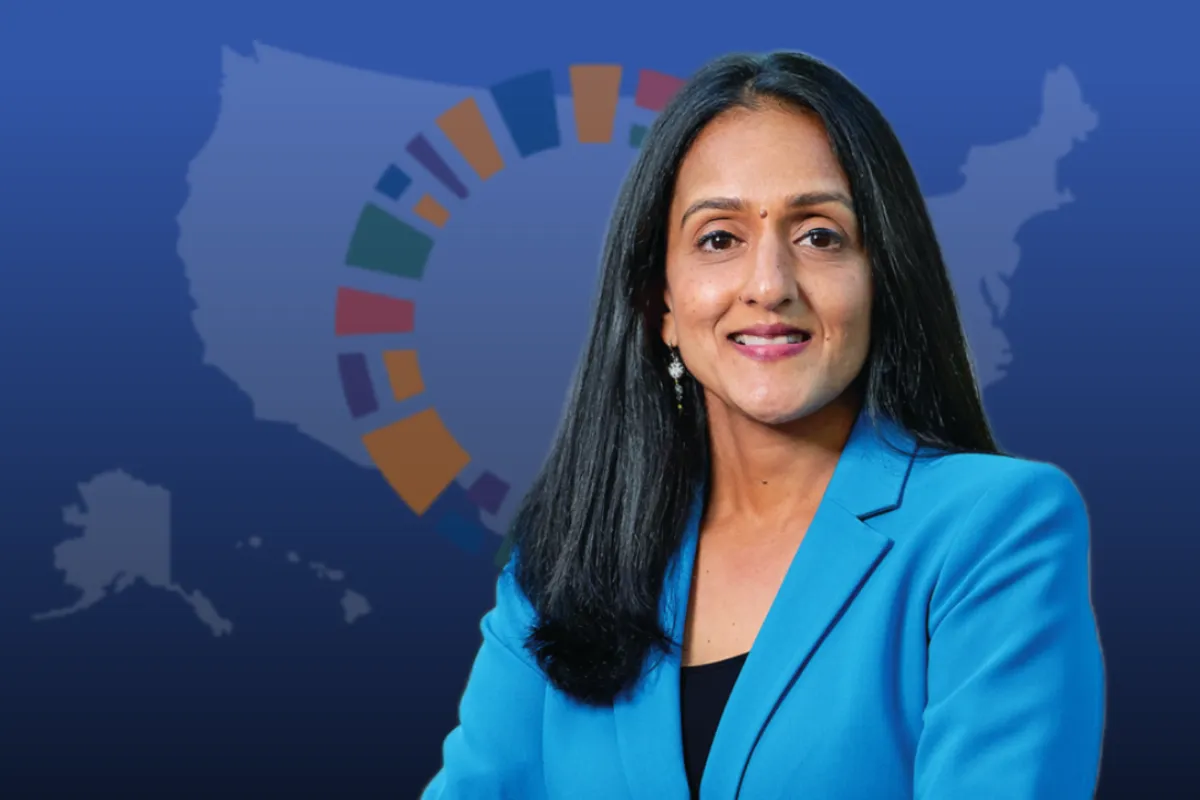
What hope is there for the rule of law when the Justice Department is deployed to settle political scores and privilege one religion over others? A lot, as it turns out—but the work of rebuilding our nation's voting and justice systems won't be fast, and it won't be easy, according to this week's guest, Vanita Gupta, a civil rights attorney and former Associate Attorney General of the United States.
In conversation with host Rev. Paul Brandeis Raushenbush, she emphasizes the fragility of our democracy due to eroding trust in institutions and urges moral courage among lawyers and citizens to defend justice and fairness. Vanita's insights on the power of faith communities in restoring trust and her call for cross-faith solidarity offer a hopeful path forward.
Transcript
REV. PAUL BRANDEIS RAUSHENBUSH, HOST:
Vanita Gupta is a civil rights attorney who served as U.S. Associate Attorney General during the Biden administration, making her the third-highest ranking official in the Justice Department. She also led the DOJ's Civil Rights Division during the Obama years. Prior to her government service, Ms. Gupta was Deputy Legal Director at the ACLU, as well as working for the NAACP Legal Defense Fund. Now she's back at her alma mater, NYU School of Law, as Distinguished Scholar and Director of the Center for Law and Public Trust.
Vanita Gupta, thank you so much for joining us on The State of Belief.
VANITA GUPTA, GUEST:
I'm so happy to be here. Thank you.
PAUL RAUSHENBUSH:
I want to start with your current position because, law and public trust - wow, what a important, necessary, and fragile quest. And so can you tell us about the work and what is your mission with that?
VANITA GUPTA:
I thought you were going to say, “what an impossible task.” You wouldn't be wrong that it's at least a fairly daunting task that I know you and so many others are trying to engage in, which is: how do we find a path towards rebuilding public trust in our institutions, in our leaders? These types of quests are actually really important to our democracy, and the health of our institutions matters and reflects the health of our democracy, in my view.
So I launched this center last October really cognizant of the fact that we are right now experiencing historic lows of trust in government, in our leaders, in institutions like the Department of Justice - which I have had a job at twice before - and understanding the context and the reasons for why we have this historic set of lows. I think one of them is just the deep polarization in our country - the fact that our media ecosystems are just reinforcing our own views, increasingly, with social media and that we aren't really listening across difference. And so this increased polarization, I think, tends to also fuel and reinforce kind of conspiracy theories and notions that we can't trust anything. We can't trust anyone. We can't trust or believe that institutions are going to work for the public good anymore. What is the public good? So there are deep profound questions about that.
There's also a view among many people, and you can look at polling and focus groups about this, especially with our young people, that our leaders and our governments don't work for the people anymore; that they work for special interests, that they are self-enriching, that frankly, to put it bluntly, there's a view that they are corrupt. And I think that there's been a huge problem where if our institutions aren't actually delivering for the American people, and also aren't places of accountability where it's viewed that the law will be applied equally to everyone, no matter how powerful or wealthy you are, that we have leaders who engage with the utmost ethical integrity... All of this, I think these are all factors that are really undermining public trust at this moment.
So I wanted a place where people could come together and talk through strategies and designs for institutional rebuilding. We're watching the dismantling of the federal government right now and a lack of understanding of just how much people in federal government view themselves as in service to the American people, and this notion that they are part of some conspiracy to undermine the American agenda, I think has been such a disservice. And so we want to help think about: how do we rebuild the federal government? How do we rebuild the Justice Department? How do we rebuild faith in leaders and equip leaders to be accountable to the American people? So those are some of the very big noble projects that we have and that's what fueled me to launch this effort, even if it is a quest that will require a few generations of work.
PAUL RAUSHENBUSH:
Well, this feels like a really crucial moment to take that on. We can't just say, oh, well, you know, trust is lost. I would say there's been an intentional undermining of trust in government, and an intentional, in some ways, putting it in people's minds that government cannot serve the people.
And so this is almost a stated ideal for some folks and some efforts. And we really have seen the dismantling. And let me just say it's harder to build than to dismantle, and that's part of it. So I love the way you started that with, it is about how do we build trust in our institutions, which is a way of saying, how do we build trust in our democracy? Because if you undermine trust in democracy, that's where other forms of government like autocracy certainly have an opening to come in. And I just think that that's one of the saddest things that's happening right now is that there is a lack of trust.
And I think specifically with the law, I do think the law is kind of the architecture of the nation. I come, as you know, from a legal background. My dad was a law professor. I kind of play a lawyer on TV, although I have no right to at all. But I was raised with this idea that the law was the highest profession because it was a way that we could figure out how to be together and imperfect, always moving forward. And so I would love to get your assessment on this very big idea of the role of law in democracy, and what is our task right now as people who care for legal structures as a way of maintaining and improving our democracy?
VANITA GUPTA:
So the American experiment with democracy is not a very old thing. This year we are celebrating 250 years. It is, as you said, an incredibly fragile moment for democracy. But democracy isn't going to be a valued system of government unless democracy can deliver for people's needs, right? So, you know, when people are feeling like the gas prices are too high, their grocery bills are too high, they can't take their families out anymore to get a basic Friday night meal to enjoy in a restaurant. Democracy has to deliver for the American people. And I think we can't make this kind of an abstract issue. It's very bread-and-butter for all of us.
But I do think the law has been, since our founding as a country, the way in which we kind of have these contested debates and struggles around opportunity, equal opportunity, about trying to make the promises that are in the United States Constitution, this incredible document that really is the embodiment of a set of promises to the American people. And the work that lawyers - not just lawyers, but that lawyers do – is to try to take people's lived realities and bridge that gap. That's, to me, what civil rights law has been about. It's about taking the lived realities and trying to bridge the gap between what was promised in the Constitution. But we are right now witnessing this incredible strain on the rule of law.
And Paul, I think you and I are in a lot of rooms and in a lot of joint projects to shore up what the rule of law means. It has to mean that the law will be applied fairly, that nobody is above the law nor beyond its protection, and that lawyers have the obligation to to ensure that that is the case. They go to court, they can be organizers, they are people of faith, they are people from all kinds of backgrounds that are, right now, doing what they can to defend and uphold the Constitution, to protect vulnerable communities, as well.
That's one of the beautiful things about the American Project is that we are this incredibly diverse country. And we have constantly kind of strived against inequality and strived to have equal opportunity. It's never been perfect, as you said, but this fight for a more perfect union - lawyers have played a deeply important role in. But I am very concerned about right now. And it isn't anything that started just recently. Let's be honest, some of the breakdown in people's views of the rule of law have been happening for quite a long time.
I started my career as a criminal justice reformer. I worked with progressives and conservatives. I worked with faith leaders and corrections and law enforcement leaders that wanted to have a fairer system, because we all know that the criminal justice system has been rife with inequality. What most disturbs me now, though, is that there's just an official attack on the machinery of the law, meaning attacks and threats on judges that are upholding the law, attacks and threats basically threatening them for doing their jobs, attacks on lawyers and law firms.
And we saw this, Paul, at the beginning of this administration: executive orders, really unprecedented, calling out law firms for having a client that might've challenged the president or the White House, challenged their policy agenda. This type of retribution agenda undermines people's faith in the law, undermines people's view of the rule of law. But I have to say, I also am very worried that people view what is happening right now through their own kind of partisan lens. So, I worked at the Justice Department. People, when I was working there, said the Justice Department was weaponized, depending on what your ideological view was. And people now are watching, myself included, watching the department really kind of corroded and this retribution agenda really taking over the non-partisan law enforcement basis for the department.
This is very concerning for the rule of law, and it's also concerning that figuring out how to rebuild trust in this type of institution that really is anchoring the work of lawyers and the rule of law in this country, the Justice Department. How do you build trust when we are so polarized and people view this from the lens that they see it? But this is the project. We have to be willing to have the hard discussions and work on this in order for us to preserve what is so kind of the sanctity of the American project.
PAUL RAUSHENBUSH:
I love hearing you talk and it's both depressing and inspiring. I think that's our lived reality daily. I do think that there are just certain things that are happening right now that have really… There's the question, there's a quote that you may have heard of that my great-grandfather, Justice Brandeis said,which was, if we desire respect for the law, we must first make the law respectable. And I am in this moment where, especially the Voting Rights Act, I think, has hit a lot of us very hard. Something that was worked so hard for and people died for to be gutted in such a way - it's not the last word, but it does feel very much like, okay, so what is really going on right now?
And I had the embarrassment of saying to Representative Jamie Raskin, who I'm sure you know, I said, the Supreme Court is not going to save us. And he yelled at me, he said, the Supreme Court has never saved us. They always have done things like this. But the question is, how do we continue to have faith in moving forward, especially when it feels like the Supreme Court is undermining so many of the rights that we thought were guaranteed and thought was established. And so I'm curious to get your take on that, if you're willing to give it.
VANITA GUPTA:
Look, for me, the last few weeks have been demoralizing in a lot of ways. And the Supreme Court's final blow to the Voting Rights Act was just a devastating gut punch for so many of us, for the reasons that you just said. But I also, in some ways, feel like it is a wake up call for so many of us to understand that it is on us when we take certain things for granted and that democracy takes work. And I think it's been very energizing to people to understand that we are going to have to now vote and show up and exercise the right to vote to see the change we want to see.
Obviously there are people wondering if their vote is going to count given the Supreme Court decisions. But this Saturday, there's going to be a massive mobilization, nonviolent, people of faith, people of all walks of life coming together, led by Black voting rights organizations in the South, in Montgomery, Alabama on Saturday. That is the power of when you're in a crisis, it can really wake people up to say, we have to now fight for the future that we want.
I will say, I don't know how you felt about this, but to me, Minneapolis and the events that happened a few months ago in the thick of winter, sub-zero temperatures, where day after day, people in Minnesota were showing up to protest nonviolently; community-based organizations, churches, mosques, organizing, happening to basically protest ICE tactics, the brutality of the actions of federal agents in their city and to reclaim their city. And then finally, you know, in the face of horrific deaths of Renee Goode and Alex Priddy, ICE retreats, the federal government, the administration, seemingly retreats, at least from Minneapolis.
To me it was an inflection point, quite honestly, for the country. People had been rushing to court, that didn't work. People had been publishing photographs and video that kind of I think helped bring it home to all of us that were not locally, physically in Minnesota. But the thing that made the biggest difference in the face of armed federal agents with guns in their streets, which you and I would think would be the most impossible of conditions to produce change in given the level of fear and the violence - that is what happened, is people showed up. And so I just refuse.
Yes, it's been a really difficult time, there is no question; but I remain hopeful, and I don't think I'm just a Pollyanna, but it is because in these moments of crisis, the thing that is just incredible about our country is that Americans are not going to give up on their communities. And it may be hard to talk about this in terms of the Constitution and federal law, but when it comes down to your local community and your neighbors and the people you go to church with, the people I pray with, the people you pray with, the people that are in our grocery stores, etc., that's where we see each other as human beings and we are willing to put ourselves at risk to demonstrate the moral courage that Dr. King modeled for all of us.
This stuff comes at a real cost to a lot of people. The fear of showing up in this moment to stand up for what's right can be a costly thing, as it was for the people of Minneapolis. And yet they did it and they prevailed. And so that's what gives me hope.
PAUL RAUSHENBUSH:
Recently I had on the head of the National Progressive Baptist Denomination, which is a Black Baptist denomination founded by King, Thomas Bowen. And he said, we're just going to have to be out there. And I agree completely.
You know, our tagline for the show is “Where religion and democracy meet.” And I am interested in the way you understand - there's a couple things going on right now, which is the America 250 effort that is being put forward by the administration, and very much a part of that is: this was founded as a Christian nation. Christians have a specific privilege in this country, almost, because of the Christian nature, and we have to retain that Christian …
Groups like mine, especially for me as a Baptist say, that's exactly the wrong interpretation of the Non-establishment Clause. It was brilliant, because it allowed Christians - and everyone else, I mean, that was the brilliance of the moment. But there's an effort, the way I understand it, I would love to hear how you understand it, almost an effort to rewrite the intention, the history, to reinforce a kind of political goal for today. How do you see that?
And as part of that, Interfaith Alliance really pushed back against one of the DOJ's efforts, the anti-Christian bias task force, which was this effort to say that the most oppressed group in America were Christians and which just felt disingenuous and a political effort rather than something that was really looking at religious freedom for all. How do you understand how religion and the law and the Constitution are all factoring into this moment as part of your work with the broader question of the law and society?
VANITA GUPTA:
I have spent my whole career, Paul, fighting discrimination, fighting for equal opportunity, fighting for the right for people to worship whichever God they want to worship, to love who they love, to live free from harassment and violence. And I find discrimination against Christians, against Jewish people, against Muslims, against Hindus, against people of faith to be absolutely abhorrent and antithetical to the American Constitution, to everything that we should stand for. And I am very worried.
And look, I have been very worried - and I'll just say this about the rise of Hindu nationalism in India, which is where my parents come from - for kind of the same reason that I worry about the rise of a type of ethno- or religious nationalism in the United States. These are two countries that are, I think, prized for being heterogeneous, for being home to not just like a few religious minorities, but actually, the fabric of our country is made up of millions of people of all different faiths - obviously India being over a billion. And so, this concerns me.
I don't think we should tolerate discrimination against people for whatever faith they engage in, as long as it's a nonviolent faith. And I am very deeply concerned around the - and I don't like this word because I think it gets overused, but I'm going to use it as a shorthand right now - but a weaponization of any type of religion in this country. I think we have the First Amendment – in fact, you know, our constitutional writers had a lot of prescience in understanding the ways in which the American project could get torn apart if one religion is ascendant on all others, given kind of what this country has always aspired to be. So I worry about the political nature.
I also, though - and I'm just going to be frank - I don't think that it is right for people to denigrate people of other faith because of what their faith is. And what's so interesting to me right now, Paul, is I do think that we're in this quandary where - and I'm going to speak as an Indian American, a South Asian American - watching this H-1B visa debate play out and seeing folks like Usha Vance and Vivek Ramaswamy and Kamala Harris get maligned for being South Asian, for being Hindu; or Mamdani for being Muslim American, and getting targeted for those reasons in really, frankly, racist ways. And I watch this and it's almost like it's equal opportunity, ideologically.
And a lot of it is online hate. And I'm profoundly disturbed by that. And these are Republican and Democratic kind of icons or folks in prominent positions. That just goes to show to me just the intense kind of fragility of recognizing and appreciating the heterogeneity of faith and belief in this country that I think is undermining our communities in really unhealthy ways.
At the same time, you've got what you're doing and the Interfaith Alliance and this incredible organizing to bridge together, to come together across faiths and to stand up and say, we're not going to stand for it. We are religious leaders. We speak together, we eat together. We may worship different gods, but we are unified by a set of values that over arch and are more dominant. And so that gives me a lot of hope. I think in our local communities, people are much more cohesive than sometimes they are in our national politics.
PAUL RAUSHENBUSH:
I think it’s really true, because you know your neighbor and hopefully you will know your neighbor and ask questions. I am curious, too: I have no idea what your religious background is, and most importantly, whatever it is or is not, I don't assume that you were raised in any tradition. But what were you instilled with as a young person? What values that may have come from religion or philosophy or whatever that lead you today.
VANITA GUPTA:
I was hoping you would ask me this question. So I was raised Hindu, and in Hinduism, the temple is in your home. I mean, there are temples also that you go to, but we have altars or places where, in our homes, we kind of bring the temple into the home. And so it isn't always this outward showing. And I was raised Hindu and I'm married to a Vietnamese American who was raised Buddhist. And so our two sons, who are both teenagers now, are both Buddhist and Hindu.
And there's a lot of overlap, as you know. Buddha was a Hindu when he started out. And so they've learned and understood what those overlaps are. And so that's how we're raising them. We aren't kind of doctrinaire in any particular way.
But the values I think that I was raised in and that I'm trying to raise my own children with is really about having a moral compass and ethical values that are often told through the Hindu traditions, the Buddhist traditions, frankly, the Christians - my kids have read parts of the Bible, they've analyzed it, they've been to, I don't know, a hundred Bar Mitzvahs and Bat Mitzvahs. They’ve really come to appreciate the Jewish faith and Jewish traditions, too. And I love that. I want my children to be exposed to that.
But fundamentally, what we try to impart is, really, a sense of a moral compass and when to use your voice, when you see something wrong to be able to speak out about it, to take action rather than just be a bystander to injustice, And to be good people, not to lie, to tell the truth, these are the basic things that I think we all want for our children. And to me, I think religion gives us stories to give lessons to our children and to help them understand how people confronted these challenges and the choices that they made and to inspire my kids.
But fundamentally, I think the moral compass piece of this feels a lot less hewed to a particular religion and more kind of a set of common values that we try to impart to our people of good character.
PAUL RAUSHENBUSH:
Is there a Hindu story that when you were young you were really attracted to? I think sometimes there's particular figures or however you want to describe them, characters or deities who go through something. You're like, I identify with that or that inspires me. Was there any story particularly in the way you were raised that, really, you were like, I think I can learn something from that.
VANITA GUPTA:
You know, it's a great question. So there's this set of comic books that are very famous to any South Asians, they're called Amar Chitra Katha. And these comic books are really what introduced me to not just, I would say Hindu - I mean, they're mostly around Hindu mythology and stories - but also for other religions, now, they get made. And I learned most of what I know about the Hindu religion through these comic books that told these stories of Ram and Sita, of Krishna, of Hanuman and Ganesh and Vishnu.
But I think the book that really affected me the most was the Mahabharata. It's a little, in some ways, Game of Thrones-like, but it teaches you all of the… And the Bhagavad Gita, which is a very famous book that really is about ethics and moral courage, but also about war and challenge, that these were some of the kind of stories that really affected me around when families were at war for generations and having to make decisions to find a pathway to peace.
So I would say the Bhagavad Gita was the most influential in terms of the ethical piece, but the stories are so rich, Paul. The Ramayana is amazing. It's the story about these two brothers, Ram and Lakshman, and Ram gets married to Sita. There's a little bit of, also, the subjugation of women in the story, and kind of the elevation of how women overcome some of that subjugation in the Ramayana that really affected me, too. I won't go into this. It's too long of a story, but these stories are very rich and they're very galvanizing to one's imagination.
And they're not beating you over the head with the lessons. You learn them through the stories because you see how they end. And I think that's some of the most effective way of imparting knowledge and information about religion is through the stories that we tell. And so some of these stories were deeply affecting.
And then I ended up studying, I took classes on different religions in college, just because I was curious about how people understand the role of religion in people's lives. And so in building community, I've thought about it a lot for organizing around civil rights, as well. And I know you've been doing such great work on so many issues at the Interfaith Alliance. And so I’m still, I think, discovering the contours of my own faith. But that's why I'm not drawn to orthodoxy. And I'm always learning from other people's faiths, too.
PAUL RAUSHENBUSH:
I think that feels very important as a model. And I feel the same way. I've been enriched so much by all of the contact I've had with so many different thinkers, including people who don't adhere to any religion, but have this incredible, rich assortment of philosophies and political inspirations.
Civil rights encompasses so much right now. I'm curious how this intersects with your story, but when we think about the sixties, there was the civil rights for African Americans, but there was also the opportunity for immigration in a way that it hadn't happened before. And the immigration of - especially opening up, which had been restricted as, again, part of, I would say kind of a White Christian project: too many people coming in from here; we’ll take them from here. At first it was Southern Europe: we don't want the Italians, we don't want the Jews from there. You know, we want the right kind of Jews. We don't want the wrong kind of Jews. You know what I mean? So this has been going on for a long time, but there was a real moment in the sixties where there was a re-understanding of how we could really embrace diversity in America and the richness that that moment happened.
And now as immigration becomes less of a how can we have a sane and an intentional immigration policy, rather it's become, we use this word reluctantly, weaponized in such a way that they're in, they're out, they're the right kind of people, they're the wrong kind of people. I mean, even if you look at what's happening in South Africa, like Afrikaners can come in, but almost no one else can.
How do you understand that as part of the legal challenge? if it putd you on the spot too much, if don't want to say it, but it does feel like a part, also, as myself and others who care about religious diversity in America, this also feels like an affront to this basic idea that we are meant for a country for diverse religious traditions rather than one that takes preeminence.
VANITA GUPTA:
I do think that US history gives us so much context. And then sometimes it gives me some solace to understanding that as bad as things are now, kind of understanding that this stuff goes in waves and there's backlash and there's progress. But the demonization of others and the demonization of other people on the basis of race, which I think has been driving some of the anti-immigrant fervor, is real and it can cause great harm.
And at the same time, I respect that the United States of America needs an immigration policy. You know, countries, unless they want to be open border countries, you have to have a set of policies. What frustrates me the most, though, right now around the immigration debate - and it's been something we've been watching for the last two decades is, Congress refusing to set intentional policy and enact intentional policy that could give us answers and guidelines and take us out of this kind of really racialized conversation around immigration right now that I find repugnant, and give answers and pathways.
And yet we have a federal government - and it includes the executive branch of which I have been a member - basically in the void of that, having to fill this gap, and in doing it in ways that can fuel this type of anti-immigrant hate or create problems at the border, etc. And I do feel like the federal government needs to do their job, the Congress needs to do their job. It's the same thing to me in the voting rights context, now, is we need a much healthier Congress that is reflecting the will of the people. I mean, I was talking about people's lack of faith in the Justice Department when we started this conversation. People's faith in Congress is way lower than pretty much anything. And part of it is it just, they haven't been doing their jobs.
And you know, it's not because there aren't great and really informed wonderful people there, but there's just the polarity and the kind of paralysis that that causes. And so in the void of this, we have what we're seeing and what we've seen as these waves. And I'm not going to let Congress off the hook on this. We need actual policy answers for how this country will deal with immigration to avoid the types of harms and just wave and backlash and demonization of the other that we're seeing right now.
This thing about seeing masked federal agents going into schools and hospitals right now and taking children away from their parents, I mean, that is not anything that should be acceptable in this country. I just don't believe it. But to me, that is a symptom of a much deeper problem - and that's where we also, as voters, need to make these demands of our institutions, as well. But this is a long, this is a big project, and it's not one that we can just throw our hands up and say, well, it's just too big, we're not going to worry about it. We are now seeing what happens when Congress doesn't do its job and actually legislate a policy for the country about this.
In light of all of this and in light of how you and I probably first connected, the other dangerous thing, Paul, is the attack on faith organizations and organizations that are working with vulnerable immigrant communities or rushing to court to uphold the rule of law because our Constitution applies to everyone in this country, not just to U.S. citizens. That is just unacceptable.
And it is so fundamental to the United States to have a robust civil society. It is something that has been really, I think, one of the crown jewels of American democracy is the civil society that we have. You know, we need conservatives and progressives and we need people of faith and people who are not of faith; but we need organizations that reflect our country. And for them to be under attack, under investigation, is not just a blatant violation of the First Amendment, but it really is, I think, a symptom of an authoritarian state where we're not allowing differing points of views, people belonging to organizations that disagree with Republican and Democratic governments suddenly getting targeted for what they're doing. So I'm deeply disturbed by this.
And the Southern Poverty Law Center is right now the most recent face of this problem. It's shocking. It should shock all of us. I don't want the Heritage Foundation to get attacked this way in a Democratic administration. And I don't want the Southern Poverty Law Center to be indicted for the kind of bread and butter work that they have done for decades. So this is an issue I know you and I have been working on along with a big, big coalition, but it's something that I think we have to continue to push back on. This is not the country we want to be.
PAUL RAUSHENBUSH:
It has been so shocking to see how they have gone after religious organizations that are doing the work that, actually, they're called to do from their faith. And this from an administration that claims that it is the protector of religion in America. And yet if you're doing work that they might view as not exactly in lockstep with their political agenda, then they, you know… And I agree, that's wrong no matter who's doing it.
Okay, last minute of advice. I'm going to ask you, what is the piece of advice that you have - and I'm going to be specific because of your position - for lawyers, young lawyers, all the lawyers out there who are graduating this year from NYU and across the country, how to understand the legal profession right now and what they should take with them into the field?
VANITA GUPTA:
I'm about to give a commencement speech next week at Hofstra Law School. So I've been thinking about this a lot. I think that lawyers have a tremendous obligation and power that they get with this Juris Doctor degree. And I right now think, look, law students are worried about artificial intelligence taking away their jobs. I'm very cognizant of that. And I still think lawyers are going to be required for their judgment and interpersonal skills and their advocacy. But I think that lawyers in this moment, and young folks, young lawyers in particular, need to understand how important moral courage has been to being able to change and affect the law and to have justice for their communities in this country.
You can go to a law firm. I don't see any problem with that whatsoever, but find a way to give back and to understand and display moral courage. It can be that you're doing that in your own workplace. It can be that you are going to court on behalf of a wronged individual. It could be that you are defending an organization that needs defense because the government is engaging with them unlawfully. But this profound notion that moral courage is something that I'll leave to other people and that somebody else will be able to fix this problem is wrong. And I think young lawyers in particular need to view themselves as part of the answer for leading this country forward and strengthening the rule of law. And it requires moral courage. And we've been seeing a lot of moral courage in abundance in all parts of the country right now.
And I think that young lawyers in particular with a dose of hope are the ones that are going to kind of continue the fight forward. So I have a lot of hope for the legal profession. I think there's a reason why law schools are seeing record high numbers, because I think young people are seeing lawyers take the mantle right now to defend the Constitution. So my thing is we have to stay hopeful and we have to be able to have that moral courage to take action.
PAUL RAUSHENBUSH:
Attorney Vanita Gupta has served as US Associate Attorney General, as head of the Department of Justice Civil Rights Division, and in prominent roles at the ACLU and NAACP Legal Defense Fund. Today she's distinguished scholar and director of the Center for Law and Public Trust at NYU School of Law.
Vanita, it has been amazing talking to you. Thank you so much for joining us on the State of Belief!
VANITA GUPTA:
Thank you so much, truly. So glad to be here.