Analysis
The SAVE Act is not what it seems.

The SAVE Act is not what it seems.
Jeffrey Jordan, Rosa Casey-Teeley, Kennedy Perry
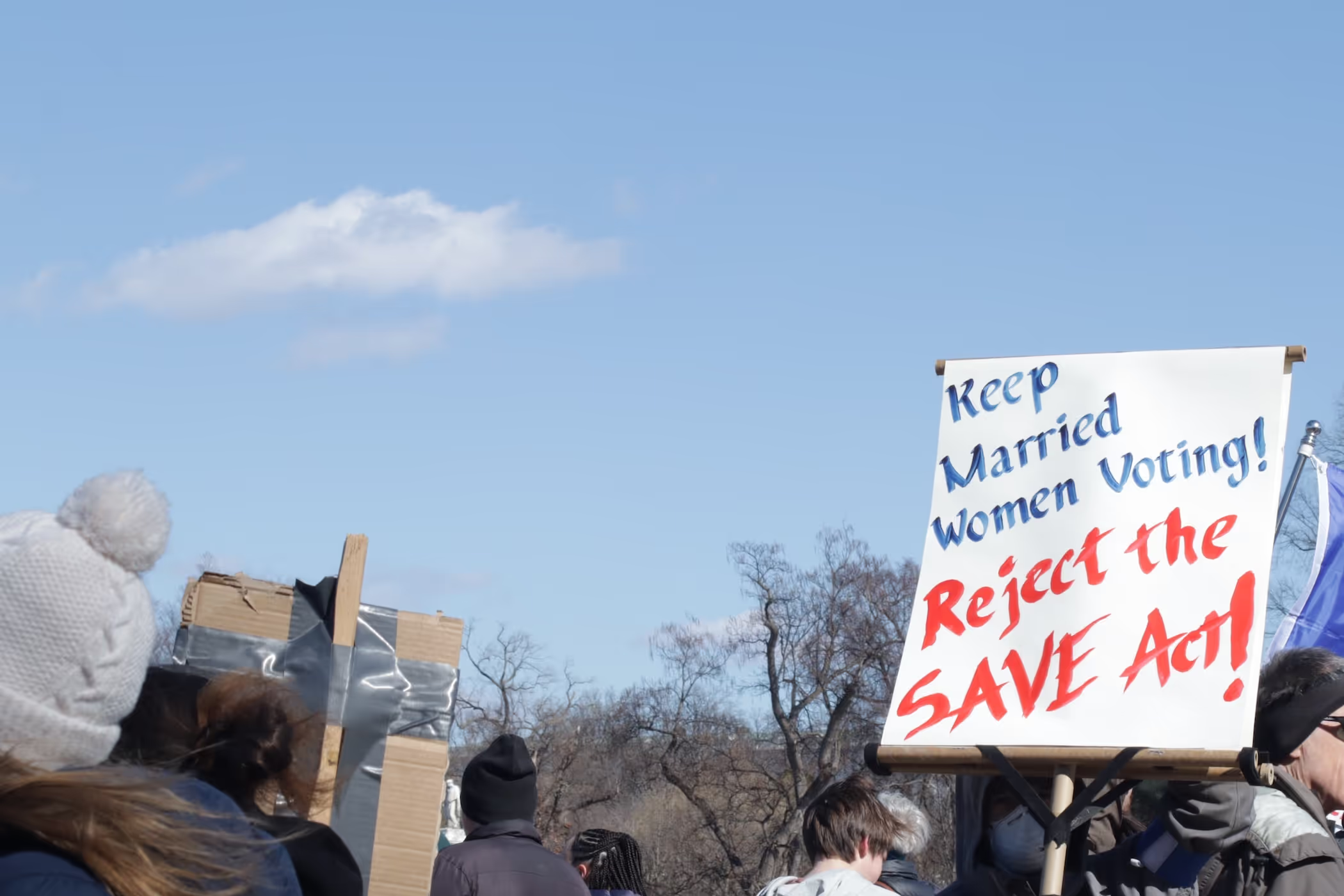
On April 10, the U.S. House of Representatives passed the SAVE Act (Safeguard American Voter Eligibility Act), a bill that, under the guise of protecting election integrity, would erect new and unnecessary barriers to the ballot box nationwide. This piece of legislation threatens the very foundation of American democracy and civil liberties, particularly for marginalized communities.
Studies show that up to 21 million Americans, about 11% of voting-age citizens, do not have government-issued photo ID. For many, obtaining the necessary documentation can be burdensome, costly, or inaccessible, especially in rural and under-resourced areas. Rather than protecting democracy, the SAVE Act weaponizes the false narrative of widespread voter fraud to suppress voter participation by not only implementing voter ID law, but requiring that every voter prove their citizenship each time they go to cast their ballot.
According to the Brennan Center for Justice, the incident rate of noncitizen voting in U.S. elections is 0.0001%. Yet, this legislation could disenfranchise millions, especially naturalized citizens, seniors, Indigenous voters, and communities of color, who may not have easy access to the documentation required.
At its core, the SAVE Act is not about safeguarding elections—it’s about shrinking who gets to participate in them.
Think of who would be targeted:
- Naturalized citizens who already completed a rigorous legal process to earn the right to vote
- Elderly voters born in rural hospitals or at home without official records
- Indigenous people whose sovereign status is often misunderstood or misclassified
- Students, low-income folks, and unhoused people whose documents may be lost, outdated, or burdensome to obtain
- Women who have a different last name on their birth certificate
- Voters who live in a city and have no need for a driver’s license
Voter suppression laws, such as the SAVE Act, have historically been used to exclude and silence. Part of a longer arc of voter suppression tactics dressed up in legal language—poll taxes, literacy tests, English-only ballots. Now it’s “documentary proof.” The SAVE Act isn’t about securing democracy—it’s about controlling who participates in it.
Under the disguise of "election integrity," the SAVE Act would require documentary proof of citizenship to vote in federal elections, something millions of eligible voters, predominantly low-income, Black, Indigenous, and immigrant folks, simply don’t have easy access to. This means that veterans would no longer be able to use their military ID alone to identify themselves, even drivers’ licenses wouldn’t be adequate identification under the SAVE Act.
This piece of legislation isn’t about fraud. It’s about fear. It’s not about protecting votes. It’s about purging voters from access to advocate for their use of power.
So what can we do?
- Call it what it is by using clear messaging:
- A voter suppression bill that targets marginalized communities
- A surveillance expansion tool masquerading as “election integrity”
- A solution in search of a problem—because voter fraud is not widespread
- Educate your community and houses of worship: Share how this bill would impact real communities through voter suppression.
- Organize in your city, county, or state: Hold teach-ins, community forums, and digital info sessions.
- Form or strengthen alliances across:
- Voting rights organizations
- Immigrant justice and refugee networks
- Faith-based coalitions
- Disability justice organizations
- HBCUs and youth-led civic groups
- Focus on intersectionality: Emphasize how the SAVE Act would harm multiple communities simultaneously, especially those with overlapping marginalized identities.
- Form or strengthen alliances across:
- Put pressure on your Senators. Demand that they publicly oppose the SAVE Act and any similar legislation.
- Call and email your senators to urge them to oppose the SAVE Act.
- Use coordinated call-in days and patch-through tools.
- Send op-eds and letters to the editor.
- Partner with the local press to elevate the stakes.
- Stay grounded in the truth: Our communities are not a threat to democracy—we are the democracy.
We don't need more barriers.
We need more access, more voices, more justice.
The views and beliefs expressed in this post and all Interfaith Alliance blogs are those held by the author of each respective piece. To learn more about the organizational views, policies and positions of Interfaith Alliance on any issues, please contact [email protected].
Transcript

Why Hasn't Ted Cruz Canceled this Islamophobic Hearing Yet?
In May, the U.S. Senate scheduled a hearing titled "Hidden in Plain Sight: Confronting the Muslim Brotherhood Network in America" that threatened to escalate anti-Muslim fearmongering and disinformation in the halls of Congress. A postponement isn't enough. Cruz must cancel this hearing for good.