State of Belief
Dancing with the Divine: Exploring Religious Freedom in 'The Testament of Ann Lee'


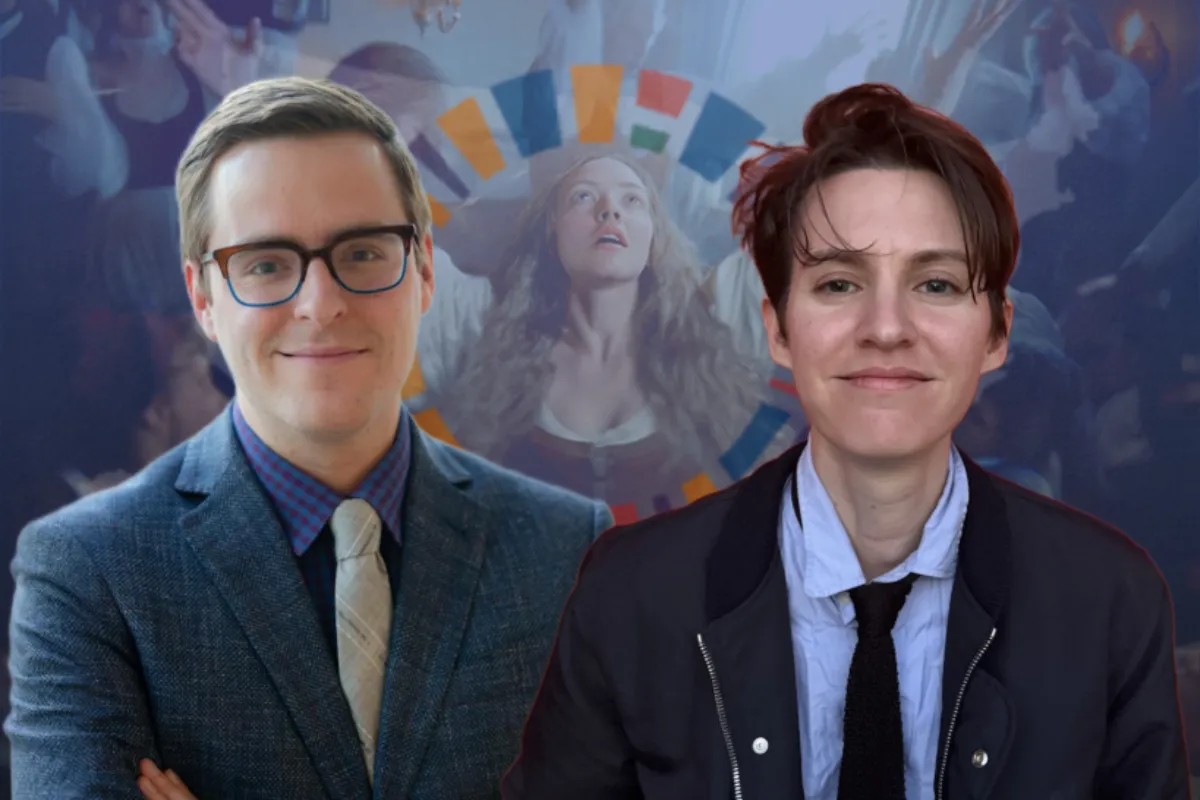
In the latest episode of The State of Belief, we dive into the vital theme of religious freedom as portrayed in the new film, The Testament of Ann Lee. Joining host Rev. Paul Brandeis Raushenbush for this enlightening discussion are Interfaith Alliance colleagues and film fans Guthrie Graves-Fitzsimmons and Alyssa Klein.Here are three key takeaways from the conversation that will resonate with many:
The Intersection of Faith and Feminism: One of the most compelling aspects of The Testament of Ann Lee is its portrayal of a strong female figure in a religious leadership role. Alyssa notes that Ann Lee's story highlights how Christianity and feminism can coexist, challenging the often male-dominated narratives within religious traditions - but also illustrate the unfair gender-based challenges that she faced, and that continue to dominate much of organised religion today.
The Ongoing Struggle for Religious Freedom: Guthrie emphasizes the historical context of Ann Lee's journey, illustrating how her quest for religious freedom in the 1700s mirrors the ongoing struggles many face today. The film serves as a reminder that the fight for true religious freedom is not just about the freedom to practice one's faith but also about ensuring that this freedom extends to all, regardless of their beliefs. This is particularly relevant as we approach Religious Freedom Day on January 16th, a time to reflect on what religious freedom truly means in a diverse society.
Courage in the Face of Adversity: Both guests highlight the courage displayed by Ann Lee and her followers as they faced persecution for their beliefs. This theme of courage is not only relevant to the historical context of the Shakers but also resonates with contemporary movements advocating for social justice and equality.
Listen to this episode and reflect on how these themes of faith, feminism, and freedom can inspire us in our own lives and communities. Let's continue the conversation about what it means to truly embrace religious freedom for everyone.
More About Our Guests:
Guthrie Graves-Fitzsimmons is vice president of program and strategy at Interfaith Alliance. Author of the book Just Faith: Reclaiming Progressive Christianity, Guthrie holds an MDiv from Union Theological Seminary in New York City and is a fellow at the Center for American Progress Faith and Progressive Policy Initiative. Read Guthrie's column on The Testament of Ann Lee here.
Alyssa Klein is a journalist and the creative force behind Interfaith Alliance's social media strategy. With a focus on art, advocacy, and social change, she's worked for prominent causes including the Women's March on Washington. Her writing has appeared in Vice, among other periodicals.
Transcript
REV. PAUL BRANDEIS RAUSHENBUSH, HOST:
Guthrie Graves-Fitzsimmons was onthis show a year ago to sing the praises of Wicked, the Musical, onfilm. In his spare time, Guthrie is also vice president of program and strategyat Interfaith Alliance. He's back today to help us look at religious freedomthemes in a new movie.
Also with us - Alyssa Klein, makingher debut. Alyssa is a journalist, film aficionado, and the brains and theheart behind Interfaith Alliance's stunning social media strategy. Alyssainnocently suggested earlier this week we consider talking about the film TheTestament of Ann Lee on The State of Belief… Little did she knowthat she'd be called upon to be part of the discussion!
Alyssa, Guthrie, welcome to the show.
GUTHRIE GRAVES-FITZSIMMONS, GUEST:
It's a joy to be here. I'm alwayshappy to be on to talk about musical film.
PAUL BRANDEIS RAUSHENBUSH:
Excellent. Alyssa, are you ready?
ALYSSA KLEIN, GUEST:
Yeah, so pumped to talk aboutmovies.
PAUL BRANDEIS RAUSHENBUSH:
All right, so let's just start withthe movie - because it's becoming a phenomenon. And I think it's reallyinteresting that this person from religious history that transcends theboundaries - it's on both sides of the Atlantic - many people, this is thefirst time they've ever heard about her, but we have this amazing film. Andboth of you came back from the break and were like, has anybody seen this film?I have to talk about this film.
Let me go to you first, Guthrie. Whydid you go see it? What piqued your interest about this film about Ann Lee?
GUTHRIE GRAVES-FITZSIMMONS:
Well, yeah, it seems pretty niche,right? There are only three Shakers left in the United States. The religiousmovement that Ann Lee started, there are only three left. And it is a musicaltaking place in the late 1700s. But all of these things are my interests. AndAmanda Seyfried is one of my absolute all-time favorite actresses. And so I'vebeen looking forward to this movie since I first saw the trailer. And it was sofun to watch: the music, the choreography, the religious history, everythingI'm interested in was really captured in this film.
PAUL BRANDEIS RAUSHENBUSH:
I love that. Alyssa, what about you?I mean, you're not always pining away for the latest Christian film. Not thatwe would call this… But why did you decide to go?
ALYSSA KLEIN:
Well, for all the reasons Guthriementioned; and also the trailer was - it's the best trailer that I've seen inyears. It's the same team behind The Brutalist. So the director, she wasthe co-writer of The Brutalist, which was my favorite film of last year,which she wrote with her husband. He was the director of that film. And on thisone, they swapped roles and co-wrote The Testament of Ann Lee, and shedirected it.
PAUL BRANDEIS RAUSHENBUSH:
Yeah, the trailer, have to say, itlooks so engaging and intriguing and the movement - and you're kind of like,oh, this is so 2026. But actually, when you start getting into the real story,the real story of Ann Lee and the real story of the early Shakers was aboutmovement. It was about dance, it was about music, and also this idea that eachof us can truly embody the divine. And the idea that this is coming from the1600s, and it just feels very modern to me and very exciting. And so I amcurious, for both of you, that idea of what it means to see this figure whoreally talks about all these things: about music, about dance - and also aboutGod as equally female and male. I mean, this is really radical, cool stuff.Guthrie, that's got to land with you somehow.
GUTHRIE GRAVES-FITZSIMMONS:
And it deeply resonated with my ownreligious experience in many ways. So first of all, you have the Shakers - whowere called Shakers, that wasn't a name they came up with themselves. And Igrew up Methodist, and Methodist was also a name people were called in England,and then they took on the name of the movement. And so the Shakers were calledthat because of their ecstatic, very spirit-led worship where they would movewith this as the spirit led them, and move together in this and sing. Andhopefully we can play some of from the soundtrack during this, because you haveto hear it and see it to really understand it. And so they were called Shakersand they kind of took that on as a name.
And they preach this radical equality andacceptance. And it's something that truly resonates with our time and theequality of the sexes. They found that the founder, Ann Lee, she fully embodiedthe second coming of Christ, and the second coming of Christ was with them andpresent to them in the person of Ann Lee. And women's equality - and part ofthat was, also, no more marriage and celibacy for all and we're going to liveas heaven on earth, and racial equality and opposing slavery and anti-war andall of these, sharing all possessions in common...
There was just this truly, like, let'sgo to the Bible, the early experiences of the Jesus movement, and really liveit out together in this true form of radical equality that we see in the bookof Acts. And it's why I still call myself a Christian today, is this beautifulvision that we get of Jesus and his followers, and that Ann Lee and herfollowers really tried to live out in their time.
PAUL BRANDEIS RAUSHENBUSH:
So Alyssa, you're not necessarilycoming at this as a Christian - that's not your tradition, and you wouldn'tdescribe yourself as a quote-unquote “believer.” But also, you were reallycompelled, I think. What did you make of it? Guthrie's coming at it kind ofwith a Christian lens, like, oh, this reveals something to me about my ownfaith. What did it feel like to you to watch this?
ALYSSA KLEIN:
Well, above all, it's an inherentlyfeminist film. And it's cool to see that Christianity, in this case, andfeminism do go hand in hand. And it's all too rare to see those two thingstogether in film. So, yeah, I went in knowing very little about the religion. Ihonestly know quite little about Quakerism, which is where Shakerism had its...My understanding is that it formed out of Quakerism. She attends a Quakermeeting. So it's a religion that I'm really interested in, and I've beenenjoying reading all about it after seeing the film.
PAUL BRANDEIS RAUSHENBUSH:
But it's also, I think this women-centeredidea and the idea that the spirit does not need to be mitigated through anyoneelse; translated, even, but that, actually, we are able to imbue it. And, youknow, I've always been someone who really has - whether it was in the disco orreally loving going to see dance and watch dance, dance for me has been a hugepart of how I've understood spirituality expressed. And so it's really powerful,Just to imagine, in the 1600s, all these women feeling empowered to move theirbodies - and not for the performance of men. It was for themselves, to thedivine. I just think it's really incredible.
For you as someone who moves in -and I think all of us do, but as a woman who moves in feminist circles orhowever you describe it, and also who really has a deep appreciation of music,you're a great DJ, and the arts - and I'm just curious how it resonates withthat broader perspective and what we can gain, universally, in ourunderstanding of what religion, faith, spirituality can be from seeing thismovie about Anne Lee.
ALYSSA KLEIN:
Yeah, I think there's just so manydifferent ways to approach religion than just what we currently see today. AndI had no idea that there was the Shaker movement in the 1700s.
PAUL BRANDEIS RAUSHENBUSH:
Well, it was funny to me. We weretexting and you said, “I want to be a Shaker.” And it's like, of course! Butthis embodiment, I think all of us who have been moved with the ecstatic senseof union that comes with great music and great community and great sense ofelevation and transcendence could understand, could relate to this.
Let me turn it to the reality ofsome of what Ann Lee experienced, because we're saying all this great stuff and,you know, hey, isn't it wonderful? Well, not everybody thought it was wonderfulat the time. And in fact, she was subject to a lot of recrimination, attack,and part of the reason she ended up in the Americas or the new land, whateveryou want to call it, it was pre- the Revolutionary War, was because she wantedto be able to express herself freely and couldn't do that in England. Talkabout that part of the story, Guthrie, a little bit.
GUTHRIE GRAVES-FITZSIMMONS:
Sure. So she joined this group thatcame out of Quakerism, that practiced this ecstatic worship and movement. Andthey faced a lot of persecution in England for their religious practices. Andso they set out for what would become the United States, they crossed theAtlantic in 1774, so right on the precipice of the Revolutionary War, in searchof religious freedom and the ability to practice their faith, as they uniquelysaw it, freely, from not just government pressure, but also societal pressure.And that was the reason so many different religious groups came to America andwanted to be free from the religious persecution they were experiencing inEngland and in other parts of Europe.
And so they're one of the uniquelyAmerican religious movements in that Ann Lee and eight of her followers crossthe Atlantic - and yet when they arrived and settled in Albany, New York, theyfound the ability to practice their faith, and yet immediately came intotension again with the authorities.
PAUL BRANDEIS RAUSHENBUSH:
I think that we we forget about thatpart of the American story. We’re like, oh, everybody came here for freedom.But then there were immediately people here who are like, uh, that's not whatwe meant by freedom. by freedom, we mean freedom to do it like we do. And thatis actually something I want to get into a little bit in a minute. We've alwaysthought of ourselves, or the claim has been, religious freedom, religiousfreedom. But since the beginning, we had people who said, okay, what we mean byreligious freedom is our definition of religious freedom.
I think one of the parts of thestory, and maybe you can say how much the movie gets into this, but Ann Lee,also, is someone who really had personal suffering. She really went throughterrible difficulties. I think she lost four pregnancies or four children. Ijust want to mention it because I think it's really one of the great openingsfor conversations about religion is that people often come out of a sense ofdevastation, or their own sense of yearning, or their own desire - and theyfind some communion, some way of experiencing it.
And so I do want to acknowledge that- and especially for her, as a woman, she felt that Jesus talked to herdirectly, and it changed her. And then it gave her a new way of understandingwho she was. And I just think it's very interesting, that kind of empowermentand what it means and how it comes into the world.
Can you talk a little bit about,Alyssa, a little bit about that part of this film, which is how the characterthat is so beautifully played becomes fully herself through this faith journey?
ALYSSA KLEIN:
You touched on it, but certainly themiscarriages are a big part of her early story. Certainly, it was thatsuffering that that it was born out of.
PAUL BRANDEIS RAUSHENBUSH:
But I think what's so powerful isthis idea of feeling like you've been specifically… I don't know, that there'sbeen a moment where, in this case, Jesus talked to you. But I think for me, aslike someone who has gone through a religious awakening, it's not always soclear and easy; but there have been moments for me of clarity where I've justbeen like, okay, this is actually where I'm supposed to be, what I'm supposedto do.
And I think one of the reasons Imention that is, for me, as a gay man, as part of the queer community, I thinkit's important to trust those ideas, those moments, and not say, oh, okay,there's other people who have those experiences, and I have to follow theirlead. Rather, instead, to say: actually, I have my own experiences, which youcan't take away from me because it doesn't match your idea of what's supposedto happen. And I really think that in some ways, maybe in that way, this couldbe considered something.
I don't want to put that overlay onit, necessarily, but that there's something about this that is very liberatingfor people who have been told that their experiences don't matter. Does thatmake sense to either of you?
GUTHRIE GRAVES-FITZSIMMONS:
It does. And it really connects, Ithink, Paul, with our shared Baptist beliefs in the priesthood of all believersand soul freedom, Bible freedom. And the Baptists and the Quakers, and then outof Quakers we have this Shaker story - all are part of the radical reformationin that they really were about, and still are about, people having the autonomyand freedom to have a direct interpretation of the divine that they can speakto, guided by this Holy Spirit, and that that shouldn't be mediated by anyhierarchy.
And you see that in this story, andI've seen that in my own life, becoming a Baptist as an adult. And now myhusband and I have been worshipping at a Quaker meeting here in DC, and to seepeople still today - it's been an adjustment for me, having been raised in moretraditional worship settings - but to sit there in the silence each Sunday andhear how the Spirit is moving in each person. We're not dancing in a Quakermeeting, but there is that same being highly deferential to the individualconscience guided by the Spirit.
PAUL BRANDEIS RAUSHENBUSH:
The other piece of this, which isreally interesting, or at least in the — and this not necessarily in the filmso much, but in the broader Quaker movement, how this translated into the waythey organized themselves, which was really to share things in common. It wasreally believing that heaven is meant to be on earth. This is, I think, latertaken up by the Social Gospel. Friedrich Engel actually references the Shakerswhen talking about this experiment of shared goods and shared life, but alsothe quality of craftsmanship. And that it matters. Everything matters. And ThomasMerton has this great quote where they make every chair as if they, becausethey fully believe that an angel might sit on it. And I thought that's sointeresting and it's what I love about it. And it's not something that I cantruly incorporate into my own life because I'm a little too scattered orwhatever, but all of it matters. And all of what we do and all of what wecreate and all of the way we craft our lives and use our time and focus ourminds, all of it matters.
I wonder about the aesthetics foryou, Alyssa, if there was anything about that aspect, if it came up in the filmor for you as just as someone who really focuses also on aesthetics.
ALYSSA KLEIN:
Absolutely. The furniture in thefilm was just unreal. They have the chairs, these handcrafted chairs hangingfrom the walls. I'm over here thinking, oh, how can I incorporate Shakerfurniture into my own home? But that's actually another big focus of the filmis on the furniture pieces.
PAUL BRANDEIS RAUSHENBUSH:
Yeah, it's interesting. I reachedout to a friend of ours who actually helped us design our house and whoseaesthetic is… I just said, hey, I'm just watching this documentary aboutShakerism and there's this movie and it just reminds me so much of your work.And he said: of course, I've been totally influenced by the Shakers. Thesimplicity of it. And he talked about all these great artists of the 20thcentury who really were aware of Shakerism and that aesthetic, and thearchitecture is so beautiful and simple, but incredibly powerful in its way.And so I love that.
I do want to turn to what youalready touched on, Guthrie, which is, there's a lesson here for religiousfreedom and how we understand what it means to live in an America in 2026 wherepeople are saying, okay, this is the religion that matters, and if you're notadhering some way to this, you are a secondary person in American society.Specifically - and we've talked a lot on this podcast, as our listeners know,about this kind of White Christian Nationalism that has a very prescribedunderstanding of what is acceptable as far as religion.
And you wrote a piece about this,about the connection with this great movie, The Testament of Anne Lee,to religious freedom today. And we're about to observe Religious Freedom Day onthe 16th - many people are going to use that day to say, okay, religiousfreedom, and by that they mean that some people get to describe what realreligion is in America - but we also have a message about religious freedom inAmerica at Interfaith Alliance and many of our partners that, actually, itreally means freedom for everybody. Everybody, including atheists, Pagan,Christian, Jewish, Muslim, Sikh, Hindu, everybody. Literally everybody shouldfeel free to find whatever inspires them.
So how does this film - and youwrote a beautiful piece about this - how does this film factor into ourunderstanding of religious freedom in 2026?
GUTHRIE GRAVES-FITZSIMMONS:
Well, let's go back to the film fora minute. I love that you're talking about Shaker furniture and theintentionality. And living with fully principled life that Ann Lee and theShakers embodied was not just in their craftsmanship, but also in theirprinciples about war and justice and equality. There's a scene in the film -it's hard to say spoiler alert when it's a historical drama where everythinghappened 300 years ago - but spoiler alert, there's a scene in the film whereAnn Lee, portrayed magnificently by Amanda Seyfried, sees a slave auction andcondemns it right on the spot. She is very overt with her calling out ofinjustice.
And again, this is 1774, on theprecipice of the Revolutionary War in the United States, and she stands by herpacifism and opposition to war, and actually encourages people not to fight inthe war, which comes with persecution again. She left England for persecution,preaches about being anti-war during the Revolutionary War period in the U.S.and is met with persecution on these shores, as well. And so from the verybeginning of this story, we have the juxtaposition of, on the one hand, seekingout religious freedom on these shores, and this becomes a core ideal of theAmerican Revolution and the First Amendment, and there were different lawsbefore the revolution and different state views on the establishment ofreligion, but it becomes part of the American experiment.
Perhaps the best ideal that isunique to this American experiment is religious freedom. And yet from the verybeginning, one of the groups that was seeking out this religious freedom has avery… There's no way watching the film that you don't think her pacifist viewsare deeply rooted in a sincerely held religious belief. Core to her faith andliving heaven on earth cannot be at war. There's not going to be wars in heaven,so if you're living heaven on earth, you shouldn’t be fighting in a war. And soit's clear it's religious, and yet she's persecuted for her faith, and theShakers are persecuted from the very beginning.
And that is the contradiction ofreligious freedom in the United States, that from the very beginning, it wasnot available to everyone. It certainly wasn't available for those withoutphysical freedom who were enslaved. Ann Lee was preaching female equality 150years before women could vote. There was so many, so lack of freedom at thefounding period and betrayal of religious freedom from the very beginning. Andyet we have this ideal of religious freedom that has persisted over these last250 years that is worth fighting for, still. And yet these views still comeinto conflict with the State.
I watched the film January 2nd,Friday night. I woke up and read immediately about, we'd launched a new war asthe United States invading Venezuela and illegally and immorally capturing ahead of state of another country. As awful as that head of state was, we wentin illegally and immorally to do it, and launched a new war. And then I'm in aQuaker meeting on Sunday with people being moved by the Spirit to again liveinto that pacifist vision. And so these attempts to live out your faith thatcome into conflict with the State are still today. And the Trump administrationhas been the worst in modern memory in the United States of going against anyreligious leader who does not bend the knee to the Trump administration.
And so this ability to live freely and live into our ideals ofreligious freedom that have been part of the American story from the beginningare still with us. And the fact that many people's deeply held religiousbeliefs, whether it's pacifism, equality… You've seen the Trump administrationattack DEI, and for many faith communities, DEI is a deeply held religiousbelief. Those tensions still arise, and it's our job, today, of those of usengaged in activism and advocacy and religious life, to again make space fortrue religious freedom - and not to have the State say religious freedom onlyfor those who go along with what we want you to do.
PAUL BRANDEIS RAUSHENBUSH:
Thank you so much. I reallyappreciate that. And listeners, you may not have seen this yet, but maybe as anobservance on January 16th, Religious Freedom Day, we should just all watchthis film about Ann Lee, and imagine what it looks like for our own life.
I'm curious how this film mighttranslate to people who don't really have any religious tradition, but we wantto invite into this wider understanding of religious freedom, and let everyoneknow that, actually, we're part of the same effort. And I just think thatthat's part of what 2026 has to be, is that we have to make sure that everybodyunderstands that when we mean everybody, we really are trying to mean everybodyin religious freedom. And I think that for too many people, religion stillfeels locked in this understanding of hierarchy, locked into this understandingof oppression.
Even, Alyssa, when we have somethingthat I'm saying on social media about the freedom against patriarchy orxenophobia or all of this - people are like, oh, I can't believe I'm hearing areligious leader say this. Which is really too bad, because, actually, a lot ofreligious leaders believe that. How can we imagine extending religious freedomfor all of our listeners and those who might not imagine that being a way ofunderstanding how they enter into the conversation about freedom in America?Alyssa, do you have any thoughts about that? What way this film kind of opensup a conversation about religious freedom to people who might not imaginethemselves part of that conversation?
ALYSSA KLEIN:
Well, I think, certainly, expand thevoices that you're listening to around religion in America. I think this filmis a great jumping off point. And then look into the different organizationslike Interfaith Alliance, like Quaker groups. I don't know that the Shakers, it'sthree left. So I don't think they have social media. If they do, I'm down. Lookinto the different voices that you can follow, different books you can read,movies that you can watch that show that there is another definition of whatreligious freedom is. And that's the definition that Interfaith Alliance isfighting for.
GUTHRIE GRAVES-FITZSIMMONS:
And look for areas in which youshare beliefs with different religious communities. And also, a lot ofreligious practices will seem strange to people. I mean, this idea of celibacyfor all may seem strange to people, that the Shakers taught. It also doesn'tseem like a good strategy for longevity. But when you think you're witnessingthe second appearing of Christ in Ann Lee, you're not necessarily thinkingabout multiple generations. But I think we have to have an appreciation both ofthe diversity of faith communities and that people can practice strange thingshere. And as long as they're not harming other people in those practices,they're free to practice those different beliefs.
And that's the beauty of ourpluralism, is that we're not coerced all to think the same way, and that asmuch as possible, we make room for people with very strange beliefs and verydifferent understandings of the divine, and we make room for people that wantnothing to do with religion at all. And all of that is welcome here.
PAUL BRANDEIS RAUSHENBUSH:
I think that's a really importantpoint when we talk about religious freedom. I think a lot of the way thatreligious freedom is being understood - I mean, the Supreme Court, I think,might be a good example here - the way they've understood religious freedom isallowing people to actually infringe on other lives or say, okay, we're outhere serving the public except for you people, specifically often queer people.
Guthrie, you have a really helpful,I think, nuanced sense, and I think you just got at it. We can't not beinteracting with people who are different from us, even if we don't totallyagree with their way of existing. But it doesn't mean that we can absentourselves from serving them and choose who to take a photograph of or bake acake for. I think that feels to me like a kind of abuse of religious freedom.Rather, people should be free not to gay marry. They should be free to becelibate, be straight, be gay, whatever you want to be. But we have to liveside by side, we have to understand one another, and we have to be in communitywith one another, even if we disagree.
And I think that's what is soimportant about the way we want to put forward an understanding about religiousfreedom today, is that we don't have to agree on everything. We don't have tobe the same. I actually do not want to convince any conservative Christian outthere how to live their life. I really don't. I want you to find that withinyourself and live well. and be in community with me. Figure out ways that, you know,I want to bake a cake for you, you bake a cake for me, and we don't have toagree exactly on how we're living our life. To agree that we want to live in acountry where everybody can feel free to find the divine in themselves and livethat out in their life. So I think that's an important idea for understandingreligious freedom in 2026. What did I miss in what I just said, Guthrie? Whatwould you add?
GUTHRIE GRAVES-FITZSIMMONS:
I would add that this is thebeautiful message of the film. I don't think people watching it, they may thinkit doesn't make sense, the practices don't make sense to them, that they maynot want to dance in this way or sing in this way, but they can appreciate thatthese people should not have been persecuted for their faith and jailed andimprisoned, and had to flee across the ocean. I think you can understand that, yes,there are some complicated areas of the law that we have to work out, but thereis so much freedom that we can afford people to practice their religionshowever they see fit.
And yet I think autocrats and rulersand elected officials and people that are trying to exert power in societyrecognize the importance of religion. And so co-opting it and using religion asa tool of the State and as a tool of the military is very attractive. And wesee that today with our Secretary of so-called War, though I refuse to call himthat. He can't just change the name of the Defense Department, and PeteHegseth, who is very unpopular, by the way, tries to use religion in this warsense. And so the temptation to use religion as a State power is so, I think,understandable; and yet when we see stories of religious persecution, like TheTestament of Anne Lee, we know that it is deeply immoral for people to bedeprived of their religious practices.
PAUL BRANDEIS RAUSHENBUSH:
One of the things we were talkingabout, and this is going to be a big focus continuing into 2026, is courage.I'm not sure exactly if Ann Lee would have said, I'm being courageous. I justthink that she had it in her. But I'm just curious, Alyssa, when you just werewatching this story as it was portrayed, how does courage appear in this story?And what might those of us who are seeking courage in this time learn from it?
ALYSSA KLEIN:
Well, certainly the examples Guthriementioned, when she sees these things, speaking out. Another element of the AnnLee’s story that I'd personally like to read more about is - my understanding,and this isn't necessarily portrayed in the film, but Ann Lee was a really tallwoman. I believe she was a really big woman. And at one point, I guess theAmerican troops or someone in the U.S., when they come to persecute theShakers, they lift up her dress, which I was a little confused about whenwatching the film. And I was reading about it after, and they wanted to provethat she was a woman, which certainly has resonance today, that they didn'tbelieve that she was a woman, and they needed to harm her for proof, which ishappens today, unfortunately. So yeah, so this is a courageous woman throughoutthe entire film and in real life.
PAUL BRANDEIS RAUSHENBUSH:
Wow. I mean, it is that example justbrings home just reminding us of what many individuals are going through today.And it's really terrifying. I think it's so interesting, just the physicalityof this. We've talked about that a little bit, but what it means to embodysomeone, something, and the dance, and the music, and have a certain kind ofway of appearing in the world. It even deepens the sense of how much I thinkthis is a powerful story for us today, those of us who are trying to supportpeople on the margins of all kinds to feel fully themselves and blessed. I justfeel like it's so important.
Guthrie, what are lessons in couragethat you find in this film?
GUTHRIE GRAVES-FITZSIMMONS:
I think that I always will come backto the pacifism. It has been something that has been deeply personal to me. Ifirst got engaged in all this faith in politics work because I was alarmed byanother immoral and illegal invasion by the United States, when we went intoIraq. And President Bush said God, you know, he prayed and God told him to go.And that's what made me interested in - now I've dedicated my whole life tothis intersection of religion and public policy - and the conviction to standagainst in such a revolutionary time, to stay convicted to your principles andyour belief in non-violence, I think is just astounding. And I see it around meall the time today.
My first, actually, after I gotinterested in this religion and politics, around 12 or 13 years old, and in myfirst trip to DC, I came to a week-long peace camp, peace training camp, whichis actually held at the Quaker Meeting House here in DC, where I now worship.and I spent a week there training with all kinds of people about how to engagein anti-war activism. And so the push to rally around the flag, whether it's arevolution or wars today, is so strong, and people to stand in their religiousconvictions against that, and it's never been popular. And to still see Quakerstoday, living out that tradition, I think it is admirable. It is the best ofreligion in that people have been jailed, and there's a lot of case law aroundconscientious objectors to war rooted in the Quaker and other religioustraditions that are against war. And it also has led to such persecution aroundthe world of people that don't want to go along with the militarism. And sothat is, to me, the most deeply resonant courage I saw in the film and in myown life.
PAUL BRANDEIS RAUSHENBUSH:
I'm just doing a deep dive inDorothy Day, which many of our listeners probably have already done. But shewas really preaching against the World War II, which was very unpopular. And Ithink many people, probably, listening would disagree with that; but I thinkregardless of your stance, that was a courageous stance, and she really thoughtdeeply about it and really tried to understand it from her Catholic faithperspective. And so I think we have a lot of wonderful religious examples.
I think it's so important wheneverwe have an opportunity to lift up, specifically, women religious leaders or anyonewho identifies that way, we can celebrate that - and certainly this film is anopportunity. But also, it's an opportunity for all of us to really think deeplyabout what religious freedom can mean in this country.
I want to thank both of you, Alyssaand Guthrie, for joining me, for your enthusiasm about this film, for yourenthusiasm for the work that we do together, and just really appreciate youbeing here on The State of Belief.
GUTHRIE GRAVES-FITZSIMMONS:
Thank you. I look forward to thenext musical film I can come back on for. Thank you, Paul.
ALYSSA KLEIN:
Me as well.