State of Belief
Protect Democracy’s Ian Bassin: Freedom Is Still Up to Us
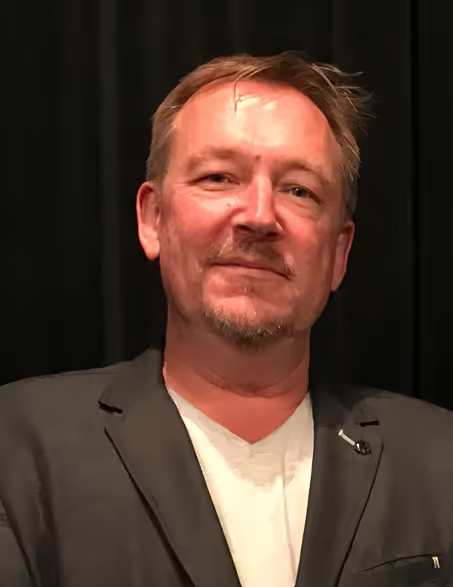

Is the chaos of today’s American politics accidental? Not at all, according to Protect Democracy Executive Director Ian Bassin. This week, he tells host Rev. Paul Brandeis Raushenbush about the seven-point playbook of modern authoritarians - and how to counter it. Ian also describes the three "d" strategy to attack democracy: Deceive, Disrupt, and Deny. He also shares a Protect Democracy resource for understanding and defeating this strategy, the Executive Override Report, available at protectdemocracy.org/DDD
August 11th is National Poll Worker Recruitment Day, and the website Powerthepolls.org contains a wealth of information about getting involved, hands-on, in our electoral system – and our democracy.
More about Ian Bassin
You may recognize Ian’s name from a powerful Ted Talk titled, How to spot authoritarianism — and choose democracy. He’s a former White House counsel and 2023 MacArthur Fellow, and Founder and Executive Director of Protect Democracy, which works to defeat authoritarian tactics and build a stronger, fairer democracy.
Protect Democracy partnered with Interfaith Alliance to produce a moving series of advertisements promoting the message “Choose Love, Not Ice”, and the article co-authored by Ian and Paul is titled, We Need A New Great Awakening.
The State of Belief host Rev. Paul Brandeis Raushenbush is President and CEO of Interfaith Alliance.
Transcript
REV. PAUL BRANDEIS RAUSHENBUSH, HOST:
Ian Bassin is co-founder and executive director of Protect Democracy, a nonpartisan organization working to safeguard democratic institutions and the rule of law. A former White House counsel and 2023 MacArthur Fellow, he is a leading voice on the challenges facing American democracy today. You've likely seen Ian Bassin's writing in The New York Times, The Washington Post, The Atlantic, and elsewhere. And boy am I delighted to welcome him to The State of Belief.
Ian, thank you so much for being with us!
IAN BASSIN, GUEST:
Paul, it's great to see you and it's great to be on here.
PAUL RAUSHENBUSH:
I’ve recently heard you speak in various settings. Each time I am inspired, I am also empowered. And I do think that that's part of your message these days. From your TED Talk to what you're talking about right now, you are actually putting in front of our fellow citizens, our friends, our neighbors, the opportunity to make a choice for democracy. And so I just want to start with a great note of appreciation, and also to give you a setup and tell us about the genesis of Protect Democracy. Where did that come from? Why did you feel you had to start it?
IAN BASSIN:
Well, as you mentioned before, I had the privilege of serving in the White House and the White House counsel's office. I had what I guess you would call the democracy portfolio back in 2009, 2010, 2011.
Now, we didn't call it that at the time; we called it government reform because we thought the task before us was simply improving our system of government. I think it's only in hindsight over the last ten years that we realized that the task was actually saving it; that we were living in a moment in which democracy was under threat, both domestically and around the world. And that threat was growing under our noses when we were doing this work back in 2009, 2010, 2011. And by 2016, I think it became pretty clear to us and to many Americans that the system of government that we had taken for granted, at least in my lifetime, imperfect though it was, was certainly not permanent or guaranteed.
And so we started Protect Democracy out of a recognition that we were living through a generational crisis, a generational challenge to the idea of fair and just democratic governance. And you're right, it is a crisis, but I also like to see it as an opportunity.
You know, there's that adage that people are told: Live in interesting times. And we do. We live in interesting times, and we live in times in which we all have a great level of agency and a great opportunity to really lean our shoulders into history and try to change its path for the better. Because out of this moment either is going to come a less democratic time, a more authoritarian time, a time with less freedom, where our children's generation may not grow up with the freedoms that we've known, or - and I believe this to be the outcome that we're trending towards - one with even more.
But the question of which of those paths we go down really is up to us. And so I do think it's a great opportunity to live in an interesting time where we could have such an impact on the future.
PAUL RAUSHENBUSH:
Well, you gave a really powerful TED Talk in 2023 called “How to Spot Authoritarianism and Choose Democracy” and that's going to what you were just talking about. You know, it's bracing. And I, as also someone who's been out there really talking about authoritarianism, specifically how religion is a tool of authoritarianism but also can be a tool of democracy and a a way that democracy flourishes, one of the things, again, that you talk about is the power of the individual.
I think it would be helpful for our listeners just to have you rehearse just a little bit - and I do want to encourage everyone to look at that TED Talk, “How to Spot Authoritarianism and Choose Democracy”, but you lay out so clearly the signs of authoritarianism. And honestly, it is almost like, yeah, check, check, check, check. But would you mind briefly going through that list and talk about how just to recognize, really, where we are and that there's a playbook that is being used; but also, there's a way to defeat this. And we're not going to end there, that's just to set up the next part.
IAN BASSIN:
Yeah, when we started Protect Democracy back in 2016, I went to some of the leading scholars on democracy and authoritarianism. At the time, they were somewhat unknown academics. They have since become best-selling authors - people like Tim Snyder, who wrote On Tyranny, or Daniel Zeblad and Steve Levitzki, who wrote How Democracies Die, or or Kim Shepley or Yasha Monk.
And I asked them: If we are going to experience an authoritarian challenge to American democracy, what will it look like? Is there something that you can tell us we should expect based on how we have seen this play out in other countries around the world in the 21st century - whether the threat comes from the left, as it has so often in Latin America in places like Venezuela, or whether the threat is coming from the right, as it tends to in Eastern Europe in places like Russia or Hungary. And they said yes. They said there's a very clear playbook for how modern authoritarians unravel and dismantle democracy in the 21st century. And it involves essentially six things.
It involves, first, the politicization of independent institutions like law enforcement, the civil service, eventually the military. It involves the spreading of disinformation, including from the government.
It involves the aggrandizing of executive power, the centralization of power in the executive at the expense of the other institutions that are supposed to also hold power and check power, like legislatures and courts and the free press and the private sector.
It involves the quashing of dissent.
It often involves the scapegoating of vulnerable groups. This has been the tyrant's favorite tool since antiquity. Because if you can pit people against each other on the basis of race or religion or sexual orientation, you distract them while you pick their pockets of money and power.
And it involves the corruption of elections.
Often, if all those things happen, you also get a stoking of violence. And we've seen all of those things play out in the United States over the last several years. And they don't just happen in isolation. They happen as part of a cycle where the autocrats in power use these tools in order to attack people and institutions and organizations that they perceive to stand in the way of their quest for total control and total power. And when they do that, they create a climate of fear. And in that climate of fear, people step back.
And institutions that are supposed to play a checking role, our checks and balances, don't do so - because institutions are not marble buildings with ionic columns outside. They're the people inside of them. The Supreme Court is nothing without John Roberts. And so when the people in those institutions, when for example, Senator Lisa Murkowski says we're all afraid up here, well, then the institutions don't do their jobs because people step back and they don't actually check power, and then power gets consolidated.
And you're right, the good news is, just as that vicious cycle can drive democracy further downwards, there is a virtuous cycle that can reverse it. We've seen it around the world, where initially the most brave actors, the tip of the spear, step up and challenge those who would attack democracy. They do the thing that the fearful don't do. And we've seen that. We've seen Alex Pritti and Renee Good, citizens who are willing in the face of incredible intimidation and scary tactics, give the ultimate sacrifice in order to demonstrate that people can make a difference.
And when masses of people, broad coalitions, come in behind those brave initial actors to get their backs, just as so many tens of thousands of Minnesotans did following the example of Alex Purdy and Renee Good, flooding the streets of Minneapolis in -22 degree weather, stopping businesses and schools, shutting down the entire state in order to say to the federal government: We will no longer cooperate with your invasion of our cities and our towns - then all of a sudden people feel emboldened to check power, and the institutions do their jobs, and the authoritarian cycle is disrupted.
So we know that there is a playbook for pushing back, and we've seen such incredibly inspiring examples of our own neighbors doing it.
PAUL RAUSHENBUSH:
I think there were a lot of moments, even in its own kind of benign and some people would say it wasn't particularly impactful, but even things like No Kings where people deciding, no, we're not going to be afraid to be public about our dissent. And they tried to paint it as violent and they tried to paint it as un-American and all that kind of stuff, and yet people still showed up.
But I do think Minnesota was a moment where the sense of inevitability was reversed. And you know, the folks had to back down. And of course, that's where, also, religion has played a really important part. And I'm very proud of the collaboration, the partnership, between Interfaith Alliance and Protect Democracy, specifically on the Choose Love Not Ice campaign. We started that, actually, I'm trying to remember, I think it was maybe before Minnesota. But we put out an ad just really asking people to choose love not ICE and juxtaposing the faith ideal of loving your neighbor, the faith ideal of loving across difference, with the incredible violence and disregard for law that ICE was demonstrating. And millions and millions of people shared that video. And we've had two very beautiful ads since then.
So I just would love to, first of all, thank you for such a wonderful collaboration; but also recognizing the strong role that religion can play, as I said before, in both reinforcing the authoritarian playbook, but also in actually having a vision and mobilizing people for another way.
IAN BASSIN:
We were so grateful to do it with you, Paul. And I think the reason it was so important for us was because there is, I think, an assumption when people are thinking about these attacks on democracy, these attacks on our institutions, these attacks on elections. We're sitting here talking about this today, a week after the president gave a nationally televised address, spinning up all sorts of false conspiracy theories as part of his attack on the midterm elections.
There's an assumption that the response to all of this is technical and legal, that the defenses are going to be in the courts or the defenses are going to be in legislatures. And those institutions have a role to play, for sure. The courts are going to play a key role, legislatures are going to play a key role, but at the end of the day, it's not courts of law that are going to determine which future, the darker one or the brighter one, we go down. It is going to be the courts of public opinion. It is going to be where the people are. And I think that is, if you look back at history, are moments where we have been faced with a a crucible of crisis and somehow overcome them to deliver, as I think we have in this country repeatedly, greater democracy on the backside of our biggest crises.
Those movements have been accompanied by revivals of faith, both religious faith and civic faith. All the great movements for democracy, for civil rights, for perfecting our union, have come hand in glove with a movement about what our country is about, what our values are, what our communities care about. You and I wrote about this when we released the first of those videos. And so I think that the videos that we've done together that are about: What are our national values? What is our national story? What are the morals that underpin the society you want to live in? are more important, even, than the court victories.
And it's also why I think the No Kings stuff has been really impactful and important - because if you go back to early 2025, there was a sense that a more authoritarian, illiberal vision of the United States was a sentence - not just as the result of elections, not just as the result of law, but as the result almost of a cultural zeitgeist. That we were living in a moment when being mean, being cruel, was the coin of the realm and was where our country was heading spiritually, emotionally, directionally. And that both had the effect of empowering, I think, an authoritarian governing model, but also kind of chilling and intimidating those who didn't share those values from stepping into the public square and saying: We hold different values.
And I think what No Kings has done and what our ads did together is to say, no, actually, those of us who still believe in caring for one's neighbor, in wanting a safer, brighter future for our community's children, in wanting a planet that we can pass on to the next generation, in believing that honesty and decency and kindness are values that we think matter and should be central to our society, that we still are a powerful voice in the society. And I think through the things we've done together, things we've seen out there, even the majority voice in this country. And I think that all of this work that we're doing outside of courts, outside of legislatures, is critical to reminding all of us that those values are still American values and they are values that can dictate the future.
PAUL RAUSHENBUSH:
I want to just touch back on the piece we wrote together. I really thank you for that collaboration and for the inspiration that you provided for that. It was titled We Need A Next Great Awakening, and it was so helpful and it struck so many people that you and I, coming from different places as far as our organizing and professional backgrounds, might come to that conclusion.
And with No Kings, with all of the places I've been and the incredible conversations I've been a part of and the gatherings that have always exceeded by three, four times what was anticipated, I started changing that to: We are witnessing a next Great Awakening. It's not going to be how we understood Great Awakenings in the past, which is in a Christian context, which is like a Christian revival, but rather a broad spirituality of the people, of democracy. And that is to act from different faith traditions alongside people who hold deep moral values without a religious tradition. So I'm actually, like you said, I'm excited about this time, even as I'm terrified of this time and what is in front of us.
I got to listen to you give a talk recently that was just so smart. And it's one of those things where you're like, I'm listening to something really smart, and I want more people to hear what this really smart guy is saying. And that was about how you understood our moment with this election and how we really need to be thinking of it, understanding that this is part of the authoritarian playbook, and again, that we're not powerless in the face of it. So would you be willing to give us the broad contours of how you understand this moment as we go into the 2026 midterm elections?
IAN BASSIN:
So one thing to recognize is that authoritarianism, generally speaking, tends not to be very popular. Now, people choose something that might deprive them of choice and control, initially, out of frustration. There are moments when the system doesn't seem to be delivering well-being for people. And oftentimes there could be a moment of rapid change, destabilization, where there's an opening for a demagogue to come in and say, I know the system isn't working, it's all rigged, it's all corrupt, it's hurting you. These other people are to blame, but I can fix it. And that's a very tempting thing that human civilizations throughout history have been tempted by.
I know people who believed in the utopianism offered by Daniel Ortega in Nicaragua because he seemed like he was going to be the salvation for a country that was not delivering for people. And so people hand over their power to these demagogues. Hugo Chavez in Venezuela. And then lo and behold, those demagogues really are are there to consolidate power and take control away from the people. And by the time the people realize that, they don't like it anymore. They don't like being deprived of agency or control.
And in those moments, they might, in a fair democracy, simply say, hey, yo, that was a mistake. We're going to vote these people out - which is why those authoritarians need at that moment to say, Yeah, we're not going to let you do that. We're going to tilt the playing field and control the elections to entrench ourselves in power. And we're seeing an effort to do that here in the United States today. And it has a very clear structure to it.
To make it alliterative, we've assigned it three Ds: Deceive, Disrupt, and Deny. Deceive, disrupt, and deny. And this is what we are currently experiencing here in the United States, where the president is deploying these three Ds in order to tilt the playing field in this election away from where all of the political indicators suggest it is going, which is the people in 2024 decided they wanted something fundamentally different. They were tempted by a vision that was on offer. And then now, two years into it, have decided they don't like it and they want to go a different direction. That's just what the data tells us.
And so in a normal cycle, you would see a pendulum swing away from the results of the 2024 election in a different direction. Except for the fact that the autocrat-in-chief is trying to tilt the playing field in order to deny the people the ability to change course from where they went in 2024.
And so the way deceive, disrupt, deny works, is, first is deception. Because in a distributed system like ours, the founders' wisdom was not to allow presidents to control elections. The founders understood that if you allowed presidents to control elections, they would be tempted to rig those elections to entrench themselves in power. And so the founders distributed the power over elections to states and localities. So our elections are run locally by states and localities, and there's no role for the president to play.
And so if an autocratic-minded president does want to tilt the playing field in an election, he needs accomplices to do so. He can't do it himself. The president found this out in 2020 when he needed Brad Raffensburger, for example, in Georgia, to quote-unquote “find” him 11,000 votes, or when he needed courts to hand him an election he lost, or members of Congress to vote to reject electoral college certificates.
Or even today, where he realizes he's asking the United States Senate to abrogate the filibuster to pass the SAVE Act. He needs accomplices throughout the system. And most of the people throughout the system who oversee our elections don't wake up in the morning wanting to corrupt the electoral process. Whether they be nonpartisan election administrators or elected Democrats or elected Republicans, they want to run a fair process. And in order to get them to do something corrupt, he needs to deceive either them or their base of supporters and voters into thinking that there's something fundamentally wrong and broken that needs to be fixed.
And so the president is out there spinning up every conspiracy theory under the sun: That, you know, non-citizens are voting at massive rates - not true. That dead Chinese phantoms have infected our voting machines, that aliens have landed from the planet Neptune and are stealing our elections, or that Cookie Monster has eaten all of the ballots. I kid you not. This is the kind of deception that's going on right now. And it's all designed to convince people that something's broken that needs fixing, so that the pressure would then be put on these accomplices to disrupt, to then change the rules, change the laws, and tilt the playing field.
And then if that fails, the last move is denial. This is what we saw in 2020, when, if the preferred outcome is not to the autocrat's liking, they simply deny the results and say, no, that was stolen. That's not actually the results. And so we're living through the midst of that right now. And the good news is we have survived this before, we can survive it again. The antidote to the deception is truth. And we're seeing that now. The president went out the other day and gave this rambling conspiracy grievance-laden address. And I think, thankfully, the American public, the American media has caught on to it. And the response to that was: Nonsense. That's a bunch of gibberish.
PAUL RAUSHENBUSH:
Yeah, one of our producers actually noticed that the Drudge Report didn't even acknowledge the talk.
IAN BASSIN:
It really landed with a whimper. And we're seeing responses on the other fronts, as well. On the disruption front, the courts are stepping in and basically saying “no” to a lot of it - not all of it, to a lot of it. And on the denial front, that's where it really is going to be up to all of us. If, in fact, the American people assert their will and choose, as they may, they have the freedom to do, to go in a direction that is not to the autocrat’s liking and he tries to deny that result, then it will be up to all of us to follow in the footsteps of our brothers and sisters in Minnesota and say: We will not cooperate with an effort to take away our agency.
PAUL RAUSHENBUSH:
I think that one of the things that's a little scary is that it felt like in 2020 there were people around him who were like, it's over. We lost. And now we have the federal government entirely weaponized, and many of the people who might have pushed back on it, even on the state level, being sidelined.
How do we understand this moment? And then I want to get into a a lot of what we're thinking must be done between now and November to make sure that the power is there to thwart these, the deceive, the disrupt, and the deny. But how do you feel the landscape of personnel and personalities is different in 2020 and 2026?
IAN BASSIN:
Well, you're right. This is the core thesis and insight in a report that we put out called Executive Override about the president's efforts to undermine the integrity of our elections. You can get it at protectdemocracy.org/DDD, deceive, disrupt, and deny. and what the report basically says is the point that you just made: that in 2020, most of the apparatus of the federal government was working in opposition to the president's attempt to corrupt the election.
And now all of the people who would stand in the way for the most part have been replaced with loyalists who are actually trying to advance the president's election corruption scheme. And so that is different this time around. and it means the threat is perhaps more serious - but again, the federal executive branch doesn't control elections. And so even though the federal executive is working, now, in tandem across the executive branch to undermine our elections, they are doing so from a place of weakness -because that branch of our government doesn't really have much of a role to play with respect to elections. And so that means that even though it is more empowered than it was in 2020, it is not the dominant actor here.
The dominant actors here are the states, the localities, the courts, even, and all of us. And so it is going to require more concerted effort by all of us. It is going to require a stronger response from the courts and the states, but it is still a weak hand to be trying to deploy the federal executive to undermine our elections. A threat, no doubt, but a threat that can be defeated.
PAUL RAUSHENBUSH:
Well, this is where there's a few ways that we've been - again, with Protect Democracy - we've been doing some scenario planning and preparing faith leaders to really think through: What will our role be? Because faith leaders still do have the trust of many in the American populace.
So some of the ways we're thinking about this is – actually, part of our job is – to counteract this “deceive”. You know, in some ways to help be a voice saying: Actually, our elections are not rigged, are fair, are not fraud-riddled, and be a voice out there. And that's one really clear thing that I think faith leaders can do, is to begin to really inspire trust and saying, no, that's not true. We're going to say what's true and we're going to use our pulpits, but also the public square, op-eds, and things like that.
Another thing that is, really, really important right now is to make contact with, I think, election officials and say, hey, we've got your back. If you experience pressure, we'll bring a thousand faith folks out to say, actually, stand your ground. I think that there's lots of ways that faith communities can show up right now for our democracy in a nonpartisan way. None of this is actually partisan work.
And then I think the last thing that a lot of us are thinking about and a lot of us are fearful of is the role - and this goes back to our collaboration around ICE - is the role that a militarized ICE but also National Guard might play in intimidation of the vote. And I'm curious how you're understanding that last threat, and if there are any particular asks you would make of faith communities vis-a-vis a kind of militarized presence around polling spaces.
IAN BASSIN:
Yeah, so I think you did a great job there of naming a number of things that faith communities can do. The first, obviously, is help congregants understand how the process works, because the more people understand about local election processes, the greater trust they have in them. When people meet their local election clerk, the local team that's overseen their elections, their neighbors, and understand the process that's involved, people have much more faith because they realize that people in their own communities are there getting ballots out, making sure ballots are counted properly, making sure the elections are run smoothly. It's not some faraway sort of foreign shadow effort.
And so I think communities of faith can do a good job bringing people together for, as you say, nonpartisan information learning sessions on how it works, which really helps to inoculate people against the lies and the conspiracy theories. You know, I love the way in which faith communities work together across divides and differences. Obviously, we love working with you at Interfaith Alliance. Your peer organization, Interfaith America, put out a project with us a couple years ago called the Faith in Elections Toolkit, which is a lot of good quality information that people can use to help people understand the process better.
The second piece that you alluded to, getting the backs of our elected officials and our local election workers, they're under enormous pressure and under enormous threats. And you wouldn't believe the value in just reaching out and saying, thank you. We see you. We appreciate what you're doing. We have lost so many election workers in the last several years because of how deeply difficult and scary, at times, their job has been.
PAUL RAUSHENBUSH:
Well, let me just reference your TED Talk, because you mentioned two election workers who really suffered terrible consequences. And I don't have an update on them, but these were two election workers in Georgia who were targeted by Donald Trump and had to go into hiding for just doing something that was a civic duty. I get so angry when I think about it. You know what I mean? But can you just talk a little bit about them? Because they were also heroes.
IAN BASSIN:
They were. Ruby Freeman and Shea Moss, who were falsely targeted by the president simply for doing their jobs and helping the voters of Georgia to vote and have their ballots counted, they were so proud to be part of the process of helping people, their neighbors, to vote. They just wanted to be of service to their neighbors in a democracy, and they were targeted for it. And you're right, they became heroes because they refused to sit down.
And they stood up and talked about what happened. They sued the people who had spread lies about them. They testified before the January 6th Committee about what happened to them. And what they have said they want out of the ordeal they went through is to inspire other people to follow in their footsteps and help our democracy work, and so to honor that.
The other thing that people can do, in addition to thanking their election workers, is become an election worker yourself. There's a great org called PowerThePolls. You can find them at powerthepolls.org, which allows you to sign up to become an election worker where you live, to get trained on how to do it, and to do what Ruby Freeman and Shea Moss did, which is serve their community by making democracy work and helping people to vote.
And that's another thing that faith communities… This is entirely nonpartisan. It's a public service, and it's helping to refill the ranks of election workers for those we've lost over the last years, either because of how much more tense it has been to do that job, but also because of the pandemic, which frankly eliminated a whole generation of election workers who couldn't man elections during the pandemic. And now we need to restock the ranks with people who are going to learn how to do this for the next generation.
And then the last piece of this, of course, as you mentioned, is: What if we do experience the deployment of ICE or the deployment of militarized National Guard or other forces to communities? And here, I think what we have seen is when that has been done over the last two years, it really has politically backfired. Nobody wants the military police in their communities. Nobody wants the kind of all-out siege that we saw in the Twin Cities and in Minnesota. And when, from a weak position, an autocrat tries to project strength like that and is exposed, particularly by communities of faith, for the immorality of that sort of heavy-handed approach to our communities and our neighbors, it politically backfires.
And so I think there's a role to play here, as as our organizations tried to play with Choose Love Not ICE, to juxtapose the morality that most people have, the vision that we all have, of the kind of values that we want to animate our societies, with the ugliness of a heavy-handed militarized deployment to our communities. And when we hold up that mirror and show people what's being done in our names to our communities, and people recoil because of the immorality of it, it actually works like a political rake where it snaps back in the face of the people who deployed it.
And I think it is important for our faith communities to point out that that sort of approach to governance in a free country is inconsistent with who we are and make that immorality really stand out.
PAUL RAUSHENBUSH:
I love the rake metaphor. You know, it is another moment for me to pitch to all of our listeners that one thing that you can do right now is get trained up in nonviolent mobilization, and Interfaith Alliance is doing that across the country. We also have asynchronistic trainings that are available on our website at Interfaith Alliance/training. And there are so many amazing trainings out there.
I think this whole conversation with Ian is about: You. You can do something. Because it's only if we, the people stand down and say, well, there's nothing I can do, that this can go forward.
IAN BASSIN:
And Paul, I love that you're doing that because, you know, people should remember that when the Freedom Riders were riding through the South to support voting rights for Black communities in the South, they were trained before doing that about methods of nonviolence and how to brave an incredibly - both spiritually brave what can be a an intimidating and scary scenario, and also how to respond when receiving all of the vitriol and the racism and the hatred and the ugliness that they faced on doing that. And it's a great example of where carrying out this nonviolent de-escalatory approach can call out the immorality of those who are attacking you.
The Voting Rights Act, remember, gets passed on the back of the march over the bridge in Selma where Americans witnessed on their TV screens people peacefully marching and getting beaten by an earlier version of the kind of militarized approach to democracy and freedom that we're experiencing again today. And it was when people saw the militarized approach of the forces in Selma being deployed against fellow Americans, that the country rose up and said: No more, we're not going to allow this anymore. And I think it was it was trainings like that that really helped that generation do it, and we're being called on again to step up in that way.
PAUL RAUSHENBUSH:
A hundred percent. And that was a really important part of, really, all the activism that's been happening in the last couple of years, even including No Kings, just the emphasis on nonviolence, the emphasis on discipline. We, a couple of weeks ago, had a whole episode about John Lewis, celebrating the legacy of John Lewis. And John Lewis really was the embodiment of this idea of nonviolence, and again, one of the throughlines here is that you don't have to ask permission to be a part of any of this. It's actually, this moment is waiting for you.
One of the things I do want to just go back to, which I think is another part of the faith community and the interfaith work that we do, is this scapegoating and demonizing communities. And specifically I do think: We're going to pit these communities against one another, whether it's Jewish and Muslim or Christian and trans - we're going to decide that there's a false dichotomy, either you're gonna win or the other one's gonna win. And so you have to, you know, choose sides, give up your agency, give up some of the the democratic ideals that you might have in order to be safe or to make sure you prevail.
And I think one of the things that we've been so intentional about at Interfaith Alliance is saying: Actually, we all have to work together for all of us to survive together. But I appreciate you naming that as part of the authoritarian playbook, because we forget the attack on trans people, for instance, it's such a small part of American society, and yet it's played such a huge role of this very, very oppressed minority of people who have been deemed such a threat.
And likewise with Muslims and Jews and there's just such a rise in antisemitism and Islamophobia and real violence towards these communities. I wonder how does that fit in right now, also, with everything you're seeing and with the vote and with the broader democracy movement. I just think it's important to kind of underline that.
IAN BASSIN:
IAN BASSIN: (39:31)
You look back on the fights between labor and management in the early days of the the Industrial Revolution, the early days of the 20th century. And management realized that if it could pit labor against one another, get the Italians and the Irish fighting, get the Italians and the Irish fighting with the Black workers, they could prevent unionization. They could prevent the workers from finding that they actually had more in common than divided them and holding power to account.
And you see the same thing play out politically with these autocratic movements. They're always finding some scapegoat to blame, whether it is a xenophobic argument that gets made against immigrants coming into the community, as Eastern Europe has tried to do, and a lot of the sort of more illiberal authoritarian movements across Europe have done. Whether it is trying to scapegoat the LGBTQ community, as both Viktor Orban did and Vladimir Putin did and Donald Trump has done, whether it is a misogynistic approach, which is a huge part of a lot of these modern authoritarian movements.
You know, you see it in Brazil with Bolsonaro, just as you saw it in the US with Donald Trump, a deeply misogynistic movement. It's always basically trying to say someone else out there is to blame, and I can identify them with what they look like or who they love or the color of their skin or the language they speak or where they come from - and that's your enemy, not me. And that distraction is often what is used to then allow the demagogue to seize more money and power for themselves.
Vladimir Putin was making himself incredibly rich while trying to spin up Russia against the phantom that somehow the LGBT community was to blame for people's miseration. It's a distraction - and we, I think, all of us, can help call that out and not allow that distraction to happen.
PAUL RAUSHENBUSH:
I think that's where, again, the love your neighbor basic thing. And actually Minnesota really came into this idea of neighbor, neighbornessism. They were like: This is really what we're about.
I generally start with this, but I'm going to end with this: a little bit more about you. I'm sorry, I feel like I've just made you into your position right now, but where do you come from? What's your background? What's your family? What was the inspiration for this life of service?
IAN BASSIN:
So I'm a New Yorker through and through. I'm a fourth-generation New Yorker, and I grew up in New York during what prior to the present moment really had been kind of the prior peak homelessness crisis in New York in the 1970s, 1980s. And I remember at the time my parents got divorced, I spent a lot of time outside of the house as that was happening, kind of walking the streets of my neighborhood. And some of the kindest, most thoughtful adults that I encountered were some of the men who were sleeping in cardboard boxes on my street. And I contrasted them with a moment in New York York City, where it was the me generation, it was a lot of wealth, living the high life.
I was very fortunate. I went to an incredibly good school that my grandparents were committed to paying for me to go to. And I saw some of the Titans of industry who had all the wealth and goods that money could buy but didn't always have the best values, didn't always have a sense of public-mindedness and public service.
And I remember contrasting the values I saw from those who had everything, and the values I saw from those who seemed, at least according to the way our society measures it, to have nothing. And it struck me that somehow we were not rewarding in a meritorious way those who had the right values. And so it led me to ask a lot of questions about how we organized a decision about who to empower, who to ennoble, who to provide material resources to and rewards to, and why. And that led me to asking questions about democracy and how we make decisions about how to allocate our resources.
And thankfully I was given such a privileged education that when I asked those questions, I had wonderful teachers who sought to answer them. And it led me down a road of trying to be part of: How do we make decisions in our society to reward the right values, the kind of values that would make us more of the shining city upon a hill that we aspire to be? And so that led me down this path.
PAUL RAUSHENBUSH:
Yeah, I'm raising my kids in New York City and it's a really interesting arena, because my kids ask every day: Why aren't you giving them money? They're confronted, just on the way to school, the three blocks to school. They see it all, and it is a wonderful place and a great and inspiring place, but a challenging place, to figure out: What are our values, and how are we living out our values? And it's fascinating. So thank you for that.
The last question I would love to ask you is just the one I'm asking everyone: What does courage look like to you right now?
IAN BASSIN:
Participating and not being deterred from engaging publicly on issues. The old adage goes, when you go to dinner, don't mention politics or religion. Well, you and I like to talk about both. And in moments like this, what autocratic movements want to do is they wat to get people to not talk about these issues. They want to get people to self-isolate. They want to get people to obey in advance. They don't want topics of current events or politics or religion or morality to be the topics around which people gather and talk.
And the best thing that we can do is deny that, and insist that we are going to talk about our shared future. We are going to talk about our shared values. We are going to talk about our shared politics. We are going to talk about our religious beliefs, our spiritual beliefs, our normative commitments that what we all can do is insist that we will not self-isolate, that we will come together, and that we will talk about this in our own community.
So whether you do it at work, whether you do it in your houses of worship, whether you do it in your neighborhood community gatherings, whether that be school gatherings or sports gatherings or block parties, make sure that you're the person who says: Hey, can we talk about what's happening in this country and what we want to see happen in this country? That is the most courageous thing you can do. I think if you do it, you will find there are other people there who want to talk about it, too - and in that lies our strength.
PAUL RAUSHENBUSH:
Ian Bassin heads up Protect Democracy, a nonpartisan nonprofit dedicated to defending democratic institutions, the rule of law, and free and fair elections. Interfaith Alliance is proud to call Protect Democracy a partner in our work. As our tagline puts it, we are achieving democracy together.
Ian, thank you so much for being with us today on This State of Belief.
IAN BASSIN:
Thank you, Paul.

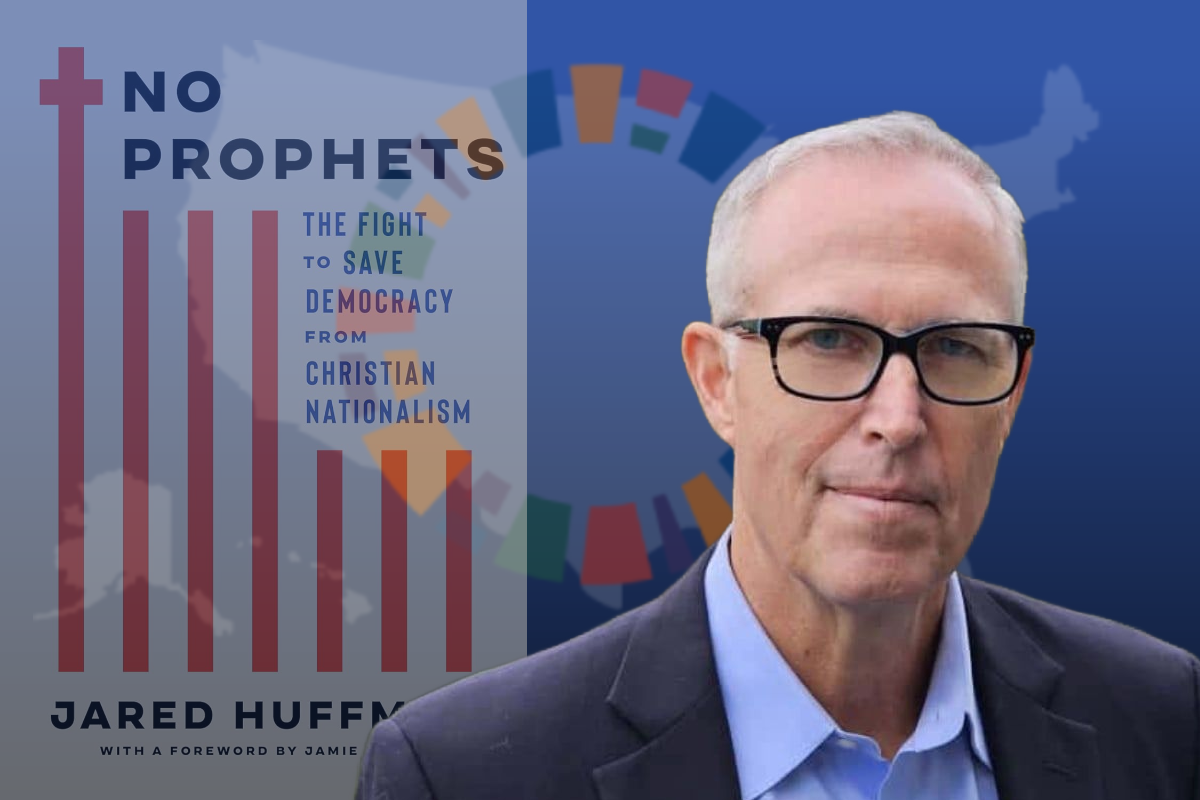
Congressman Jared Huffman: The Fight to Save Democracy From Christian Nationalism
The co-founder of the Congressional Freethought Caucus joins host Rev. Paul Brandeis Raushenbush to discuss how he's seen authoritarian impulses show up in our government and to share some of the insider stories featured in his best-selling new book, "No Prophets"