State of Belief
The Power of Faithful Non-Violent Resistance with Maria Stephan
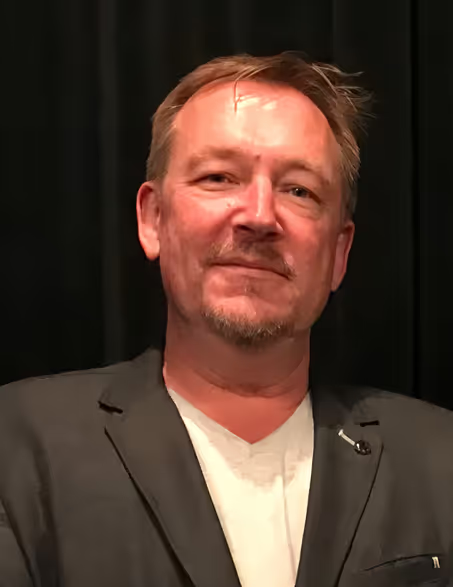

This week on The State of Belief, host Rev. Paul Brandeis Raushenbush is joined by Dr. Maria J. Stephan, co-lead and chief organizer at the Horizons Project. In the conversation, we get her expert take on the pressing issues of authoritarianism, democracy, and the vital role of faith in social movements. A key component of that is faithful, nonviolent resistance, which Maria has observed and supported in different parts of the world.
The ground covered includes:
- The Subtle Erosion of Democracy: Maria emphasizes that democracies are not always dismantled through overt military coups; rather, they often face a slow, insidious decline. Authoritarian leaders can undermine democratic norms and institutions by eliminating checks and balances, weaponizing government agencies, and suppressing dissent.
- The Power of Faith in Resistance: Throughout history, religious communities have played a pivotal role in resisting authoritarianism. Maria highlights how faith leaders and congregations are stepping up to provide moral support and physical presence in protests and acts of civil disobedience.
- Courage in Action: Courage manifests in various forms, from speaking out against injustice to putting one’s body on the line for the sake of others. Maria reminds us that courage is contagious; when individuals see others taking a stand, it inspires them to do the same. This ripple effect is vital for sustaining movements and fostering a culture of resistance.
We encourage you to listen to this meaningful and timely episode, and reflect on how we can each contribute to the fight for democracy and justice.
About Dr. Maria J. Stephan
Maria is co-lead and chief organizer at the Horizons Project, which works on building inclusive democracy and dismantling tyranny through nonviolent action. She is a political scientist and co-author of the award-winning book Why Civil Resistance Works. Previously, Maria served as Director of the Program on Nonviolent Action at the U.S. Institute of Peace and held foreign affairs roles in the U.S. State Department.
Transcript
REV. PAUL BRANDEIS RAUSHENBUSH, HOST:
Dr. Maria J. Stephan is co-lead and chief organizer at The Horizons Project, which works on building inclusive democracy and dismantling tyranny through nonviolent action. Maria is a political scientist and co-author of the award-winning book, Why Civil Resistance Works. Previously, she served as director of the Program on Nonviolent Action at the U.S. Institute of Peace and held foreign affairs roles in the U.S. State Department.
Maria, what a time to have you with us. Welcome to the State of Belief!
DR. MARIA J. STEPHAN, GUEST:
Thank you, Rev. Paul. Great to be with you.
PAUL RAUSHENBUSH:
So we actually met this year because of what's going on in our world. And everybody was like, you have to meet Maria Stefan! Have you met her? It's because you have a vision for what is happening right now. You have been looking at these kind of movements of authoritarianism and democracy for a long time. What do you see as an opening? What do you see as the reality in America right now?
MARIA STEPHAN:
Well, Paul, yes, I have been focused for the past 25 years or so on working with groups around the world who have confronted authoritarianism in its various forms and have engaged in nonviolent movements in an attempt to advance fundamental freedoms, rights, and democracy. And so part of that has involved studying the dynamics of authoritarianism and the so-called authoritarian playbook, which is the set of tactics and methods used by autocrats all around the world.
And an important dynamic that we've seen around the world about rising authoritarianism and how democracies die is that democracies are not dying abruptly as a result of military coups or tanks in the streets. They're dying subtly as democratically-elected leaders go on to eviscerate the norms and institutions of democracy. They eliminate checks and balances. They use the government agencies to punish dissent and opposition. They undermine civil liberties, all with the goal of maintaining and consolidating power and staying in power indefinitely.
So I think we're seeing this rapid consolidation of authoritarian power at the federal level in the U.S. We're certainly seeing the weaponization of government agencies to attack any forms of opposition dissent. We're seeing the abuse of federal law enforcement, the use of ICE to terrorize communities, make people fearful, try to keep suppressed dissent. So we're seeing active attempts to undermine the right to protest, you know, free expression. And we're seeing the weaponization of our streets and the militarization of our streets, the deployment of the National Guard in cities across the country, all the attempts to normalize this military presence is kind of an executive show of force.
So all of this is kind of contributing to a pretty alarming escalation of authoritarian practice in the US and erosion of democratic norms, institutions and freedoms.
PAUL RAUSHENBUSH:
Yeah, isn't that wild? You say it happens slowly, but in some ways, even those of us who are kind of prepared for this moment, it has been almost a frenetic pace at which they have tried to throw this at the American people. And so we are seeing everything that you mentioned. It really is happening.
We're ten months into Trump 2.0, and a lot has happened. I want to get into what we can all do and how you view this moment as an opportunity. But have there been a couple things that you would just highlight for the person who says, oh, you're overreacting? Oh, no, this is normal. Every administration comes in with their priorities. I've heard that. Were there any examples of that where you say, no, that's not just an administration coming in with priorities, that actually transcends that and is moving into a different sort of consolidation of power in the effort of authoritarianism?
MARIA STEPHAN:
I think one of the most blatant examples is just the abuse of federal law enforcement and seeing masked men abducting people in the streets and transporting them away in unmarked vans. So the abductions, the disappearances, all very core to authoritarian practice. We're seeing declarations of domestic terrorism – so, using the term “domestic terrorists” to put in a bullseye leftist organizations, others who, are working on racial justice, economic justice. And so the Declaration of Domestic Terrorism, which opens the door to surveillance, wiretaps, arrests.
You know, we've seen attacks on universities and law firms, kind of the threats and using regulatory retaliation. So threatening these institutions with funding cuts, with legal action, if they don't comply with certain governmental priorities.
We've seen this with the pressure that was put on ABC and Disney after Jimmy Kimmel, after the statement he made after Charlie Kirk's assassination. We saw the pressure coming from the Federal Communications Commission to pull Jimmy Kimmel Live.
So this abuse of power - and certainly the abuse of our men and women in uniform, deploying them to cities across the country, saying they're there to promote law and order when you know these cities are not facing emergencies or crises. And so this kind of abuse of power being manifested in all these different ways are very clear signs.
PAUL RAUSHENBUSH:
It is amazing. The list is big. And then the DOJ, you know, literally go after these people for revenge or whatever it is. Really kind of just personalizing, almost personalizing these institutions saying, I'm going to decide what we're going to do, in this massive expansion of executive power.
Of course, I'm interested in the way that religion is being weaponized and manipulated. And we've seen how, frankly, the people who got Trump reelected, a lot of them were White Christian evangelicals - we can call them Christian Nationalists, however you want to talk about it - who felt very aggrieved about a country that they could no longer control, or they felt like they were losing their country - as if it was theirs to own. Can you talk a little bit about the ways that you've seen - from your vantage point, which is kind of more lofty than mine - how you've seen religion function in authoritarian takeovers across the world, but then we can go more specifically in America?
MARIA STEPHAN:
Well, religion is a powerful thing. And we've seen in this country and around the world how religious actors in communities have sometimes provided moral and material cover for authoritarian and fascist regimes. Religious frames, symbols, organizations have been used to justify racial and ethnic priorities, have been used to justify racial and ethnic hierarchies, to rally people around ultra-nationalist appeals, and promote an exclusionary vision of societies - which, when it's melded together with the desire for political dominance is a very dangerous thing.
So we've seen political leaders in places like Hungary, Victor Orban, we've seen Bolsonaro in Brazil, very much mobilize their bases using kind of ultra-nationalist, religious nationalist appeals, often scapegoating minorities, immigrants, members of the LGBTQ community. So all do kind of mobilize their base and reinforce power.
And very much in the United States we have a long history of religious nationalism, upholding authoritarian systems - whether it was the racist Jim Crow apartheid system in the South, to more recently, with the development of the MAGA movement and this fusion of religious nationalism with the desire to maintain and dominate other groups in society.
PAUL RAUSHENBUSH:
Obviously, Interfaith Alliance has been very activated - because in some ways, this is why we were created. We saw this 30 years ago with the Christian Coalition, really trying to say: we are the religious keepers of America. With Jerry Falwell, Ralph Reed, Pat Robertson, saying: we're the ones whose voices matter because we represent true Americanism and true religion, and we're the ones who should be dominating.
And they were activated because they're, like, we're losing our country to these women. The women, the gays, the Muslims, the Jews, name their people who just weren't them. And in some ways they were right. We were growing into a more diverse nation, which is actually what we were founded to be. What we're seeing now is almost the revenge of the White Christians with their guy in power who promised them retribution, literally promised them retribution. They're coming out of a kind of a grievance cycle in their media, saying the most oppressed people in America are Christians, White Christians, and everyone else is picking on us and all this. It feels so overt.
When you put it in the context of everything else you're saying, it's so clear what it is, with this Anti-Christian Bias Task Force group saying anybody who opposes their vision of Christianity - by the way, I don't count, for any of my listeners who might be under the illusion that your host actually counts in this. I definitely am on the outs. They have their vision, and a lot of times that's anybody who might speak up for LGBTQ people, the rights of women, the religious minority.
So they've set up this Anti-Christian Bias Task Force that is being operationalized in government systems, plus the Religious Freedom Commission, which is all right-wing Christians, one Orthodox Jew, and saying: we are the ones whose religious freedom really matters; we will be the litmus test of what matters, and we're going to go after people. And we've seen that. It's been so blatant.
Are you surprised by how they're not even making an effort to have a veneer? They're just being so clear. Are you surprised by the way they've operationalized their religious wing, or does that fit in with what you've seen in other parts of the world?
MARIA STEPHAN:
Yes, it seems so blatant. And you think about, as well, January 6 and the religious iconography of the crosses, the slogans. It’s this kind of blatant appeal to ultra-nationalism and fusing certain understandings of Christian identity with political dominance - and doing it loudly and proudly - has been used, certainly, by autocrats around the world. And I think now there's more of a permission structure.
So some of this was quieter, perhaps, more beneath the surface. But now there's more of an opening and a permission structure to be bold, public, overt, in the symbols, in the slogans, in the fascist salutes… So this melding of this religious ideology with authoritarian practice is becoming clearer and clearer.
PAUL RAUSHENBUSH:
Have you clocked or been aware of the biblical statements on the DHS recruiting work, and all of this ICE - they're using biblical passages in governmental videos, and really claiming God in that work; and that they're doing God's work through ICE and through the National Guard. I just didn't even think that was possible, that you're just using one tradition on... I don't know. It blows my mind, because I'm not that creative in the way I want to control our country. But they're being very, very like: okay, yeah, we're just going to own that. I feel like even just the religion thing has been a misstep, because there's such a tight knot of religious backing of this regime that actually leaves out so much of religious life in America.
And just one example - and I want to hear your impression of this, Maria - is the Catholic Church, which is not the most radical of institutions. I mean, we have radical Catholic traditions, but it's actually kind of always been very in the center. And yet the attack - you know, J.D. Vance out of the docket attacked the Catholic Church, Catholic bishops, for their immigration work, accusing them of of improprieties with money, which I thought was really bold of someone. And then, really, attacking the idea of their immigration work and their care for immigrants as a really bad thing.
And I think it's been so interesting to see the Catholic hierarchy push back. How have you read that? I mean, it just seems, first, to have Pope Francis write a specific letter addressing it, and then for Pope Leo, now, who has spoken out about it way more than he normally does as someone who is very judicious and even-keeled. I think if I was on the other side, I'd be like, warning, warning. How are you reading that?
MARIA STEPHAN:
You know, the Catholic Church has not been outspoken on democracy issues of late at all. And many perceive certain Catholic bishops to have been very embracing of Trump's agenda. And so there's certainly that perception. And so not only has Pope Leo spoken out strongly in defense of immigrants and kind of rejecting the immigration policies, deportations; also, the US Conference of Catholic Bishops just issued a pretty powerful statement condemning the deportation policies as an attack on human dignity and the common good. And so drawing very much on core Catholic social teachings to say, what is happening - the raids, the abuses, the abductions, the disappearances - this is wrong, this is antithetical to the Catholic faith.
PAUL RAUSHENBUSH:
It was actually kind of amazing to see a PSA that they put together with these, you know, older men, of course, all men. But saying this over and over again and presenting a very united front saying: this major policy of the Trump administration goes against our teaching. That's very strong. Maybe abortion has reached that level, but it's at that level now.
And I think that's the other thing that's so interesting is Catholic bishops showing up at immigration courts, saying, we're going to protect our people; but also the part of the abuse of ICE and detention is that the protected right of people to religious practice is being abused. And priests have gone, and bishops, I think, have gone to detention centers and said, we want to give communion to our people, and they have been refused. And you know, I think nothing really annoys folks as much as saying, you can't do a basic thing in your religious tradition. That's a basic principle.
And that gets into all of the freedom of religion issues that are at the root of this, which is, they don't really believe in religious freedom at their core. What they believe is religious freedom for a very few people, and not for the majority of Americans. And we've seen this play out in the way that Muslim and Arab Americans have been treated at university settings, silence, no due process. We've seen this in the way that all sorts of groups don't feel that this administration is speaking for them.
And what's interesting, and I'm curious if you agree with me here, I was just thinking, I have not heard one inspiring religious voice speaking for the MAGA movement. Like right now, there's no one out there beautifully articulating a vision that has caught hold and that people are sharing. It's really not them. They don't have any soaring religious rhetoric that would invite success of their political authoritarian aims.
But what you are seeing is on the other side, thousands of religious leaders showing up. And I want to turn towards that, because I know that you have been watching this very closely and probably have been one of the people who has helped us realize the power of this. A lot of people are really showing up right now, willing to be arrested, willing to show up; at the very least to be out there praying. It's been interesting to see very hard-nosed secular legal folks, people who are really approaching this moment from all sorts of other angles, lift that up and say, wow, look at that. Have you had a similar response?
MARIA STEPHAN:
For sure. And as we see the acceleration of these authoritarian dynamics, these abuses of power, these acts of repression, the politics of retribution and revenge - as this intensifies, we're also seeing an intensification of courage and faith in action. And I think we're seeing it in so many different ways right now. Everything from people of faith, faith leaders, showing up for the protests as people of faith. No Kings, the largest single-day demonstration in U.S. history. And, you know, millions of people, not a single act of violence. And you had people of faith showing up powerfully, speaking to the power of faith leadership in this moment, providing a moral anchor for this, organizing for this mobilization. So powerful.
As you say, we're seeing faith leaders putting their bodies on the line. So you think about LA, all the faith leaders, Latino, other, who are providing protective accompaniment and blocking ICE from ordinary people. We're seeing Broadview, Pastor David Black, who, while participating in prayerful vigilance outside of an ICE detention facility, shot in the face with pellets. Alligator Alcatraz, we're seeing interfaith delegations, people showing up, ritualizing faithful presence at detention facilities. Here in New York, the Jericho Walk, interfaith delegations showing up outside of 26 Federal Plaza to show presence and to pray and to sing and to call attention and awareness to what is happening in the immigration courts and immigration system. So many expressions of faith, now.
I participated in a deportation defense training that was held in a church basement in New York. So you're seeing churches providing space for organizing, for training in Know Your Rights, in de-escalation, in deportation defense, in nonviolent resistance. So this role of organizing, of training, of putting bodies on the line, of the moral protests, of the non-cooperation that we're seeing, the powerful Lenten Target boycott - the boycott of Target over anti-DEI policies that has engaged so many people, has cost Target billions of dollars to put the focus on the need for inclusion, racial diversity.
We've seen faith leaders participating in the boycott of Avelo Airlines, the main airline responsible for ICE deportation flights. So we've seen congregations boycotting, withdrawing economic support, from companies that are involved in acts of repression, and just the mutual aid that's happening. The provision of food and medicine, just meeting people's basic needs in community, people who are fearful, who are under attack, faith communities across the country. And this is all faith traditions. We are seeing Christian, Jewish, Muslim, Sikh, Hindu, very multi-faith expressions of faithful presence, solidarity, and resistance in this moment.
PAUL RAUSHENBUSH:
I'm totally fired up about it. And as I've said to you in other settings, and I want our listeners to hear, one of the pledges of Interfaith Alliance is to be part of a broader community training 100,000 faith leaders in this coming year, recognizing that we need people. And by the way, I love that you mentioned all the different ways that people can show up, because it's not like we're training every one of you to get arrested. That's one kind of resistance and it's really important. There's all kinds of ways that all of us can show up, but I want to make sure that people feel trained, that people feel like they have knowledge and skills to do the work and to show up.
And I think this is, actually, for me as a religious leader and an interfaith, it's actually quite thrilling that - unfortunately, what is happening is happening - but what is the opportunity here is actually to reinvigorate a spirit that has been in America throughout our history when terrible things are happening. Religious people often are the ones who are willing to dig deep into their tradition, and find the courage, find the spiritual discipline it takes to do this kind of work. I'm really excited about it, and I've been talking about this in churches and communities and interfaith gatherings and theological training centers, and every time I mention that, invariably, I have a crowd around me saying, how do we do that? We want that. There is a hunger for those trainings.
And so, Maria, I know this is one of those things that we are really working on. I'm in Little Rock, Arkansas, right now that we're recording this. I mentioned that I had three different couples who were just like, what's the next step there? When can we do the training? I'm like, give me a second, but we will do it. So I just I think it's so important.
But also, there's another part of this, which is also another kind of courage, which is some of these religious communities have taken the administration to court about the rescinding of the Sensitive Spaces Act. In the first month, we had the Cooperative Baptists, along with the Sikh Coalition and the Quakers, take the administration to court. That was the first time the Cooperative Baptists have ever done that, but they view it as a pastoral issue. All of this is not just about an abstract idea of democracy, it's about our people. What's happening to our people? What's happening? We can talk about democracy and how important democracy is. Democracy is just about people. It's about our neighbors. It's about how can we love our neighbors?
There's lots of different strategies. And I know yours. I really want to lean into some of these training ideas. But have you also been seeing other creative ways? I love that you mentioned the boycotts, but it just seems like religious folks are really being creative in the way we can show up right now.
MARIA STEPHAN:
It's showing up to vigils and demonstrations with signs: What Would Jesus Do? Or just like a reflection on - for Christians, of course, but in different faiths - how do we lean into what our faith calls us to do in this moment? And is what is happening around us in keeping with our core beliefs and faith? And so you're seeing more and more people showing up in lots of different ways.
And you mentioned the training. Just because in some of the research I've done on pro-democracy movements and mass nonviolent movements around the world, training was key to the success of those movements, because just preparing people for the hardships to come, the repression, helping them think strategically about how do we engage in protests and boycotts and strikes?
And so you think about the role of training in church basements, Quaker meeting houses, synagogues, during the Civil Rights Movement. It was so integral to preparing people for the lunch counter sit-ins, for the bus boycotts, for the freedom rides. And faith institutions and communities have such power to bring people together in communion, help people to see their connection to one another, to feel a sense of solidarity that, yes, we can prevail, to instill a sense of hope. And also to skill people up, as you say, we've got to be prepared to figure out how to focus our energies in this moment. And, you know, there's so many things that people are doing and that need to be done.
And yes, we need to be taking care of our communities and so many people of faith. You're seeing the level of survival strategies and mutual care and the soup kitchens and people, you know, the rapid response networks that faith networks are organizing in this moment to take care of neighbors, provide basic needs. And so all these kinds of activities - and certainly the faithful, the physical presence is so important. When people of faith show up, it helps to diffuse tensions, often, and instill a nonviolent discipline. It helps address people's fear, and encourages people to join. So the participation of faith leaders, it has this recruitment and mobilization effect. And it helps to mitigate violence and repression, which is so key to the ability of movements to sustain themselves and to grow.
PAUL RAUSHENBUSH:
I love that. I got a chance to talk to Katie Fang on her show, and she said: I have to tell you something. Churches are like a gateway drug to resistance, because, she said, my mother, who is 82 years old, who was always really conservative, had never been to any protest ever. Our church in Miami had a small bus going to the No Kings rally, and because it was through the church, she felt comfortable going and showing up with a sign. It was her first protest ever, and here's this 82-year-old woman holding up a sign that reflected her own faith and why she was there. And I thought that's one of the most powerful stories I've heard, is people showing up.
And the other thing it does is it undercuts the narrative that the administration wants, is that we are the God people, we are the religion people, we are the people who are really protecting religion. And actually, it just gives lie to that claim, when all of us show up in this other way, and in all of these different ways, and it's very moving.
I had a chance to talk to John Lewis when he was still alive, and he talked about those trainings and how no one really went without some training. What are some of the ideas of when we start unveiling these trainings around the country? It seems like different people need different things. What have you seen that have been the variety of different ways - and because I really do want, listener, I really do want you to start thinking, like, oh, I could get trained, even though I've never thought of myself in that kind of terms as like someone who who goes to protest, even if you've never thought of yourself as someone who would do nonviolent resistance, which sounds like someone has to give you that badge and say, oh, you are now a nonviolent resister. This is actually just something that we did internally: say, I want to show up and I want to show up well, and I want to show up with information and I want to show up with some sort of sense of of understanding why I'm showing up.
And also what I think is the opportunity those of us who work in the religion field is to help people understand: you actually have what it takes. You have the spiritual well from which you can bring your water and sustain you with courage for this moment. So what are some of the ways that you can imagine people, maybe, who haven't really even thought of themselves in that way, but actually showing up.
MARIA STEPHAN:
There are so many different ways for people to get involved in this moment and there are so many needs, and people with different skills, passions, risk tolerances. There's a way for people to get involved doing different things; and for some, it's helping them to get involved in protecting people in their community, whether it's ICE watches, know-your-rights work, deportation defense, documentation, patrols, de-escalation. So preparing people to help defuse tensions and maintain calm and nonviolence around various activities.
PAUL RAUSHENBUSH:
Can I ask you a little bit about that last one? Because my guess is that there might be a lot of listeners who are like, oh, you know, I might not feel capable of understanding how to show up and counteract ICE, but I actually do have a passion for being a presence for peace. Say a little bit more about what is deescalation? I think that sounds really important.
And when we think about the success of No Kings and when we think about what it meant to show up and, again, give lie to all the propaganda that was coming at No Kings right before it happened, which was like, this is a hate America thing. This is a violent group. These are radicals. And then you have Katie Fang's mother showing up. What does deescalation mean? We could go down any one of those. I just wanted to kind of highlight one: when you break it down, what kind of skills does that involve?
MARIA STEPHAN:
A lot of it is preparing people emotionally, psychically, to respond to various incidents that happen, whether it's escalation of rhetoric, acts of violence. How to prepare yourself to be grounded in that moment, and then know the various powers that you have in that moment, whether it's through things that you say - so how to use non-threatening language for people who are very aggravated, who are aggressive. Everything from deflecting attention, their attention, so they're not singularly focused on the target of their attacks, to just promoting a sense of calm to diffuse the tension, to everything from training people to exit, to being able to move away, to get away from the attacks or the violence or the increased rhetoric.
So it's a range of tactics to basically help diffuse the tensions, to calm to the extent possible, and to help protect people, and to create a different environment so that the conflict can be resolved in a different way, or you're at least protecting people from that harm. So it's getting into the range of different kind of tactics and a ways to approach.
PAUL RAUSHENBUSH:
I love that. And I'll just say all of this, these trainings, unfortunately, we have a crisis that's requiring us to be trained up. I feel like almost any of these trainings are good skills to have as people, and especially… Well, I won't just say especially, I'll just specifically say that last one, that sounds like when Jesus talks of blessed are the peacemakers, I mean, there are ways that all of this, frankly, all of this leans into whatever religious tradition you are, about loving your neighbor, about showing up well in a democracy.
The reason we're feeling so passionate about training up so many people is I actually think all of these skills build a muscle memory around democracy itself, and can be applied to how we show up around election time, ensuring that people can actually vote and people feel comfortable voting and people feel that their vote matters. And so I'm really excited about that.
When you think of - I'm not asking you to have the magic ball or anything like that, but if you think of an arc of an authoritarian presence, because one of the things that's really important to mention is that while it seems terrible right now, and it is terrible, it doesn't mean it's forever. And it doesn't mean we're going to lose. And one of my favorite quotes from you, that I quote from you in a sermon that I do, which is, as people of faith, we have a vision for the future that is not tied to this, that is about the beloved community that King talked about, or the kingdom of God that Jesus referenced, that's on earth as in heaven. We can't just say, oh well, this is what it is, because we have a vision that compels us forward. And you mentioned how important that is in movements, that we don't give in to cynicism or despair or the sense that it's inevitability. Those are words that you've used that I think are really helpful. And I am curious how you view us in this moment and the future.
MARIA STEPHAN:
Sure. It's so important what you say about just the power of the affirmative vision, what we are fighting for, the communities that we are seeking to build. And even as we engage in resistance, it's still how we are showing up for our communities and members of the community, what care looks like. How to put beloved community into practice and helping people see the alternative: a society grounded in respect for dignity, for the common good, grounded in love - and faith leaders better than anyone can ground action in a sense of love and shared humanity and respect for inherent dignity of all, the image of God in all. And faith leaders can communicate that and act in that way with so much credibility and power. And so there's a need for that.
People are exhausted. People are fearful. People are feeling deep anxiety about the moment we're in. And so having that spiritual power, that mooring, that yes, we can prevail, yes, we are aspiring to this beloved community or this type of society where we deeply care about each other, where all have the ability to be free and to thrive. It's something we can build together. So that is just so important, that grounding and that sense that we can prevail. And that hopeful arc is really, really important in these very difficult times.
PAUL RAUSHENBUSH:
I heard something that I really think is so important to emphasize, is that this isn't something we have to wait for, that we can actually embody it with the way we treat one another now. It's not just about what the future will happen once we've defeated these authoritarians, but actually, it's about how we act on the way there and how we create beauty and love and possibility in this moment now as part of what will guarantee the success of us eventually getting there. But we're not someone who's just like, let's trample over everybody in order to achieve… That just doesn't work. And, you know, the end will reflect the means. And I think that this is incredibly important what you're offering there. And it's a real opportunity.
And again, I'll say for all of you who are interested in the trainings, please, please reach out. You can write an email [email protected]. We'll have your name on a list. Wherever you are in the country, our goal is to make sure that your community has the opportunity to learn about what Maria is talking about and to remember that Maria didn't make this up. However brilliant she is in articulating, this is actually a tradition in America. This is a tradition across the world. This is a religious tradition that we're leaning into. Traditions, but an idea and a practice. We can look at how Gandhi inspired King and then Heschel. This is big and beautiful, but it's also about each one of us. And it's really exciting.
I do want to just, as the last question, what does courage look like to you right now? How do you understand the need for courage in this moment?
MARIA STEPHAN:
I think courage is showing up for people and communities in different ways, even when it's difficult, even when there is risk involved; when it can cost you something. Speaking out when maybe it's not comfortable to do so, or showing up in solidarity. For some, it's putting their bodies on the line. So I think it looks very different for different people. But yeah, it's taking action that involves some level of risk. And willingness to accept some costs for taking action in this moment.
Courage is contagious, of course. So people seeing other people engaging in acts of protest or defiance, saying something that maybe goes against the grain of the community that they're with, that breeds courage on others' part. I think this ripple effect of seeing people showing up bravely in different ways - and that's what sustains our movements - is just seeing and being inspired and supported by the courage that we're seeing around us.
PAUL RAUSHENBUSH:
Dr. Maria Stephan is co-lead and chief organizer of the Horizon Project. Maria, thank you so much for being with us today on The State of Belief.
MARIA STEPHAN:
Thank you so much, Paul. Really wonderful to be with you.