State of Belief
What Are "Christian Antichrists?" Dr. Matthew D. Taylor Explains


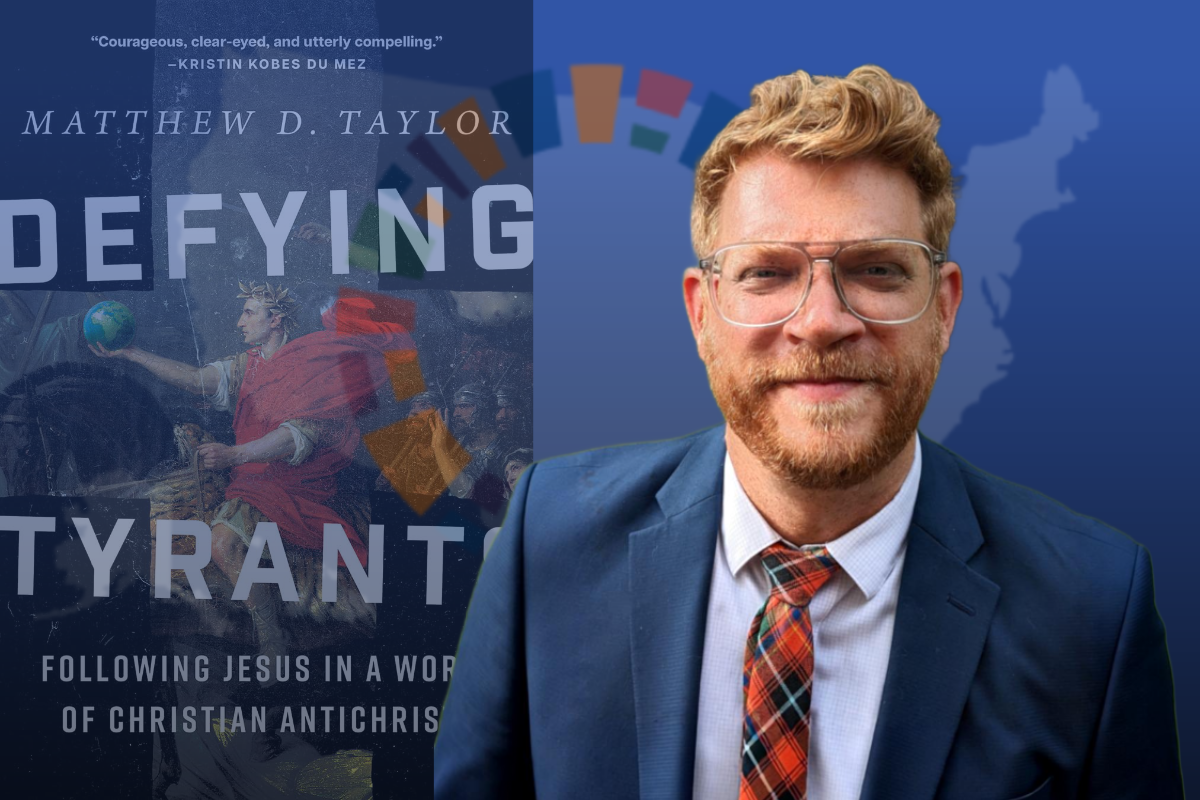
This week, host Rev. Paul Brandeis Raushenbush is joined by a preeminent expert on Christian Nationalism and the New Reformation Movement: Dr. Matthew D. Taylor. His new book (out Oct. 6th) is Defying Tyrants: Following Jesus in a World of Christian Antichrists. We get deep into the history and harm of this word: a quest for power that looks like faith, talks like faith - but then harms people in Jesus’ name.
Matt makes a case that’s both biblical and uncomfortably current. He argues that “Antichrist” isn’t just about bad doctrine—it can describe people who claim Christ but act against him. We also get into Jesus and empire, Christian Nationalism, Pete Hegseth, and what it might look like to resist tyranny without violence.
Dr. Matthew D. Taylor is an award-winning religious studies scholar, author, and nationally-recognized speaker on religion and politics in the United States. He's a visiting scholar at Georgetown University's Center on Faith and Justice, and is one of the leading researchers of Christian Nationalism and the New Apostolic Reformation, charismatic Christian movements that are quietly growing influence on American politics.
Matt holds a PhD in religious studies and Muslim-Christian relations from Georgetown University, and has taught at Georgetown and George Washington University. His books include Scripture People: Salafi Muslims in Evangelical Christian America, and The Violent Take It by Force: The Christian Movement That Is Threatening Our Democracy.
The State of Belief host Rev. Paul Brandeis Raushenbush is President and CEO of Interfaith Alliance.
Transcript
REV. PAUL BRANDEIS RAUSHENBUSH, HOST:
Dr. Matthew D. Taylor is an award-winning religious studies scholar, author, and nationally-recognized speaker on religion and politics in the United States. He's a visiting scholar at Georgetown University's Center on Faith and Justice, and is one of the leading researchers of Christian Nationalism and the New Apostolic Reformation, charismatic Christian movements that are quietly growing influence on American politics.
Matt holds a PhD in religious studies and Muslim Christian relations from Georgetown University and has taught at Georgetown and George Washington University.
Matt's books include Scripture People: Salafi Muslims in Evangelical Christian America, and The Violent Take It by Force: The Christian Movement That Is Threatening Our Democracy. His brand new book is Defying Tyrants: Following Jesus in a World of Christian Antichrists, and continues to investigate that intersection of religion, political power, extremism, and American democracy. It comes out on October 6th, and I am so happy it brings the author back to our show.
Matthew Taylor, welcome back to The State of Belief!
DR. MATTHEW D. TAYLOR, GUEST:
Thank you, Paul. It's always an honor to be with you.
PAUL RAUSHENBUSH:
Listen, this book has stuck with me. The title – I continue to think about it. And let's just start there and we will expand out of there. I think this is a very provocative - intentionally, but really provocative title. Defying Tyrants: Following Jesus In a World of Christian Antichrists. Can we talk about what a Christian antichrist is?
MATT TAYLOR:
Yeah, that's why I put it in the subtitle. I want to have a conversation about it. So I think that there's been a lot of talk throughout Christian history about The Antichrist, capital T, capital A. And this goes back to the second century where people, Christians, have started kind of speculating about this. I find much of that conversation is not very closely attached to the biblical text. And I am a Protestant. I was raised evangelical, Paul. I care about the text. I care about what it actually says. And if you go and look at the text of the New Testament, that word “antichrist” only occurs in one dusty little corner of the New Testament in the epistles of 1st and 2 John, toward the back of our New Testament. And there's tiny little epistles, and that's the only place where we find that word.
And if you go and study those texts it's as often being used in the plural, antichrists, as it is being used in the singular. In fact, in 1 John chapter 2, the really pivotal passage, it says, “You've heard that Antichrist is coming, but now many antichrists have come.” And so one of the questions I'm asking in this book is: what is the biblical text? What are these biblical authors doing when they're calling people around them? Because what occurs in these texts, they point to a particular group of people and say, those are the Antichrists. And so why use this very loaded word in reference to a particular group of people?
And when you look at it, those people are Christians. They broke away from the community that John is writing to, that John the Elder is writing to. And there's something deeply offensive about this group of people. And so as I try to show in the book, a lot of what is going on in that text is that this breakaway group has been abusive. They've been harmful to the community. They've claimed that they are superior to the rest of the community. They've claimed that they have things to teach the rest of the community. And they have harmed and abused other people in the name of Jesus.
And so what the John and the Johannine community, the community that's receiving these texts, are doing in calling those people antichrists, is they're saying they claim to be like Christ, but they act the opposite. So they are antichrists. And I think that this is actually a very useful scriptural concept for our time and, really, for understanding Christian history. Because Christian history has not been a history of Christians behaving wonderfully and kindly and generously towards their neighbors. There have been plenty of Christians who act that way, but if you look at the structures and institutions of Christian history, they've largely been shaped by Christian imperialism, Christian supremacy, Christian power over others.
Christians have colonized the world in Jesus' name. Christians have committed crusades and pogroms in Jesus' name. And I think we need to reckon with that history, even as I remain a committed Christian. I remain committed to the values and the teachings of Jesus. I'm just very troubled by the way that many of my fellow Christians have claimed the name of Jesus throughout history to enact their own agenda of power.
PAUL RAUSHENBUSH:
It's so interesting, because it's really helpful to hear you define how these early communities defined antichrist. They didn't say, the right dogma. It wasn't necessarily that they were… As someone who gets called an Antichrist a lot online for just saying love my neighbor - that tends to be worse if the neighbor is LGBTQ or anything like that, clearly I'm an Antichrist. But that's, actually, not what you mean by this. You mean actually it's a behavior that's done ostensibly in the name of Jesus that's actually harmful and abusive. And I think that this is really important.
And it's such a powerful word. We've heard it and it's mind-blowing to me. I'm a Protestant too, and you would think that antichrist was every other word in the Bible the way it's thrown around. How it comes up and how it is described is so important. One thing that, you know, is interesting is that I think what you're suggesting or what you're actually doing is reclaiming this word in a way to describe something that feels real to your faith, that describes some really dangerous, lethal behavior that we're seeing by some Christians in our country today.
MATT TAYLOR:
Yes. And I think part of the problem is, and this is how this term has sometimes been applied in the past, is it gets conflated with the category of heresy. And heresy is a real topic in Christian history. Heresy is the idea that somebody has denied something essential about the teachings of Christianity, something essential about the doctrines of Christianity. That's a real thing that has really happened throughout Christian history. And so we talk a lot about heretics.
I think that antichrist is a more primal rebuke. I think it's about behavior. It's not merely about belief. You can say the words of the Nicene Creed and in your heart, in your mind, on some level, mean them, believe those things, and then turn around and enslave another person and beat them. That person is an orthodox Christian by the standard definitions that we use. They said the words of the creed and they meant them. But their behavior is a betrayal of the very teachings and life and model of Jesus in such a profound way that it damages the reputation of Jesus. It harms the gospel of Jesus because of their betrayal of the name of Jesus.
It would be one thing if they were out enslaving people - I'm not in favor of that at any level, but we're saying this is really bad that I'm doing this. This is in violation of my faith. And so I can't reconcile those things, but I'm not going to make excuses for it. When you do it in the name of Jesus, when you harm people in the name of Jesus, when you violate Jesus' teachings and pretend that you are adhering to them, I think that is a form of heteropraxy.
A false practice, a harmful behavior that is so damaging and has caused so much damage throughout Christian history that many, many people have besmirched and rejected Jesus, who never got a chance to even encounter Jesus because they encountered his awful followers.
PAUL RAUSHENBUSH:
Oh my God. I think that's a really important point. I think it's interesting because what I'm hearing, there's a certain you can't take the evangelical out of the boy. Like there is a certain thing for you - and I feel it too sometimes - it's like, yeah, you know, I get it. You don't have to be a Christian, but I wish you had met a Christian who actually was following the way of Jesus and the way that Jesus inspired this radical love for our neighbor, rather than this other kind of Christian who's just trying to impose this on you and it doesn't matter who they hurt on the way.
And this is what we're seeing today with this term Christian Nationalism that we've been talking about now for several years now. And it's interesting that - you probably remember this, a couple of years ago, maybe, people were very reluctant to use that term. They're like, uh-oh, this is where people are going to feel like we're attacking Christianity or something like that. I think it's established what we mean by that, which is an imposed Christianity on the rest of the country, whether they like it or not; and one version of Christianity, which are the people who are in power.
And so what I want to get to next is the first part of your book's title. I'm sorry, I'm really focusing on the title. It's very exegening your title, but, Defying Tyrants, and then says following Jesus. This is actually a book aimed at Christians meeting this moment almost, and it's a very particular moment. What do you mean by defying tyrants? And why is that an important Christian principle for you?
MATT TAYLOR:
With the title, I was trying to come up with a phrase that actually does capture the politics of Jesus. You know, we talk a lot as Christians about Jesus is our model. What would Jesus do? How do we imitate and follow the path of Jesus? We are disciples of Jesus. I agree with all of that. So why do we ignore his politics? Why do we not pay attention to how Jesus actually inhabited his own political moment? And the moment that Jesus inhabited was a moment of tyranny, a moment of empire.
And we sometimes also forget how new the Roman Empire was when Jesus was living on the earth. I mean, Julius Caesar took over and all the events that you read in Shakespeare. That's happening in the time of Jesus' grandparents. And then it's Augustus, Julius's successor, who enacts the Pax Romana. And Augustus dies when Jesus is a teenager. So this is all still pretty darn new.
This Roman Empire phase and this Pax Romana that Jesus and the early Church are living under is an age of tyranny, and not just a kind of generic tyranny, a religious tyranny. Caesar claimed that he was a god and that everyone needed to bow to him. In fact, we have all kinds of archaeological evidence that the term that we use as Christians, gospel, is not originally a term for Christians. It was Caesar's term. It was a form of imperial propaganda. You can find these inscriptions around the empire, especially from Augustus, right, who dies when Jesus is a teenager, saying, Hey, good news, we've got great news for you, people of the Roman Empire. You are now living under the reign of a God, a God who walks the earth, a God who reigns from Rome, a divine son has come down from heaven and is now the dictator over all of us. And you are pacified, you are colonized. Welcome.
That was the propaganda that was being pushed throughout the empire as the early Church is growing up, as Jesus is living as a colonized human being on the outskirts of the empire. And the early Christians then take up that language. Why do they do that? They're not imitating, they're mocking. They're challenging. They are pushing something in Caesar's face and saying, You claim to have a gospel? You claim to be a divine son, we'll show you what the actual divine son looks like. And he doesn't look anything like you.
And so I think that there is something about the way that Jesus stands up to these imperial powers. And I try to show in the book how Jesus, even as this colonized human being, is resisting and refusing the systems of power that Rome had instituted throughout the empire, the hierarchical systems of domination and coercion and power that the Roman Empire ran on.
And then Jesus, of course, dies, the death of an insurrectionist. Jesus dies as an enemy of the Roman state. And we Christians - I've heard all of the sermons, Paul, all throughout my life: Well, you know, the Romans just didn't understand Jesus. They didn't understand that his kingdom was not of this world, and they didn't understand that his kingdom was a spiritual kingdom, and they mistakenly understood him to be an enemy of the state. Wrong! Jesus was an enemy of the state, Jesus was a threat to the powers that be, because he was resisting and challenging it.
You know, when Jesus does go to his death, in the Gospel of John, there's a scene where the religious leaders, the Jewish religious leaders in Jerusalem, are having an argument with Pilate about what to do with Jesus. And Pilate is kind of wishy-washy, he's like, I'm not sure what to do with this guy. And Jewish leaders come to Pilate and they say: Hold on a minute. Don't you know that anyone who claims to be a king is defying Caesar?
They're right. Jesus did claim to be a king. He was defying Caesar. I don't think the Romans misperceived the threat. They understood the threat quite well. We have misperceived the threat, or we have caused that threat to be watered down and watered down to the point of it being non-existent. And the reality is that Jesus and the early Church were persecuted and they were challenged and they had this oppression from within their system because they were refusing to conform.
It wasn't because they were pious. It wasn't because they were monotheists. Jews were monotheists. They made up about a tenth of the empire. They had found ways to accommodate with this imperial cult and everything. It was because the Christians continued to resist Roman systems of power. And that was a threat to the system. And somehow we have lost that. And we somehow have come to think that to follow Jesus is to conform to these systems of power, to theologize systems of power instead of resist them.
PAUL RAUSHENBUSH:
Huh. Which brings us to Pete Hegseth. I mean, honestly, I do think what you're describing, it's just so interesting the way members of this administration use the scriptures to legitimize what they're doing when they're actually mimicking more the Roman Empire than they are the role of Jesus.
The book is coming out October 6th. We're going into an election season. if anything, things have gotten worse since the last time we talked. You know, people are more entrenched. As they become less and less popular, they’re becoming more and more intent on claiming power wherever they can. And I think that The Department of Defense, Department of War, if you want to…
MATT TAYLOR:
I call it the Department of Holy War.
PAUL RAUSHENBUSH:
Yeah, holy war. I mean, all these things are happening in real time and I feel like they know the clock is ticking and so they're trying to take control of things in a way that can't be wrested from them, even if the people vote against them. So tell me how you understand this current moment - and I'd like for you to start with Pete Hegseth and the people who surround him, because I actually think he's a really good example, once we're talking about the Roman Empire, of someone who kind of mythologizes that Roman power, and is, in some ways, an example of what you're talking about in this book.
MATT TAYLOR:
I think that Pete Hegseth is a prime example of Antichrist Christianity. I mean, he not only mythologizes and theologizes; he has marked his body with the imagery of the Crusades. He has at least three tattoos that reference the Crusades. He wrote a book titled American Crusade that spoke glowingly of crusader ideology and why we need to resurrect it. And he talks openly of Christendom.
And so part of my argument in this book is that we can have the conversation about Christian Nationalism, and that's fine. I think it's a fine phrase that is useful in its way. But this stuff didn't start in 1980, this stuff didn't start in the 1950s, this stuff didn't start in 1776. This stuff goes back a very long ways in Christian history, at least to the fourth century, with the conversion of Constantine.
And then you begin to have these Christian empires. And Christian empires, well, empires don't love their enemies. Empires subjugate their enemies. They conquer their enemies. Empires don't serve the least. Empires push more and more power up to the top. That's what tyranny is: the rule of the few over the many. And so what Hegseth is doing is, yeah, it's bizarre. It's frustrating. But it has a long lineage. In fact, it is in sync with a lot of Christian history.
I think that what we are facing right now in the United States is a threat to our democracy that is unlike any threat that we faced before. We've had other threats. I mean, we've had civil war, we've had rebellions. We had an authoritarian system in the Jim Crow South and in the antebellum South as well, where some people's rights were completely eradicated and they were forced into slavery or subjugation. That's also part of our history. But I think what we're facing right now is a threat to our liberal democracy, a threat to the very nature of our constitution, and an attempt to undermine it in such a severe way that I don't know that we could call ourselves a democracy anymore.
There's a really interesting institute called the Variety of Democracies Institute. It's in Sweden. And every year they put out a report. This is an exhaustive report covering 202 countries. They get more than 4,000 scholars contributing on this. It's very numerical. This is not some kind of partisan or provincial kind of report. These are serious scholars studying democracy around the world. In 2026, this year, for the first time in the history of the report, they downgraded the United States from being a liberal democracy.
PAUL RAUSHENBUSH:
Yeah, we had the lead researcher on this show talking about that. It was mind blowing. And they said we have never seen such a rapid decline. The rate of decline was mind-blowing to them. And we have to recognize, if we feel like something's wrong, it's because something's wrong.
MATT TAYLOR:
Yes. In this report, there's a footnote that's fascinating that says in the twenty-first century, globally, they have only seen six countries experience a faster one-year decline in their democracy. Five of those were coups, like coup d'etats with the military taking over. And the sixth one was a self-coup, where the politically elected leader refused to leave office when they were no longer constitutionally eligible to be the president.
So, in other words, if you think of those Varieties of Democracy kind of metrics as a democracy Richter scale, 2025, the first year of the second Trump administration, registered as a coup d'etat on the democracy Richter scale.
PAUL RAUSHENBUSH:
So talk to me a little bit about how you understand - I'm sorry to put this on you, but the midterms. Your book is coming out in a very particular moment. I do think that there are many Christians who are actually pushing back against the Antichrist right now. I think it's very inspiring the way Christians have showed up against ICE and in other ways. But I am just so worried about, what won't people do? And you were the one who kind of blew my mind about this in 2024. And part of your perspective is that you're seeing underneath, through these kind of prophets who are saying, okay, you know, Trump can't lose because he's been anointed and etc., etc.
Where is that movement right now with the midterms? Have you been following them now? Because it feels like that's another kind of seismic disruption to our democracy that I think most people have no idea is happening.
MATT TAYLOR:
I try to keep pretty close track of the religious leaders around Trump. If you've seen those photos with Trump surrounded by pastors and priests and they're all laying hands on him and praying, those are the people that I try to keep track of. And within that world, it has functionally become a world of theological propaganda, where what they are selling to their people - and most of those people in that show up in those photos have some following; those are the celebrities that show up in those photos. Celebrity pastors, celebrity revivalists, celebrity prophets. A lot of them are Pentecostal and charismatic.
So they come from a particular wing of evangelicalism where there is this belief in modern prophecy. But they became fixated with Trump. He's become a sort of messianic figure, quite literally messianic in their understanding. And they'll compare him to different biblical figures and attach these meanings to him.
I think what we are seeing right now is I think we are gearing up for another election. And part of what I have learned in the process of watching this over a number of years and also talking to experts who study these things around the world is, I think we need to stop thinking about the struggle for democracy as being about a single election and more about being a generational struggle. And what we have experienced in the last decade is the beginning of what will be, no doubt, a generational struggle for the sake of American democracy.
And what happened in the 2024 election was that enough of our fellow countrymen and countrywomen elected Donald Trump and the MAGA movement to power again, based on the false promises that they made. They won legitimately in a democratic election. And since then they have proceeded to dismantle the systems. They're pulling up the ladder behind themselves. And they are even now gearing up to try to find ways to rig this election.
That doesn't mean they're going to successful. In fact, midterm elections are kind of hard to rig in the United States. We have a very decentralized election system with a lot of different diffuse power centers and actors all over the place. And so it's not an easy one for them to rig. I think that they're going to try. They're going to do what they can, and there's a lot of ways to rig an election. There are a lot of authoritarians around the world who have developed quite a playbook for how to do this, and they learn from each other. They're kind of a class of people. I mean, this is why Trump gets along so well with Putin and Erdogan and Modi and all these other dictators around the world. They're all riffing on each other's playbook. They're all thinking through how to take over these democracies and turn them into autocracies.
But the reality is, even if they were to rig this election, it doesn't mean that the fight is over. Because democracy is about people, ultimately. It's not about institutions per se. The institutions are mediating and structuring the will of the people. But ultimately, in a democracy, it's the demos, the people, who are responsible for that. And what we've seen around the world is that when these religious nationalists and religious authoritarian movements do come to power, they're very hard to displace. You kind of have to build a supermajority to get rid of them. But when democracies manage to do that, they come back stronger. They come back wiser. They come back with more energy and more united because they've had this kind of near-death experience.
And they've learned lessons from that. I mean, there's a reason. It's right after the 2024 election in the United States the the leader of South Korea attempted a coup. He attempted to institute martial law and to try to overturn South Korean democracy. You know what happened? It lasted like six hours. He tried to do it in the middle of the night. People took to the streets in thousands. Lawmakers were climbing walls of the legislative building to get inside to cast their votes against this measure. And that leader is now serving life in prison.
That is what a healthy democracy does in the face of an authoritarian threat. But the South Korean people, I think, reacted that way because they've had experiences with authoritarianism in recent memory, in living memory. And they know how precious democracy is, and they are willing to stand up in that moment. That's the kind of reactive system that we need. That's the kind of limbic system that we need in the American people that we would react to these moments. Unfortunately, we've gotten kind of ossified and atrophied and comfortable. And part of the reason I wrote this book is I I want to stir some people up.
PAUL RAUSHENBUSH:
And I think to invite people into the process. There's that old adage, show me what democracy looks like, this is what democracy looks like. It's the people showing up and that's what we need. I am curious, just to press the point a little bit, have you heard any more about - because Trump is plummeting so much and like he's obviously flailing in such an overt way with his craziness and his crazy memes and just all sorts of crazy. Are they still viewing him as messianic? Or is there like, maybe, we need to jump over to JD Vance? I'm just trying to get kind of a feel like you're my mole on the ground. Are they finding new opportunities for people and new objects in order to find champions that are anointed by God in order to take over American democracy and create a theocracy?
MATT TAYLOR:
The folks that I track, the kind of Pentecostal charismatic, especially non-denominational charismatic networks and leaders that really surround Trump, they're still very stuck on Trump. They have not jumped to the JD Vance camp. And in fact, I don't think anyone thinks of J.D. Vance as a messianic figure, other than maybe Peter Thiel. He's just not a charismatic figure in any sense of that word. And I think that they have really dug in on Trump.
Now, part of the story of Christian Nationalism in the second Trump administration - the story I think in the first Trump administration is the story I try to tell in The Violent Take It by Force, this kind of displacement of the evangelical establishment by this new crop, this new breed of charismatic non-denominational leaders who really surround Trump. Paula White Keane is one of the real thought leaders. The New Apostolic Reformation is very important to that story. Part of what has changed in the second Trump administration is there are a bunch of new entrants into the realm of Christian Nationalism thought leadership. And so you've had these other movements of Christian Nationalism that have also tried to move their way into the administration and influence it. And that includes this group of Calvinists.
We talked about Pete Hegseth. He and his mentor Doug Wilson and this whole realm of kind of hardline Calvinism, a lot of this goes back to this group called the Reconstructionists in the 20th century. But this kind of vision of systematic Calvinism dominating - it's very patriarchal, very misogynistic, often quite racist - that has become a real force. It's not a huge demographic force, it's demographically a pretty small movement, but they're very influential within the administration, especially in the Department of Holy War.
PAUL RAUSHENBUSH:
Don't they have a church, now, in Washington DC? And this guy is preaching in the Pentagon. I mean it's absolutely insane.
MATT TAYLOR:
Yeah, I think they have set up a real kind of power center within the military, which should have all of us very, very concerned because oftentimes the military is a key factor in the degradation of democracy. This is why there are so many of these coups that we talk about. That's the military getting involved and taking over. So no, they're a real source of concern. I'm just saying they just aren't very popular.
The other force that has really asserted itself are the these hardline and reactionary Catholics like JD Vance who have also seen this kind of moment of opportunity. And so now I think we really do have these kind of converging three theological and social movements of Christian Nationalism all angling to affect and drive the agenda. And that has diluted some of the power of these charismatic evangelists.
They're still very powerful. I mean, Paula White Kane directs the White House faith office. They still have a lot of influence in these advisory circles around Trump. They're still very, very pro-Israel and have really helped to propel Trump's alliance with Bibi Netanyahu and with Israel. But you've got these other voices that are out there that are also kind of jockeying for power. I think that we are in a very ambiguous and ambivalent moment in the spirituality of MAGA.
And frankly, I think right now, a lot of those Calvinists and the Catholics, these kind of new entrants into the realm of MAGA theology, they tend to lean more towards antisemitism and anti-Israel sentiment, even as you have these kind of Christian Zionist evangelicals who centered more around the White House faith office and Paula White Kane, the NAR, that is still pushing this very pro-Israel agenda. And so now you're seeing this real rift emerge within MAGA politics. And I'm not going to mince words. I mean, when when we talk about the antisemitism that is present there - I'm not a fan of Christian Zionism. I think it's a very dangerous ideology that leads to a lot of problems.
Antisemitism is also horrible and disgusting. And some of these folks that have become embedded within the administration - I'm not being euphemistic: They are Nazis. They embrace Nazi ideology and more and more of the staff inside the administration. You had stories, especially from Politico, that keep exposing how many of these Republican staffers on the Hill, within the administration, in the Senate, who are not just Nazi-adjacent, but openly talking about Nazism, embedding themselves within the administration.
PAUL RAUSHENBUSH:
It's wild. It's absolutely wild. When I think about what Hegseth has done to the military and the way he's dismantled and gotten rid of the quality people who actually have been leaders in our military and he's the ideologue. I mean he's the ultimate DEI. He's putting in people who have no right to be in there, including himself - I'm using DEI in a fake way. I mean he's just what they claim it is.
MATT TAYLOR:
They claim it's a meritocracy and they're putting in the worst people.
PAUL RAUSHENBUSH:
Yeah, a hundred percent. And so the question is, how do you dismantle something like that? I think this is what I'm trying to get my mind around is, when you talk about this being a generational struggle and we have this entire new generation of people who have been radicalized. And again, I don't think this is an overwhelmingly popular movement, this radical Christian Nationalism, but it is real and it's in power. How do we imagine a future?
And I guess the getting back to your book, because part of what you're actually saying is that Christians have a responsibility in that. And I'm curious, how you imagine not just the midterms, but the next two years and then beyond, what is the role for Christians who actually do want to follow Jesus in this time, in an authentic way - and I'll consider myself among them - how do we show up in this time?
MATT TAYLOR:
So I think we have to remember that Jesus did not defeat the Empire. Jesus was executed by the Empire. Now, ultimately, the vision of chosen powerlessness, of care for the poor, of love for the least, of letting go of your own coercive power for the sake of loving others, well, that has found real traction in the world. And I think ultimately that vision that we read about in the book of Revelation will dismantle the kingdoms of this world and replace them with the self-sacrificing kingdom of God. But that's not a promise for America in 2026. That's a promise for the eschaton.
And so in this world, most people in human history have lived under tyranny. It is an enormous privilege to have lived in a liberal democracy, as many of us have had that experience. I mean, right now, about 7% of the world's population lives in a liberal democracy. About 74% live under autocracy. And that's been the majority of human experience throughout history. So I think we can live the politics of Jesus in whatever the situation, whether it's a liberal democracy, a struggling democracy, or tyranny.
The challenge that we have right now, I think, for Christians, is Jesus and the teachings of Jesus, I think should lead us to the defiance of all tyrants, of all hierarchy, of all claims that some human beings are better or more entitled than other human beings. What we are watching being constructed right now is a form of Christian tyranny, where Christians are using the language of Christianity, the image of Jesus, to build this system of oppression. And if that, if you are a Christian, if you are somebody who claims to follow Jesus, and if that doesn't make your blood boil, then I don't know what to do with you.
The abuse, this blaspheming the name of Jesus that Pete Hegseth and Donald Trump and Paula White Kane and Doug Wilson and JD Vance and the whole crowd of them, if that doesn't drive you nuts, then I don't know if you actually are committed to the way of Jesus.
PAUL RAUSHENBUSH:
But let me ask you this. Let's take this all the way, the Christian language. Have you seen anyone who has kind of seen the light? Have you ever interviewed anyone who was caught up into hardcore MAGA Christianity or any of, you know, however you want to describe any of these movements? And then come out of it and said, what was I doing?
I mean, whether they're in the political realm or the religious leadership realm or civic leadership, are there examples of people who can be turned around? I mean, we have to hope that people can come out of this.
MATT TAYLOR:
I have talked to people who've had radical transformations. For many of them it was a long journey. It was not like an overnight thing and many of them are not kind of name brand people. I've interviewed a lot of the kind of celebrity preachers and the people around Trump. Those folks are not persuadable. They're getting everything that they want right now - why would they want to change?
So part of the message that I'm pushing in the book is not that it is our task to root out all these aberrations of Christianity, to root out all these tyrannies. We resist them. And in resisting them, hopefully we persuade some of our fellow Christians. I think the early Church looked around itself and said: There are antichrists in our midst. Jesus looked around himself and said, Hey, watch out. There are going to be false prophets who claim that they are operating in my name and they're lying. There are going to be false messiahs who claim that they're operating my name. They're lying. There are going to be wolves in sheep's clothing. There are going to be wheat and tares.
So I don't think that the goal is to purify Christianity, to fix Christianity. Christianity is a human tradition and it reflects all the complexity and messiness of humanity. I do think for those of us who are committed to the way of Jesus, part of the task right now is to live the way of Jesus in the midst of this incipient Christian tyranny. And that part of what that means is confronting our fellow Christians. I am unwilling to let Pete Hegseth go around saying that what he teaches is the gospel. He can keep doing it, but he's going to hear it from me that it's wrong.
I think we also need to care for the victims, particularly of Christian empires. The people who are being crushed in the name of Jesus, the migrants, the LGBTQ community, people of color, people overseas, the people who are driving boats in the Caribbean getting blown up by our military, people in Nigeria being bombed by our military, people in Iran, innocent people in Iran who are being attacked for reasons that we cannot even coherently rationalize and justify this war.
I think we need to express the concern that Jesus had for the least of these and care for those people. And I do think that if we are following the way of Jesus, part of that way, and this is where I think the path of Jesus leads in extreme times, is not to take up arms, not to do violence. I don't think there is any violence in the way of Jesus, but to put ourselves between the lynching mob and its victims. Put ourselves between the persecuting army and the community. I mean, that is what Jesus is doing on the cross. He's absorbing the violence of the empire into himself and standing between the empire and the community and showing a different way. And I think that is the task of Christ's followers in this time.
Not necessarily to say, well, we've got all the solutions. We can fix this. I mean, I don't know that democracy is in the Bible. I think democracy is a great idea, and it was an idea that was around when the New Testament was being written. The New Testament authors don't seem too interested in it. I'm an advocate for democracy because Jesus taught me to love my neighbor. Jesus taught me to do unto others as I would have them do unto me.
What I would have others do unto me is respect my rights, respect my religious freedom, respect my body, not inflict their will upon me. And I think that is what democracy at its best is trying to do. And that's why I stand for democracy. But if the United States becomes a system of tyranny, I'm still an American. And I'm still going to resist that tyranny, in part because I'm a follower of Jesus and that's what he taught me.
PAUL RAUSHENBUSH:
Woo! We've been preached to in the best way. Dr. Matthew D. Taylor is an award-winning religion scholar and author. His newest book, Defying Tyrants: Following Jesus in a World of Christian Antichrists, comes out October 6th. Matt’s Substack is called Matthew D. Taylor's Reckonings.
My friend, it's always great to have you on The State of Belief. Thank you so much, and best of luck with this book. It is powerful and needed in this moment.
MATT TAYLOR:
Thank you, Paul. Stay strong out there.

Congressman Jared Huffman: The Fight to Save Democracy From Christian Nationalism
The co-founder of the Congressional Freethought Caucus joins host Rev. Paul Brandeis Raushenbush to discuss how he's seen authoritarian impulses show up in our government and to share some of the insider stories featured in his best-selling new book, "No Prophets"