State of Belief
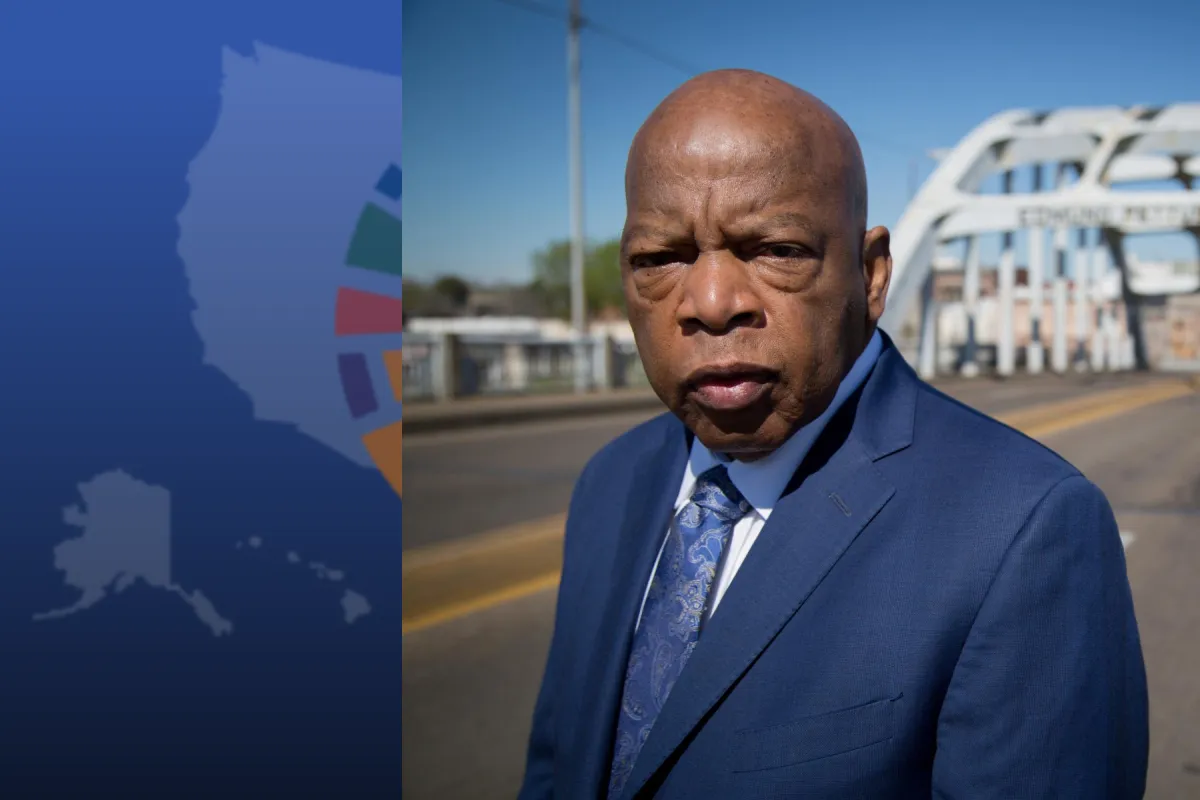
We Need Good Trouble Now: Celebrating the Life and Legacy of John Lewis


This weekend, July 17-19th, people across this country are carrying on the legacy of the late civil rights icon and Congressman John Lewis, who famously called the work of justice “making good trouble.” It’s the “Good Trouble Lives On” Weekend of Action, and historian David Greenberg, author of the authoritative biography John Lewis: A Life, joins host Rev. Paul Brandeis Raushenbush on The State of Belief.
Challenges that Rep. Lewis faced as a civil rights activist are reemerging like never before - and the lessons of his activism can help guide us forward today.
On Thursday, July 16th, Senator Alex Padilla, along with the coalition Faithful Democracy, convened an interfaith roundtable discussion on protecting elections and voting rights to commemorate the legacy of Congressman John Lewis, six years after his passing.
We start the show with just a few minutes from this historic event, which brought together diverse leaders and a total of ten sitting members of the US Senate.
More about David Greenberg:
Dr. David Greenberg is a historian, author, and journalist who focuses on U.S. political history, the presidency, media, and public opinion. He is a professor of history, and journalism and media studies at Rutgers University, and among his books is a comprehensive biography of the late congressman and civil rights icon, John Lewis.
The State of Belief host Rev. Paul Brandeis Raushenbush is President and CEO of Interfaith Alliance.
Transcript
REV. PAUL BRANDEIS RAUSHENBUSH, HOST:
Dr. David Greenberg is a historian, author, and journalist who focuses on U.S. political history, the presidency, media, and public opinion. He is a professor of history, and journalism and media studies at Rutgers University and among his books is a comprehensive biography of the late congressman and civil rights icon, John Lewis.
As we mark the sixth anniversary of Rep. Lewis's passing at the age of 80, he's being remembered with a nationwide Good Trouble Lives On Weekend of Action. And I'm happy to get the insights of a scholar who closely studied Lewis's work and his impact.
So, Dr. Greenberg, welcome to the State of Belief!
DAVID GREENBERG:
Good to be with you. Thanks for having me. And you know, it it's exciting that this Good Trouble Weekend, Day of Action has lived on after Congressman Lewis's death. You know, it's not something that he himself planned or envisioned and it sort of spontaneously arose as a way of commemorating his commitment to making our country a better place.
PAUL RAUSHENBUSH:
Isn't that wonderful? He's one of those people who, like, the longer you stay with him and the more you kind of learn about his life, is the more you're inspired. And I just thought your biography was so inspired. I felt like I was a better person after I had read it - because of your wonderful prose, but also just because I had been close to someone whose life and work I had admired, not abstractly, I knew something and I had a chance to interview him myself, but the more I learned, the more I was like, wow.
What drew you to Rep. or Rev. John Lewis? When you're a biographer or an author or a journalist, you're looking for subject. What drew you to John Lewis?
DAVID GREENBERG:
And he an ordained minister as a teenager, actually, although he never really used the the “Reverend” title and didn't really practice other than officiating weddings and occasionally leading a prayer or prayer service here and there. But he was someone who, by the time I set out writing this book in the late two thousand teens, clearly was, had become an icon already. And yet I saw somewhat to my surprise there was no biography of him.
Obviously, as a young man standing up to the state troopers at Selma and on the Freedom Rides, other moments, he did become a a national figure. But for many years he was somewhat out of the limelight and then he was a congressman - but you know, only in the last decade or so of his life did he really kind of ascend to that status, I think particularly as one of the last surviving members of a truly heroic and history-making generation.
I also thought some of the ideals that he devoted his life to - in particular interracial cooperation, having a movement based on a kind of universalism of race so that we weren't going to be pitted against one another, and in particular nonviolence, which obviously a lot of people still admire, but maybe has not enjoyed the same kind of sort of mass commitment as it did, say, in the sixties. I thought these were ideals worth discussing and showing that they stayed alive in the person of John Lewis.
PAUL RAUSHENBUSH:
Yeah, I love that. So let's get into John Lewis's life, because this is someone who, if you looked from afar, you would say unlikely – unlikely, in part, not because of any personality or anything like that, but unlikely because of his way that the family into which he was born, which was a good family, but also very poor, very poor. And I think he was the first person in his family to go to college. He was an unlikely person to leave that, and he really did leave it and go to college. So talk to us a little bit about his background. Who were his people?
DAVID GREENBERG:
Yeah, it really is a an amazing story. He's born in 1940, one of ten siblings, most of them younger, to Willie Mae and Eddie Lewis, who are farmers. They’re sometimes described as sharecroppers, but they managed, by the time he was born, to scrape together - or soon after he was born - a small, well, a hundred acres, a piece of land with a kind of ramshackle house. It was still very hard work tending the farm because they were constantly, as many farmers were, in debt for seed and tractors or supplies.
But it was also, of course, Jim Crow Alabama. So African Americans were sort of at the bottom of a hierarchy, and all kinds of rights and privileges were just off limits to them. And for him to ascend from this very hard-working religious family, the church was very important to them. And it was a large extended family, so there were sort of cousins and other family members throughout the county that they would get together at holidays and family reunions.
So there was a lot that sustained the family, despite the poverty, despite the racial segregation. And yet somehow, the impetus to transcend that, to make a better life for himself, for his family, for his people, for America, was something that was really quite unusual. Came from deep within.
PAUL RAUSHENBUSH:
It really did feel like almost like, touched by the spirit, because he started to read a lot. It was clear that he was gifted in many ways. And they got money to send him to college. He went away to college, you know, I mean, quite terrifying, I can imagine, for someone who really has only seen a segment of the life - although he had cousins up in Buffalo, which gave him a little bit of a broader view.
But then he went to a school, I guess it was called American Baptist Seminary or something like that. It was to train black ministers. And then he gets introduced to some really important ideas there, and some really important people. That's also the history here, that there's all of these strains of thought, amazing strains of thought come together in this moment when they needed to come together. Who are some of the people he met there and what were some of the strains of of thought, ideas, practice that he got exposed to in a very important formative moment?
DAVID GREENBERG:
That's really putting it well. I mean, it's amazing. This was a a tiny little seminary, American Baptist in Nashville. And he comes already knowing the work and having listened to sermons of Martin Luther King, and he's a reader of the newspaper, so he knows about King and the Civil Rights Movement. And so there's a bit of a split in the student body between those kids who just want to go back to their hometown and be a preacher and lead a congregation and those who are interested in the fight against segregation and in the social gospel.
And some of the ministers who are close to King were actually there in Nashville. For example, Kelly Miller Smith, a very important leader in Nashville, head of the local NAACP chapter, and also part of King's Southern Christian Leadership Conference. He's a professor at American Baptist. He teaches John Lewis homiletics. He encourages John to come to his church services on Sundays in town at the First Baptist church - First Baptist, I think it was called, “Colored Church” or or something like that. So he's, soon into his college experience, drawn into that world.
C.T. Vivian, who's another name people will know, is a former student now, kind of like a TA at the school. Then there are fellow students, Bernard Lafayette, James Beville, some who are maybe lesser known, Joe Carter, and a number of others who John Lewis is really the first to be drawn to this group of ministers, but some of his friends hear him and hear his enthusiasm and they join in with him. And you know, many of these young men go on to be the leaders of their generation in the Civil Rights Movement. It's really quite remarkable.
PAUL RAUSHENBUSH:
Yeah, it's a small place. But a little point of familial pride, the name Rauschenbusch comes up a lot in the broader Social Gospel, Rauschenbusch was part of the Social Gospel; but there was also a really important Black Social Gospel movement that maybe is less well-understood - although there was a professor, Dorian, at Union, he said, it's the most important religious movement in American history because it really took the ideals of the Social Gospel, but also then applied it directly to the liberation of Black Americans. So, he also comes into contact with the important and transformative and I think kind of life-changing or informing idea of nonviolence.
DAVID GREENBERG:
That's that's exactly right.
PAUL RAUSHENBUSH:
The soul force that's Gandhian, but also has now expanded beyond Gandhi and many people. And for him, there's a moment, interesting, later on when you talk about, for some people, nonviolence was a tactic. For Lewis, it was a way of life. That feels really informative. Right now, as we're thinking about, how do we respond to our moment, there is the tactic of nonviolence, but then there's also the spiritual discipline and kind of philosophical and religious belief in the power, almost transcendent power, of nonviolence on humankind.
DAVID GREENBERG:
Well that's exactly right. And through Dr. King at a remove, but also Kelly Miller Smith and also I should mention James Lawson who was a divinity student at the time at Vanderbilt, but a close ally of Smith and others in this Nashville group, that was really devoted to these ideals that King… King, of course, was the one who sort of popularized them in the Black Civil Rights Movement.
You know, Lawson had been to India and studied Gandhian nonviolence. There he was really a direct contemporary, I think the exact same age as Martin Luther King. And when the two of them first met at Oberlin, where Lawson was studying, Lawson told King of his plans. He thought he was going to go to Yale, maybe, and get a doctor of divinity, and King said, No, you've got to come to the south. There was this feeling that the movement maybe had stalled a little bit after the Montgomery bus boycott and they were really looking for new new sites, new places of direct action.
But as you say, the key was not just treating this as a tactic - although, you know, it should be said, for many of these very sort of brave and accomplished men and women in the movement, they didn't quite have that deep devotion that King and Lewis did. And Lewis - friends said, King said this, others elders said this about him - there was something about him that latched on to this right away. James Lawson, who I had the privilege of interviewing, he passed away himself a couple of years ago, he said when John Lewis arrived at American Baptist, he was ripe for these teachings. That there was something in him that was already responsive.
And what it meant was not only not fighting back so that the media gives you sympathetic coverage and that sort of helps with the cause. That's of course important. But you know, for John Lewis, it was really about, even, loving your enemy and understanding your enemy as one of God's creatures, as the victim. Even the oppressors he saw as victims of an oppressive system. And so you had to find the kind of love in your heart for them - and the idea that eventually this kind of breaks through. Eventually this sort of will help them see the error of their ways.
PAUL RAUSHENBUSH:
A lot of people immediately jump to Selma. I just think it's important to stay in Nashville with the sit-ins, which John Lewis actually was a leader in and kind of cut his teeth. You know, one of the things that I hear that drives me a little crazy is people are like, well, there's nothing I can do. I'm like, there is always something to do. And if the whole world was made up of people who said, well, there's nothing I can do - we would not have John Lewis. John Lewis was part of a moment, but he also decided to step into that moment and said, actually, there is something that I'm going to do and it's going to be hard, but I'm going to do it.
Talk a little bit about what happened in Nashville, which was where he went to school, but also where there was just severe racial segregation and denigration.
DAVID GREENBERG:
Right. So in 1959, the ministers who are leading this civil rights group decide it's time to mount a desegregation campaign against the stores, the five and dimes, the lunch counters in downtown Nashville, and the students who have been attending, first, Lawson's lectures and then they start doing workshops, sort of trainings in how to practice nonviolence: you don't hit back, what happens if you're called racial slurs, if people spit on you, and training people to discipline themselves. So they plan for a series of actions that will put these stores to the test.
Now it so happens there is, in Greensboro, North Carolina, another group that gets there first, as it were, that sort of in February of 1960 does their own citizens at a Woolworth’s in a famous story there. But at that point, Lewis and his group hear about this and they're, okay, we were about to do this. So they are ready to jump in. And it sort of spreads like wildfire around the South.
Other college towns, other groups of mostly Black - but many cases, like Nashville, they're integrated groups, Black and White together, start doing these sit-ins. The Nashville one is the biggest. It's also the most integrated, which I think is interesting, and it's the most successful that by that spring they have reached a deal with the city and with the store owners to desegregate the Woolworth’s and the McClellan’s and this whole group of stores that had been such a problem.
It gets national attention. King comes to town, sort of praises the national movement. And John Lewis - as well as his friends, but he really was one of the few who was a leader of the group. They like to have a kind of radically democratic organization where they said there were no leaders. But the truth is you always need leaders, and he he was a leader of the group. He was the one who was kind of the most earnest, the most intent, the most capable of of saying to people like, I know we got beat up and jailed last time, but it's time to go again this week. He was just relentless. And he starts earning attention in the movement, and very soon nationally, for this courage.
PAUL RAUSHENBUSH:
It's really interesting. I want to lift up a name that was new to me and I need you to remind me of it. But there was a woman, Diane Nash…
DAVID GREENBERG:
Yeah. Diane Nash.
PAUL RAUSHENBUSH:
That was a new name for me. And one of the things that a lot of people are doing now is reminding people of the women of the movement, which were a huge part of the movement that definitely did not get the kind of attention that they deserved. But she was one of the main organizers. Can you say a few words about Diane Nash?
DAVID GREENBERG:
She had a slightly different background from some of the students there. She was from a Catholic background, from Chicago, had come to Nashville to go to Fisk University, an HBCU as we now call it, and was completely shocked to see the segregation. Remember, she's from Chicago, so obviously there's racism in Chicago. But it's a totally different animal from the South.
I think this is one thing I discovered in the research. Historians sometimes have been - I think in recent years to the good - trying to call our attention to racism pervaded the North as well as the South. But we sort of forget they were very different worlds. And so Nash is really the one who becomes, of the students, the sort of administrative whiz and sort of the helmsperson of organizing the students.
PAUL RAUSHENBUSH:
Yeah, really the organizer. She understood, actually, there needs to be structure, and probably was a major part of that. And I just wanted to make sure that we lift it up, because that was a new name to me, and it's probably a new name to a lot of the listeners.
One of the great things about the fact that he's getting this kind of treatment now is that he and King were not the same people, but he had a life that - you know, because of the horrific and tragic assassination of King, we don't know what he would have become. But John Lewis managed to eventually go into Congress. But talk to us a little bit about the trajectory of his activism after Nashville.
DAVID GREENBERG:
Right. And we'll touch on the political career, too, but yes, for now the years from say ’60 to ’65, ’66, this is really the heyday of the movement. It's when we see the historic passage of the Civil Rights Act and the Voting Rights Act, as well as other historic legislation, historic Supreme Court decisions. It's really a transformative time. And again, John Lewis comes to American Baptist at age 18, kind of gets involved in the movement, eighteen, nineteen years old, and within such a short time becomes a leader.
One key is the formation of a group called SNIC, as it was nicknamed, Student Nonviolent Coordinating Committee, which originally was just a coordinating committee. You had students in Atlanta, you had students in Washington DC, you had them in Nashville. So it was just a way to kind of keep track of what each other was doing. But it soon becomes a full-fledged group of its own under the wing of Martin Luther King's Southern Christian Leadership Conference, although differences emerge, generational and tactical.
Lewis remains incredibly close to King and devoted to King. Of the people in SNCC, he wants to carry the banner of nonviolence, not deviate from it. He becomes a key player. I'll just kind of run through them quickly. The Freedom Rides to desegregate interstate bus travel in the South in 1961. He's a major figure at the March on Washington, the youngest speaker there. You should go watch his speech there on YouTube and see a young John Lewis speaking to 250,000 people.
PAUL RAUSHENBUSH:
That's a great, actually, way to observe Good Trouble Lives On is to - and again, the tenor of his speech was maybe a little bit different. You know, he had some other ideas that he was inserting into the March on Washington…
DAVID GREENBERG:
Yeah, there's a very dramatic story that I have kind of reconstructed in full for the first time about the negotiations between the older leaders like Roy Wilkins of the NAACP and A. Philip Randolph, and then the younger folk at SNIC, led by Lewis, who want to put in some more militant radical stuff the older folks don't want to undermine the unity behind passing the Civil Rights Act.
PAUL RAUSHENBUSH:
Right. But what were some of the more radical things? I mean, maybe they don't sound radical today, what were some of the demands that Lewis wanted to have in there?
DAVID GREENBERG:
Well, for one thing, some of the rhetoric is just much more uncompromising. So it starts off saying we cannot support the Kennedy Civil Rights Bill. In the end, he softens us to saying we support it with reservations and sort of enumerates some of the things that are not in there, that there's not enough about containing police violence, actually, as an interesting issue. That one doesn't get addressed until the Bill Clinton years as president.
There's just a deeper kind of you might say systemic critique of racism in American society. And yeah, it's a point of tension and they're they're back there at the Lincoln Memorial huddled underneath the colossal statue negotiating over words; and John Lewis, who's never spoken to a crowd of this size in his life, he has the earlier draft which he practiced within an inch of his life. And one friend of his who was there says, I just remember John, as everyone was rewriting the speech, saying, don't change too much, you know, because he was sort of a halting speaker, he had that little bit of a speech impediment and a thick Alabama rural accent. So he was nervous. He was going to have the glover of a speech he'd never seen before. But as you could see, he pulls it off.
PAUL RAUSHENBUSH:
That's amazing. That's great background. That's biography right there. That really brings to light… You're seeing someone give a speech, but you don't know what just happened behind the scenes - literally behind the scenes.
I want to turn, just for a moment, and then we're going to keep going with all of his activism, especially I want to hear your thoughts about Selma. But he also found the love of his life. And that's an important part for him - because he wasn't a player, let's put it that way. There were some, I loved the depiction of some of the fellows at American Baptist, like “Beville, the devil” - but he was not that. But he did find the love of his life. Talk about his wife.
DAVID GREENBERG:
Right. So, just to finish the point before. I you see through the 60’s as he emerges as SNCC Chairman and then Selma, a story I think that people will probably know the outlines of. He emerges as this major figure. There then is a big split in ‘66. We've passed the Civil Rights Act, we've passed the Voting Rights Act, and the movement - not just SNCC - but is at a crossroads of where does it go? And it takes a turn under Stokely Carmichael's leadership toward Black power, toward more separatism, kind of ending the commitment to the interracial alliance, and ending the commitment to nonviolence.
And so Lewis leaves SNCC at this point, and he's a little bit in the wilderness. And by 1968 he's back in Atlanta, which is where SNCC was headquartered, so he's been living there starting in ‘63. He's twenty eight years old, he's not had serious romantic relationships, he's been so invested in the movement. And he set up with a woman named Lillian Miles, who's from Los Angeles and is a librarian and really takes a shine to John Lewis. And he has been working in ‘68 on the Robert F. Kennedy presidential campaign.
And of course, ‘68 is a very tragic year. Lewis is with RFK the night that Martin King is assassinated. And then two months later he's in the Ambassador Hotel when Robert F. Kennedy is assassinated. And so two heroes, two people who he really thought were going to be in the forefront of continuing to lead the country toward a better place, are in such a short time killed. And he's really quite depressed. He checks into the hospital, actually, for depression or exhaustion. he's just in a bad place. And it's Lillian who comes to visit him each day, brings him his mail, brings him his newspaper. He's always a reader, a reader of the news.
And very unromantically, he proposes to her from the hospital bed. And they're married that winter. Daddy King, Martin Luther King's father, performs the wedding. And then for decades together in Atlanta, they have this very important partnership. And as we know in many relationships, there's often a woman or a spouse or a partner kind of behind the public figure. And she was an important part of his political campaigns.
They raised a son, John Miles together, whom was adopted in 1976, I think it was, and really a very important and treasured person in in John Lewis's life.
PAUL RAUSHENBUSH:
I love that you call it a partnership, because I do feel that it's really transformative. There are moments where you can kind of do it all, and then you're not sure that you can do it all alone. And I think it's a real testimony to that part of a person and that we often can forget that.
Now, let's talk about John Lewis's decision to run for office, because he's largely been… Although the campaign, so he's aware of that, but he also has been an activist and someone who has tried to change laws in a certain way, deciding to be part of the lawmakers is a shift. What went into that decision?
DAVID GREENBERG:
Well, it goes back to another important mentor of John Lewis, Bayard Rustin, who was a key aide to A. Philip Randolph, also to King. And Rustin writes an article in the mid-sixties called From Protest to Politics, where he argues that the same coalition that brought us the March on Washington and the passage of the Civil Rights Act needs to sort of get behind the political movement now: Now that Blacks can vote and run for office in the South and elsewhere, bring African Americans from the movement into elective office.
And some people were already doing this. John's friend Julian Bond had run for state legislature in Georgia in a very controversial story. And Lewis at first kind of hangs back. He he does other important work at a voter education project, which is basically getting Blacks to go ahead and register and vote now that the legal obstacles have been removed. But by 1976, ’77, Andrew Young, another important figure, a key lieutenant to King, who had been the first Black congressman from Atlanta, he goes into the Carter administration as UN ambassador. So there's a race for his seat.
Lewis decides to take the plunge. He he doesn't win but comes in a credible second. And from then on, he's thinking about running. Serves on city council in Atlanta. And the big race comes in 1986. And it's a very dramatic story I tell in full in the book, because he runs against his best friend, Julian Bond. They'd come up together in the movement. Bond had been sort of a mentor in some ways to him, a guy who came from what's often described as Black royalty. His father was a famous educator. He met people like Paul Robeson and Albert Einstein when he was a boy. Bond was dashingly handsome, silver-tongued. Everybody thought he was going to win.
But John Lewis, with his kind of gritty, authentic, deep and sincere manner, ends up winning that race. And again, there's some dirty campaigning or negative campaigning, there's a a lot of tension, the fracturing of a friendship, quite tragically, that gets slightly repaired later in life, but but never entirely.
PAUL RAUSHENBUSH:
Well, in movements or in politics, a lot happens and it's hard to maintain a perfect angelic... But one of the questions that I had is, what is it like for Lewis to actually be a lawmaker?
PAUL RAUSHENBUSH:
How does he bring his faith, his commitment to good trouble, nonviolence - how does he approach being in Congress?
DAVID GREENBERG:
That a great question because it's really one of the themes of the book, that John Lewis realizes early on that he's not going to be just a kind of routine lawmaker. And sometimes I interviewed people who said things, you know, he wasn't much of a lawmaker, almost a little bit dismissively. But other people, I think of the late Barney Frank, who was actually my hometown congressman growing up, from outside the Boston area, he said, you know, I had a lot of colleagues who could be legislators. John was something more important, which was having a moral hero for our time in the United States Congress.
And what Lewis figured out how to do was how to leverage his knowledge of tactics from the movement, and even his reputation to, you know, a Congressman would know if you could get John Lewis to sign on to a bill, that was going to count for a lot. And he knew how to kind of deploy his moral authority strategically at the right time; when to s speak out. Once behind the scenes to President George Bush, Sr., who had just vetoed a Civil Rights Bill of 1990 or ’91 and John Lewis tells him to his face at the White House why this is wrong; and it's partly why Bush comes around and signs the bill the next time around. Publicly, privately, he brings that experience from the movement into politics - just as as an activist, he had developed a political sense, whether it's negotiating over the speech of the March on Washington or in other instances to bring a political sense into the movement.
PAUL RAUSHENBUSH:
Almost like the moral conscience of Congress, in a way. Of course, you know, reviled by by by some. But for many, almost transcending that.
DAVID GREENBERG:
By some; but it was also remarkable how many Republicans, even people like Newt Gingrich, who he fought with all the time, had this deep respect for him - and even affection. He would lead these annual pilgrimages to Selma every year with congressional colleagues and he always took special care to make sure the Republicans - because there weren't as many who would go - that the Republicans who came along got to be at the front of the parade and were attended to and had a meaningful experience, and he did earn the respect of of a lot of his political adversaries.
PAUL RAUSHENBUSH:
Well, you know, one of the things that we have is a big bus tour coming up in anticipation of the midterms, and we're calling all of, actually, our election work The Vote is Sacred, which is rooted in this idea of the vote is almost sacred.
The reason we're talking about him now and the reason he feels so important right now is that we are in a moment, we're taping this the day after Donald Trump gave a speech in which it's very clear he's laying the groundwork for denying the election results, for sowing distrust in our elections. It's nefarious and it's an attack on our democracy. And so, almost, Lewis speaks with a voice right now about what it means to promote the idea of the vote, how to organize to ensure the vote is able to happen and to really double down.
We had a back and forth about his first public speech, which was democracy as a reality. And I spoke about that yesterday with 10 senators there, just talking about what it means to have John Lewis's first speech talk about democracy and how important it means it is for us to really recognize the crisis we're in. How do you understand this moment vis-a-vis your deep appreciation and understanding of Lewis?
DAVID GREENBERG:
Well this really kind of goes to the heart of what Lewis fought for both as a young man, as an activist, and then as a member of Congress. And it's interesting because initially in the movement there was sort of this rift: Do we continue with direct action against segregation, which was obviously important, or do we embrace sort of trying to achieve voting rights? And there are people who thought we had to do one or the other because we didn't have the people power to do it all. Lewis is at first on the direct action side, but he becomes a convert, and then of course his life is associated probably with, if you pick one cause, voting rights.
And that's what the Selma March is all about. That's what this career before Congress as a voter education project is all about. And as a congressman, he's involved in every renewal of the Voting Rights Act. It's a law that, unfortunately, is always set to expire, so it always has to be renewed. I mean, now it's been done on twenty-five year intervals instead of five or ten. And toward the end of his life, the vote, as you say, being sacred, being the most important tool of social change we have in a democracy, he would say was really the thing he fought for most.
And, you know, when he would go around giving these talks, whether on behalf of colleagues who were running for office or just to citizens' groups or even doing a book talk, it was always about how important it was that each and every one of us vote and get others to vote. Because that is our voice as citizens and that is how we exert meaningful control over our leaders, even those who seem intent on on defying it.
PAUL RAUSHENBUSH:
I appreciate so much what goes into a biography, how much research, but my guess is, is that this actually, in the end, was a blessing for you as a person and as an American to spend this much time with John Lewis.
One of the things that we're talking about a lot on this show is courage in this moment. And I wonder if you have any thoughts about John Lewis and the practice of courage in this moment.
DAVID GREENBERG:
For me, writing this book - you said it about reading it is inspiring - writing it was not only a labor of love and felt like a privilege to write his life, but was inspiring and made me want to be a better person. It just had that effect. You spend every day with him. But you also realize how hard it can be to sort of summon the courage, just like he did it: not hitting back when he would get beaten up, or taking the high road and finding it within himself to forgive others, George Wallace or the state troopers, the Klansmen who were violent toward him. He found this genuine forgiveness within himself.
And I think, obviously, there are systemic and structural factors that shape our ability to protest, to fight, to become activated. But there's also kind of something within each of us that I think we need to sort of struggle and seek to achieve. And I think in some ways having people like John Lewis out there, if we know his life, if we know the story of the movement, if we know the importance of moving from protest to politics and not disdaining politics as dirty or as a sphere that's beneath us, but a legitimate sphere, an important sphere. If you believe in democracy, you have to believe in politics. Having someone like that out there as a model whose life we can read about and study and draw inspiration from, I think is a way that each of us can find some courage within ourselves.
PAUL RAUSHENBUSH:
The John Lewis Good Trouble Lives On Weekend of Action continues through Sunday, July 19th. You can find events near you at the website goodtroubleliveson.org. I will say, good trouble lives on every day of the year in our hearts. And so please be inspired by not just only this weekend, but every day. And it's really important that we not only represent the late great John Lewis, but our own communities and our own beliefs, and get out there and be part of good trouble and protecting and expanding our democracy.
In addition to John Lewis: A Life, Prof. David Greenberg is the author of Republic of Spin and Nixon's Shadow.
David, thank you so much for joining us today on The State of Belief!
DAVID GREENBERG:
Thank you, Paul. I enjoyed talking with you and hoping our listeners are drawn to the life of John Lewis, which I think will continue to inspire them and all of us.