State of Belief
How Christians Can Defend Democracy Against Christian Nationalism


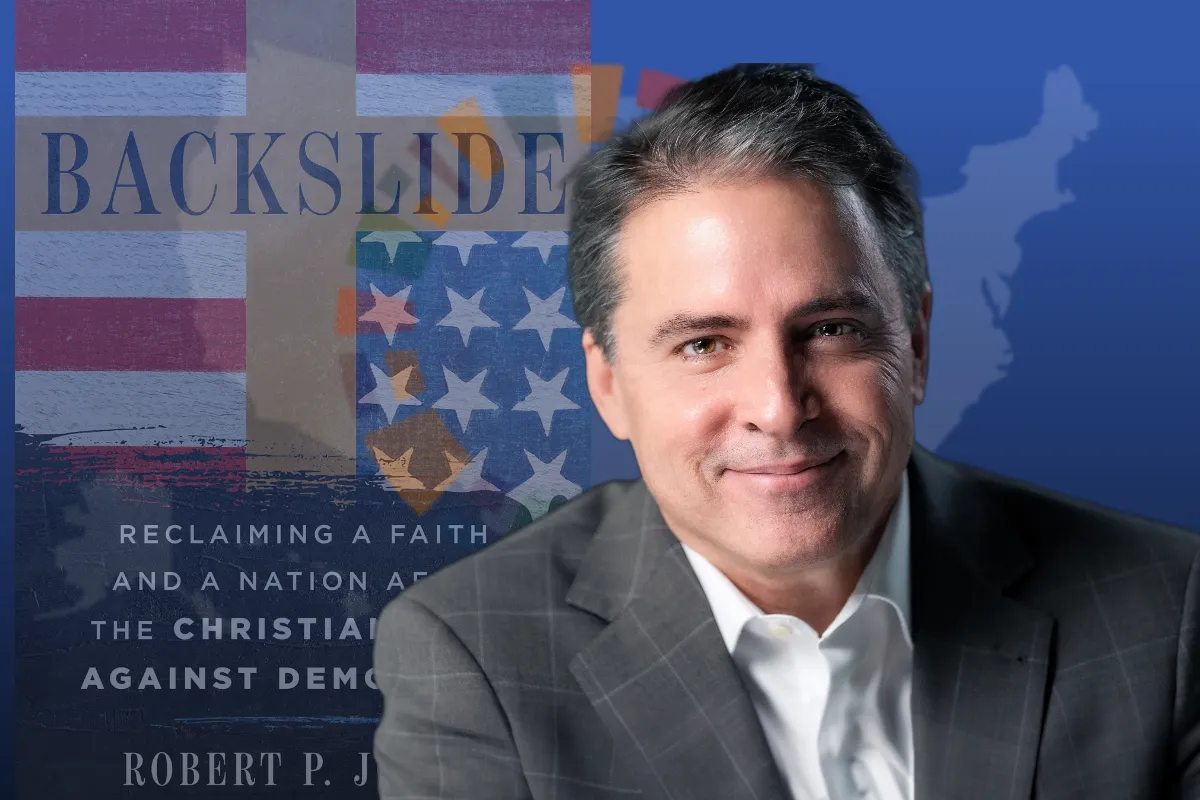
“It is as bad as you think it is - and probably worse.” Those chilling words from Dr. Robert P. Jones, Rev. Paul Brandeis Raushenbush’s guest this week, mirror the gravity of the title of his new book: Backslide: Reclaiming a Faith and a Nation After the Christian Turn Against Democracy. A historian and sociologist, Robby credibly traces the parallels between 2026 American democracy and 1933 Germany, in particular highlighting the reluctance of the Church to meaningfully engage with the flood of authoritarianism in the country at the time. The crisis of faith and the crisis of democracy Robby sees in the United States today have parallel origins – but also will both benefit from similar prescriptions, which he shares in detail in his book – and in this interview.
Dr. Robert P. Jones is founder and president of the Public Religion Research Institute. His best-selling books include The End of White Christian America; White Too Long: The Legacy of White Supremacy in American Christianity, and The Hidden Roots of White Supremacy and the Path to a Shared American Future. Robby's brand new book is titled Backslide: Reclaiming a Faith and a Nation after the Christian Turn Against Democracy, and his Substack is Redeeming Democracy.
The State of Belief host Rev. Paul Brandeis Raushenbush is President and CEO of Interfaith Alliance.
Here's Robby's article mentioned in the interview: What White Christians Have Wrought
Transcript
REV. PAUL BRANDEIS RAUSHENBUSH, HOST:
Backslide: Reclaiming a Faith and a Nation After the Christian Turn Against Democracy. Strong words for a book title, but they come from a leading authority on American values, beliefs, and politics.
Dr. Robert P. Jones is founder and president of the Public Religion Research Institute and the best-selling author of several essential books on democracy, on Christian Nationalism, on religion, and on race. In this new book, which comes out on September 8th, Robby doesn't sugarcoat the profound spiritual and moral backslide he sees as consuming a big part of our culture.
Ironically, an extreme departure from Christian values is cloaked in the rhetoric of a nation founded by Christians for Christians. So Robby is uniquely talented at unraveling this kind of complex sociology that this moment demands, and also at bringing hope to the table in the form of actions and strategies to reverse this backslide.
So Robby - we're all counting on you. Welcome back to The State of Belief!
ROBBY JONES:
Oh, man. Well, thanks. I'm glad to be back.
PAUL RAUSHENBUSH:
With that windup! I think it's helpful for some folks who maybe don't come from a tradition for who the word “backslide” is actually very loaded. And it has a kind of a deep and threatening spiritual implication. Can you talk a little bit about what backsliding means in the Christian context so that perhaps our listeners who might not be so familiar with it will understand the resonance of that title of your new book?
ROBBY JONES:
Well, I grew up with this word all around me. I've been on the show before, many of your listeners may know, but I'll remind you, I grew up in the deep south, in a Southern Baptist church, so inside that White evangelical southern world. And you know, I spent quite a bit of time, actually, thinking about what it meant to backslide. And it was usually applied to salvation: so were you going to lose your salvation? Did you really mean it when you dedicated your life to Christ? The the warnings were just constant, particularly, I think, in my teen years.
Because what happened in the Baptist world is that we don't do infant baptism, so you do believers baptism, which is around the time Confirmation usually happens. But in this world it actually had happened much earlier. So I was baptized when I was six, and so when I got to be a teenager, the questions of like, well, how much did I really understand about what I was doing back then? And particularly when, let's say, I was not living my best moral self life, you know, and I was thinking, does this mean that I made these mistakes, that I made these terrible decisions? Does it mean that I never was saved?
And this whole idea of falling away from the faith and backsliding, Bible study after Bible study warning about the dangers of this. So that's the kind of context in which I grew up. You may have missed some of this, not being in the southern Baptist world.
PAUL RAUSHENBUSH:
I missed that, you know, because I'm from like a pinko commie mainline tradition that we were born backslidden. But no, it really is the constant threat. It's kind of the worst thing, but I'm very curious how you mean it in this book. Because this book really has a wind up. I mean that title, I was like, whoo, Christians turning against democracy. I think I know what you mean, but in that way, actually, it kind of reclaims the idea of backsliding. What does it mean when we turn against something that is so fundamental to our country? So can you just explain why backsliding or backslide was such a good word for you to use in this title of your new book?
ROBBY JONES:
Well, like I said, it was a word very familiar to me growing up and one that invoked a little bit of terror, as that description might have indicated. But here's the thing. If you go and Google “backslide” today, depending on the algorithm and your search history, you'll just as likely find political stories, now; it's not just a theology word. It's being used a lot in political science today.
So, you know, in my day job, I'm the founder and president of Public Religion Research Institute. So we spend a lot of time reading political science and social science literature, and I've been really struck that this word has made its way into the political science literature to talk about - and the term is “democratic backsliding” that you'll hear in in politics, right? And it's been used to describe the way in which formerly established democracies have been kind of pushed off their moorings and are literally sliding toward authoritarianism.
So we've seen it used across Europe, we've seen it used for Bolsonaro, other places, but increasingly in the US - particularly with Trump's second term, we've been seeing this term used quite a lot. So I thought given this history and the fact that in the US, this group of White Christians who, if you ask the question, well, who's responsible for Trump being in office in the first place? You know, it is White Christians in this country that have put him into office.
I think we talked about this after the last election, but you know, the only kind of public post-mortem piece I wrote after the 2024 election was a piece called What White Christians Have Wrought, because all the pundits like, oh, Latinos moved, you know, this many points in his direction; and he made some inroads among African Americans. And I was like, Yeah, but that's not the story. You know, the only way he's in office anytime is that more than eight, like 85% of White evangelicals voted for him. But here's what everybody forgets: six in ten White non-evangelical Protestants voted for him. That's the mainline. And six in ten White Catholics voted for him.
So all in all, if you take White Christians, White Christians - about two-thirds, that is a margin of two to one - have voted for Trump every time he's been on the ballot. You might say, okay, in 2016, that first election, you might say, okay, people are just gonna roll the dice and maybe they're ready for a change. But by the time we get to 2024, White Christians know exactly what they're voting for. And they still voted for the guy who essentially advertised throughout his last campaign that he was going to subvert democracy. And yet White Christians lined up and voted for him in essentially the same number.
So that's where the “after the Christian turn against democracy” part of the title comes from, from just looking at this White Christian abandonment, I would say, of democratic principles and the core principles of love and empathy and neighbor and all those things out of our faith.
PAUL RAUSHENBUSH:
I think this is such an important book and I think it's going to be really important for the midterms, but I don't want to get there yet. I want to actually go backward,s because I think one of the things it's always a good idea to do in conversations like this is say, like, okay, this just wasn't invented in 2016. You have traced it beautifully in your books, actually. Book after book, and in different ways coming at it differently. But you've also recognized that kind of the White Christian legacy, they like to say it's a Christian nation, it's a Christian nation. And then you're like, well, okay, so what have you really done to be proud of, as Christians? And who are we talking about as far as the Christianity that we're talking about?
Give us the very brief version of how you go back, because we still are in our 250th year and the question of identity and the question of who we are and the role of religion in that... And how some people, I think, again, specifically White Christians, want to claim a role that doesn't include everyone, but also, what are they really claiming?
ROBBY JONES:
Well, I think from before the founding of the country there has been a great temptation - and moving into the early days of the country - this tension and temptation, I think, to give lip service to democracy while we are claiming a very hierarchical, exclusive country for White Christian people. And so the the question is, do we really mean these words that we say around religious liberty, for all the non-establishment of religion in the country, that there's no religious tests for office, all these things that are actually embedded in the Constitution? Or is that just kind of lip service and kind of noble-sounding words, and we really are about establishing and holding up a White Christian country? I think this has been the unanswered question through centuries, more than 250 years of our country.
So one way of understanding the previous books I've written has really been, you know, I'm an academic. And so when I'm angry, when I'm confused, when I'm trying to make sense of things, when I'm like, how can this be happening? I turn to the tools that I have. So I turn to research to try to make sense of it.
And so one of the ways that kind of understanding the last three books has really been, I started in the present, with this book called The End of White Christian America that was about the present demographic changes in the country.
Then I wrote a book called White Too Long: The Legacy of White Supremacy in American Christianity, which went back to my own family's history through Civil War, 19th century world showing how my family's embeddedness in the Confederacy, for example, was kind of part of abandoning this quest for a liberal democracy and trying to, again, establish a White Christian state where people could follow Jesus and own other human beings - and not see any contradiction between that.
And then the the last book was me saying, well, what happens if I go back? How far does this go? So I wrote a book called The Hidden Roots of White Supremacy, where I went back to the 15th century, so the late 1400s, and kind of the beginning is Columbus and the beginnings of the colonial period, and that these questions that we're struggling over have their roots in this Doctrine of Discovery and this idea that these lands were designated by God to be for the use of European Christians, and everybody else is sort of second class. And we still haven't gotten over that hubris and that claim.
I mean, if you kind of take a step back and think about it, right, that the God of the universe has decided that this plot of land on this planet is designated for this group of ethnic people who claim this particular religion. I mean, it's an astoundingly arrogant claim to make if you really take your theology even remotely seriously.
PAUL RAUSHENBUSH:
Yeah. It's so good. I mean, when you put it that way, it's very idolatrous and crazy-sounding.
ROBBY JONES:
And self-serving! Oh my goodness…
PAUL RAUSHENBUSH:
Immensely self-serving!
I think this is a helpful backdrop, kind of a wind-up to where we are today. But this book feels like you're really speaking into this moment, and you recognize we are in a current moment, really, of crisis. Can you talk a little bit about how you understand the current moment around Christians and democracy that will be helpful for us to really understand the dynamics at play?
ROBBY JONES:
I mean one way of measuring this is - I should do this just for fun, but what I would say is, if you look at the ratio of text to percentage signs or text to charts in books I've written, this one has fewer percentage signs and charts in it. And I think it's because the moment we're in requires less analysis and more moral courage and action. And I think this book is trying to write into that moment.
So I think, look, yeah, we need some analysis. And you'll find the charts if you're a nerd. There's charts in there and there's references to things where you can quantify. Just one example: There were two big studies that track democracy in the world. One's called the Bright Line Watch Study, the other one's called Varieties of Democracy Studies. Both of these independent studies have shown that just in Trump's second term we have lost more democratic freedoms in this country than any period in American history. And that they have, essentially Trump has, taken us back sixty years in terms of our democracy. And basically that's taken us back to even the very beginnings of the Civil Rights Movement, is where he's rewound our progress.
When many - and I would count, myself included, count, really, the Voting Rights Act and the Civil Rights Act really is the beginning of modern democracy in the country. You know, we didn't have a full pluralistic democracy. We were denying African Americans their rights to vote. So he's taken us all the way back there. And so you realize how compromised our major, particularly White Christian, institutions have become either apathetic or completely compromised here. And so I am trying to kind of ring a bell in this book and say it is time. In fact, I should say I go there. In the beginning of the book, I have a chapter called The Future Regret. And I sort of start by saying, what are we going to regret either doing or, mostly, what are we going to regret not doing in this moment?
PAUL RAUSHENBUSH:
I think that's really helpful. You know, I've heard people talk about that lately. It's like, what are our children going to ask us? What the hell were you doing? Where were you? And I do think many of us have been active, but the real question is, what will we have regret not done? And I think that's a really good place to start.
It's interesting, what I hear you saying is that we're in a crisis of democracy, but we're also in a crisis of faith. For those of us who are Christian, especially those of us who are Christian and White, there is a crisis going on here, both of which are involving a kind of backsliding from the ideal of which we can imagine both faith and democracy being. So when you were thinking about this book, what was your hope that people who were going to read this book - and I suspect this will be another bestseller - would realize that maybe they hadn't put it together.
What kind of connections did you, when you were writing this book, you were like, okay, that's really important for me to point out to the American people right now?
ROBBY JONES:
Well, you know, I said I go there in this book, and one of the ways I go there is to say, we can compare this to any number of periods, but I I don't think it's an exaggeration that we can compare this period to 1930’s Germany. And I know there's been a lot of debate about whether it's an appropriate analogy to make. And look, the truth is, I'm an academic and I have been, you know, appropriately trained to be cautious about making too heavy-handed comparisons between two different historical periods, particularly across continents. All of that is true and right. However, when we have the president of the United States using language like immigrants are poisoning the blood of the country, that we have to kind of root out the vermin, that we have to kind of purge the nation of the enemy within - I mean, these are not just fascist statements. These are actually Nazi sentiments. And in the book, I actually take some of Trump's speeches and I put Mein Kampf right next to them in the book and just say, look, I'm not making this up. You literally can almost read this off the page here.
PAUL RAUSHENBUSH:
Those are fascist statements.
ROBBY JONES:
And we have to not brush this off as Trump just being Trump - or I think that's the temptation. I'm kind of trying to say, look, this is really important, and the bright lines being crossed here are real. And even though it feels like there's a new outrage every day, we can't let that numb us, I think, to the moment. And so again, it is a kind of bell-ringing, I hope, kind of book to say: It is as bad as you think it is, and probably worse.
PAUL RAUSHENBUSH:
At some point someone said in a kind of important moment: believe him. Stop pretending like he's not saying what he means. He actually is saying what he means and he's also doing what he means, and we've seen the attack on the academy, we've seen the attack on history, the attack on the Smithsonian…
ROBBY JONES:
Yeah. I mean, my book got banned, right?
PAUL RAUSHENBUSH:
Your book got banned! The attack on the press, the intimidation. All of this. These are authoritarian tactics. Can you say a little bit, just continuing the analogy of Nazi Germany or the run-up to Nazi Germany, what was the role of the Church in that, and how can we continue to make that analogy? Because I think that's important, too. We always think of ourselves as the good guys. And you know, I think of Eric Mataxis. He wrote the book on Bonhoeffer and, you know, this a very discredited book. The family of Bonhoeffer has discredited him. But he's a super Trumper. How do you put yourself on the right side of this? But they do and they don't see that, like, well, maybe we're actually contributing to something that we really shouldn't be. Talk a little bit about the the role of the Church in the run-up and the strengthening of Nazi Germany, and how they may or may not have realized what they were doing at the time.
ROBBY JONES:
I mean, I think that's the thing. You know, we read back and yeah, the name people know is Dietrich Bonhoeffer. But it is important to know that he was very much a minority voice. It was not like he had some massive following. Even people he initially had with him splintered and eventually abandoned him. He ends up himself getting killed in a concentration camp before the end of the war. It's not a great victory story of the Church standing up to injustice. And we hold him rightly up as somebody who saw it early, made clear calls to the Church to stand up. In the book I do talk about him.
But the other person that I talk about is actually another pastor here. His name is Martin Niemöler, who people probably know his little poem: First they came for the trade unionists and I did not speak up. Then they came for the Jews and I did not speak up because I was not a Jew. Then they came for me. And you know, that's on the US Holocaust Museum. It's carved in the wall there. But I hold him up, actually, as a better example of how hard it is to see what's going on around you in real time, because he came to it actually quite late. And he eventually does stand up. He eventually does himself get imprisoned.
But even in his own reflections back, he is tormented by the years that he did not stand up. And he talks about even God kind of indicting him after the fact for him not standing up. He finally gets arrested in 1937, but by his own lights he says, Yeah, but from 1933 to 1937, well, all kinds of stuff was winding up. He compromised, he rationalized, he pretended it wasn't as bad as it was. As long as it wasn't affecting the Church proper, it wasn't something a pastor should be speaking up against - all these kinds of rationalizations, until finally in ‘37 he begins to speak up and then he himself is arrested. He survives. But I think that's a much better example of kind of how hard it is to see it in real time, not rationalize it away.
And I hold him up because he looks back with regret, saying, like, I should have stood up earlier. And he has this… Can I just read a little bit here from Niemöler?
PAUL RAUSHENBUSH:
Yeah, please do. I'd love that.
ROBBY JONES:
So he talks about going back to visit Dachau after the war because he was imprisoned there for a bit, and he sees a sign posted on the outside, the crematoriums, actually, and it says how many people died here. And his wife who's with him actually collapses when she sees, like, faints from seeing the sign. And he's like, you know, when I saw the body count, that didn't affect me that much because I knew - this was not new news to me.
But the sign said: Between 1933 and 1945, this many people were killed here. He said, what got me was the 1933 to 1945. And I realized how many years, while this was going on, I was safely doing my job, pretending like things were okay. And he says, reflecting back on that, this is how he talks about that: He says, what ran through me hot and cold, that's as he's moving, looking at the sign was something else, not the body count. That was the other two numbers, 1933 to 1945. I groped for my alibi and knew that those two numbers were the wanted poster of the living God for Pastor Niemöller. My alibi reached from July 1, 1937 - when he was arrested - to mid-1945, but there stood 1933 to 1945.
And then he gives this kind of very moving kind of dialogue between him and God. Adam, where are you? Mensch, where were you? Yes, I know from ‘37 until the end you have an alibi. But here you're being asked, where were you from 1933 to 1937? And I couldn't avoid this question any longer. In 1933, I was a free man. 1933, at that moment in the crematorium yard, it occurred to me, yes, 1933, that's right. And then he concludes with this. “And on that day when we got home, I read the chapter of Matthew 25 with new meaning. I was hungry and you gave me nothing to eat. I was thirsty and you gave me nothing to drink. I was sick and in prison. You did not come to me. As a Christian, I could have known and I should have known in 1933 that in each of these human brothers, whether they be called communists or whatever, God in Jesus Christ was asking me whether I wouldn't want to serve him.”
So that's his recollection back. And I sort of end that chapter, and the last chapter, is our 1933.
PAUL RAUSHENBUSH:
That is amazing.
Honestly, it feels like it is 1933, and maybe even a little later. But I do think that that is really, really incredibly moving. And I just want to spend a second on Matthew 25, because somehow this has become controversial. You know, Matthew 25, some of it is very uncomfortable. When you mention Matthew 25 to kind of the White Christian Nationalist group, they're like, well, that is like kind of this weird spiritual metaphor. You know, like, hungry for Jesus, you know, like thirsty for Christ, you know. When it's actually really tangible work. And I just found that so fascinating that they were twisting themselves, to try to like, you know, for people who are supposedly taking the Bible literally, if not very, very seriously, they seem to really want to disavow that particular chapter.
So that you say that we are now at 1933. I am interested in that. What does that indicate for those of us who are trying to do the right thing? Because where I would say - and we can fight about this, I'm looking forward to fighting with you, Robby. We never fight. We should fight more. But I feel like perhaps there are more people speaking up now from a faith perspective than there were in Germany in 1933. I do feel like the faith community has been - and it's my job to make sure we are. And so maybe I'm trying to make myself feel better, but we are really speaking up.
We sued the Trump administration on religious freedom. We're coming out swinging with a lot of different initiatives and showing up on the streets, showing up against ICE, showing up for No Kings or other ways and people are really putting their bodies - you know, for instance, in Minnesota. So are we really in 1933, or is there a way in which your book is helping to encourage those of us who are speaking up and to increase our numbers, or do you really feel like we are just not doing enough or not doing the right things?
ROBBY JONES:
It's complicated. I will say where I would agree with you is, going back and rereading Bonhoeffer, rereading Niemöller, rereading Hannah Arendt for this book, it did become clearer to me than it was before I started work on this book how insular the German churches were, and how long it took them to get out.
And what's notable to me and sad to me is that they didn't actually get fully activated until the state came after them directly. I think that even for Bonhoeffer, his first impulse was not Jewish people per se. His first impulse was that the state was coming after Jewish converts to Christianity. And that was what motivated him to work, because they were coming after Christians that just happened to be ethnically Jewish, so it had to kind of come home in a very intimate way before many German pastors got active.
And I think that is a difference here. We do have people standing up - and I'm talking to you, but we do have more of an interfaith connectivity, that it's not just sort of one religion. It doesn't fall to just one church to do this. We have kind of a a broader coalition that is active. And I do think we have people active, I would say, on a more sturdy spiritual and moral ground. That is not just such a self-interested moral ground, not just to protect our own, which is I think what moved people out in the German churches in the early stages of this, and do see it with more clear eyes, I think, for what it is. And partially it's because we have that example to look back to that helps us see more clearly. So we have that benefit of that that they didn't have at the time.
So I guess I hope two things. I hope the book is a wake up call to those who've kind of been sitting on the sidelines and thinking, you know what, the pendulum will swing back. It's not so bad. It'll be fine. You know, we just kind of get through another election cycle, it'll all work out. It always does. Those kind of apathetic voices, I want to say a clear, yeah, no. I don't think that's right.
But then I think, to the people who are active, I want to say, yeah! And the only way we get through this is with more people standing up and linking arms across lines of difference.
PAUL RAUSHENBUSH:
You mentioned that democracy depends on certain kinds of moral and spiritual habits. Can you talk about that? Beause I love that idea. I do think there's a question of being kind of lackluster in faith, but also lackluster in democracy and in our practice of democracy. And as someone like me, you know, I don't think I've really thought about democracy until now in a way. I'm sixty-two. I think it was very kind of like, okay, that's the part that's just kind of trotting along. But then now I'm being forced to really imagine what are the ways that - I mean, you've heard that if you've been on the street at all, you've heard like, you know, “Show me what democracy looks like, this is what democracy looks like!” Answering that question even further, what does democracy really look like? What's your answer to that?
ROBBY JONES:
Well, my first answer is that I'm with you. As someone who, I mean, my professional life is thinking about these questions. And this is the first book I've written with democracy in the title of it for exactly this reason. We're at a moment where we have to actually make explicit what has been implicit, I think, in many of our convictions here. We just assumed that democracy was part of the backdrop. We didn't have to defend it around the edges or whatever, but we could assume that some basic structures were sturdy enough that we didn't have to kind of constantly pay attention to them or defend them. And I think we're learning, yeah, actually we are going to have to figure this out.
But I also am fully aware that particularly inside of White Christian traditions and kind of where I mostly write about, we don't have a long history of explicit theological reflection around pluralistic democracy. In fact, in my tradition and the White evangelical world, the longest tradition we have is a theology of White supremacy. I mean, that's the deepest and richest theological tradition we have, right? The thing that stood up Jim Crow, the thing that was for segregated schools, the thing that… In fact, I went back and reread early Southern Baptist leaders' prayers and speeches supporting the Confederacy that were unflinching that this was God's will for the highest vision of human society on earth was the Confederacy. That's the deep theological tradition. And again, the Southern Baptist Convention is still the largest Protestant denomination that had that commitment at its core.
PAUL RAUSHENBUSH:
Isn't that fascinating? I don't think I've ever heard someone say that. Like, the deepest kind of theological tradition for many White Christians, including White evangelicals, but also including White mainline, is the support of White supremacy, Jim Crow, and there were prayers about this and theologies written and and whole infrastructures.
But the other piece of this is that there was also this incredible rich history, which I also think is so important to bring up right now, that that wasn't that. And that you've also looked at. I thought your book about - I think it was your last book - that I just loved where you first went around the Doctrine of Discovery and the way it impacted Indigenous people. And then on top of that was the White supremacy. But then responding and acknowledging that, but then attempting to move forward, was another way of thinking of our democracy and using religious and theological ideas, which was, how do we move…
ROBBY JONES:
Yeah. Yeah. And it's a great unfinished, like, we never settled that debate, that big theological debate.
PAUL RAUSHENBUSH:
And I think that that's the part of the the work here that I'm excited about that this book also can, it's not just, like, wake up, we're going there, we're talking about ringing a bell; but like all of your books, there is a way that it turns towards what we need to do right now. And I know it's a bigger book than this, but because we're talking about this book and it is a September book on a very important midterm, how are you understanding the way this book or the ideas, rather, implicit in this book, are playing into this moment in which we're trying to figure out what this election will look like, and have you thought about that?
ROBBY JONES:
Well, yeah. I mean, you know, it's interesting. I was trying to, knowing when the book was going to come out. I ended up having to try to strike this balance between, you know, newspaper articles or magazine articles can be written for a moment. Books can't really be written for a moment. They’ve got to have a kind of wider aperture. So the struggle between knowing this book is coming out two months before the midterm election, so I’ve got to say something, but it's got to have a bigger lens than that. So I do talk a lot specifically about the midterms in the book and how important they are. And in fact, I do think it's not an exaggeration to say they are the primary lever by which we might save the country. This midterm election is that. And I think a lot hinges on how the election goes, how the election is settled.
I actually think more than any other election, I think, if you ask me, the election to me goes from election day to January when the next Congress is actually sworn in and seated. And I think if we can make it to that point with a Congress that is actually going to check this authoritarian president, we are in a much different place than if we don't get there by whatever other means. And so I just think there's so much at stake here.
PAUL RAUSHENBUSH:
Yeah, and it's so interesting that you put that time frame on it. I remember in 2020, my father was still alive. He was like ninety at that point, and I said, okay, so Biden won. And he's like, nothing is finished until it's finished. And he was the first person who alerted me to the idea. And I thought he was crazy. I was like, What are you talking about? But he was like, I will not feel comfortable until he's in the White House. And I was kind of like, Wow, okay, old man, and yet he saw this. Because he was so dismayed by what he was witnessing that he was like, I don't know what they're not capable of. And so I think it's so important, actually, that we listen to this.
One of the things that I'm really most excited about, and I think this fits into what you're talking about, is how many people we have already trainedm 30,000, 40,000 people across the country, in some degree of democracy protection, whether that's election protection or mobilizing, showing up around ICE facilities, showing up, kind of non-cooperation, whatever it is, people are getting trained in different things. But I think that's also like a muscle memory for democracy.
You know, there's a lot of people who are like, well, what can I do? And the first thing is, get trained up in your local community. Someone is doing a training. I know that because we're helping to fund them. And you will feel more powerful. I think that that could be something that would help the backsliding is the more we recognize that, actually, it is up to each of us to to be a part of our democracy.
ROBBY JONES:
And I think this is another, you know, where I would say that muscle memory is not what we would want it to be, but it is closer at hand in the African American Church than it is in the White Church. We've never really had a robust cross because we haven't had to fight in the same way that the Black Church has. So I think that kind of training and realizing, yes, we are going to have to get in the streets. We are going to have to put our bodies on the line. We are going to have to volunteer to work at the polls. We are going have to be trained to be poll watchers. We are going to have to organize attorneys to be ready to respond to challenges to vote counts. All of that is going to have to happen here.
And the good news about that is that I've already seen… There's a case just this week where - and I'm blanking on the city now, but border town in Texas - where the community had to organize, previously, just around water rights. And so they had to kind of form some community organizations and some connections. And now ICE is trying to open up a massive detention center there.
But the muscle memory that they built organizing around water rights allowed them to react really quickly and get organized very fast to oppose it. And it's at least going to get scaled down, if not eliminated now from what it would have been had those people not been ready to stand up and offer some resistance.
PAUL RAUSHENBUSH:
I think that's the reason, in Minnesota, that George Floyd led to the ability to respond so quickly. And I was just thinking about Act Up and with AIDS and the LGBTQ community, and then there was women's rights.
ROBBY JONES:
Yeah, those networks were already there.
PAUL RAUSHENBUSH:
I think showing up not necessarily for a community or our community, but actually for democracy is an interesting, perhaps a different twist on the idea of what it means to show up right now, with a whole existential crisis of our nation.
I would love for you to kind of just talk a little bit more about how you end this book - because you're right, you can't write a book about a time, and I think you're very wise not to over-index on the midterms. But just like The End of White Christian America became the 2016 book in a way, and it continues, how do you imagine the trajectory of this book? Because no one election is going to solve what we're in. And indeed, this is kind of like, I hate to be in the moment in my life where I'm kind of like, I'm not sure I'm going to live to the point where we have gotten over this.
My hope is that we continue a trajectory of recovery, but how do you imagine this turning back towards a faith that is valuable and turning back towards a nation that actually lives up to the “liberty and justice for all”? What is the trajectory that you would like to see?
ROBBY JONES:
Well, look, we’ve both got kids. And I was thinking a lot about my kids when I wrote this book. In fact, the dedication page reads, For my children and to those born later. And that reference to those born later is a Brecht poem, where he's writing out of his experience of 1930s Germany. And he's writing to the future generations out of that moment. So I did have the future a lot on my mind.
And I should say that there's a little more theology in this book than I usually delve into. And so part of it I do think is about a different kind of formation that we're going to have to find over time. That's not going to be a quick and easy fix. And so theologies of democracy, theologies of solidarity, these kinds of things are going to have to be built. And it's probably not going to be you or I that’s going to build them. It's going to be probably our kids, the next generation. But I think what we're lacking is part of what I'm doing here and pointing to where it goes.
And I've kind of got sections in the book. So I start with - you'll recognize, I think, these are theological categories. These aren't chapters but kind of sections. I start with intention. Then I do examination, then formation, then confession, then transformation and redemption is kind of the arc of the book. so it's a kind of heavily theological framing.
PAUL RAUSHENBUSH:
Wow. I think that those are very powerful. All of a sudden this goes from, for me, kind of hearing, yeah, I can imagine many churches, not just churches, but many faith communities looking closely at this, but specifically churches I think are implicated - but also part of the redemption, as you say. And I would love to see book studies there - and my guess is that that's going to be a huge part of the market for this book.
ROBBY JONES:
I hope. Yeah, I had that in mind when I was writing it. It's just thinking, what would the tools be? But I end the book, really, with… Well, I end the book with something that's not quite a Kumbaya call. So the next to the last, the penultimate chapter, is called Embracing Division. So it's not actually a call to hold hands. I mean it is, but it's also a call to draw lines, because I think one of the things that particularly progressive religious people are reluctant to do is to draw a line and say, Nope, outside of this, we just have to resist you. If you're on the other side of this line, we hope you come over and join us. We really do. There's an invitation to be here, but as long as you're on that side of this line, if we're going to work for love and justice, we have to actually resist what you're doing.
PAUL RAUSHENBUSH:
Can you say what is one of those lines for you?
ROBBY JONES:
Sure. yeah. I mean, I try to name a few of them here. And I do draw on Bonhoeffer's idea of a kind of status confessionus. This idea of something that is so clear that to not stand against it is to compromise your faith. Look, I could be wrong. I don't have perfect vision myself. But I do think it's worth saying. so I'll just go out on a limb here and say, concentration camps on US soil… This is, I think, safely a place where Christians can stand and say: Yeah, if you're for building concentration camps, you may well have backslid from the faith. And in fact you may be in a state of apostasy - I pull that term back out and talk about that term, as well. And we have to name that and we have to be willing to say that and not pretend that that's not happening.
But all with a kind of goal at the end of the day that people do come back from this state of falling away from the faith. I mean, it's not a condemnation to eternal damnation. It really is a call. It's like the prodigal son. It's a call to come back. But you can't call somebody to come back if they don't know they're lost.
PAUL RAUSHENBUSH:
Dr. Robert P. Jones is founder and president of the Public Religion Research Institute. His books include The End of White Christian America, White Too Long: The Legacy of White Supremacy in American Christianity, and The Hidden Roots of White Supremacy and the Path to a Shared American Future. Robby's brand new book is titled Backslide: Reclaiming a Faith and a Nation after the Christian Turn Against Democracy, and I hope you are following his Substack Redeeming Democracy.
Robby, it is always great talking to you. You are the most depressing person I know. I'm joking, I'm joking. You're not at all, actually. You are incredibly inspiring. I I feel better talking to you. I feel more hopeful. Naming things is not bad. Naming things is actually super helpful.
ROBBY JONES:
There's hope. There's hope.
PAUL RAUSHENBUSH:
Clarity is helpful. And I think that last thing you said about recognizing when apostasy is happening is the only way, frankly, that you can bring redemption and salvation, if we really want to go there with theological terms. So thank you so much for being with us on The State of Belief one more time. Best of luck with this book. Backslide: Reclaiming a Faith and a Nation after the Christian Turn Against Democracy.
ROBBY JONES:
Thanks, Paul.