State of Belief
If Hungary Can Do It...: Reversing Democracy’s Decline with Staffan Lindberg


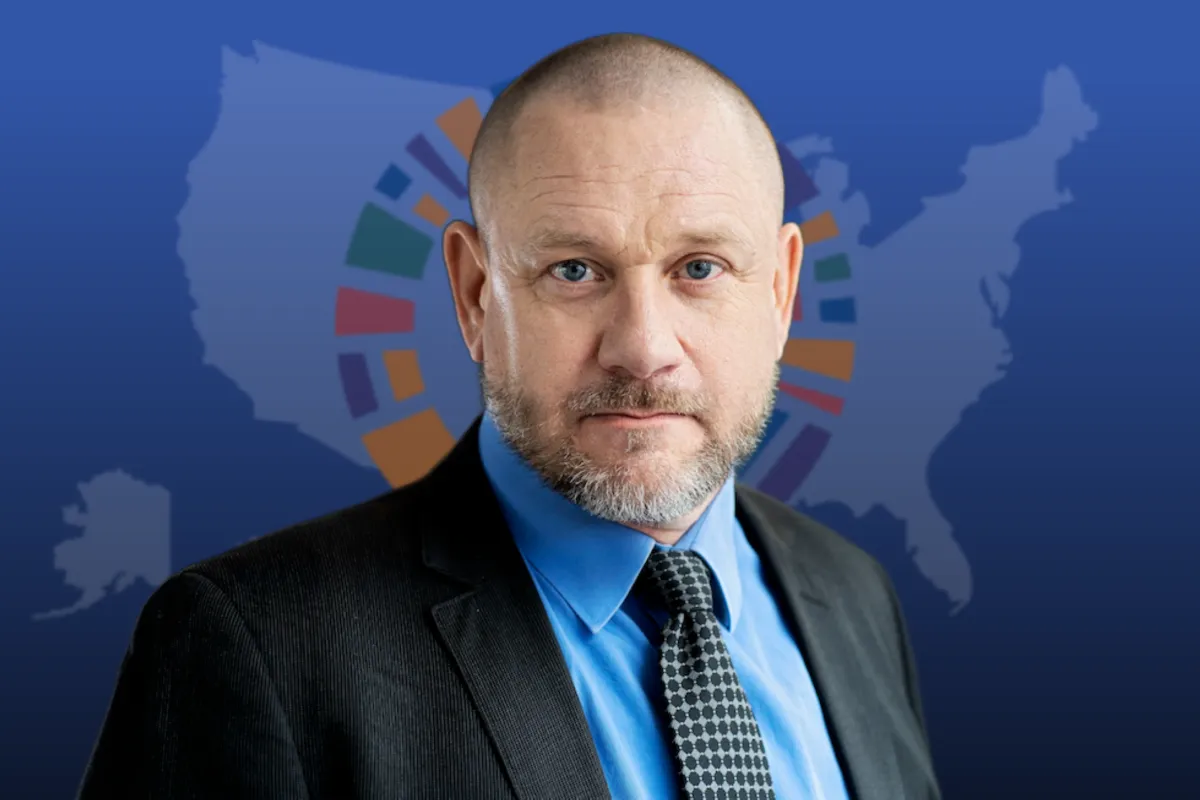
What does democracy truly mean in 2026, and how can we ensure its survival? What hope can the recent election in Hungary offer for reversing the slide of democracy in the US and elsewhere? Host Rev. Paul Brandeis Raushenbush talks with Dr. Staffan I. Lindberg, founder of the Varieties of Democracy Institute, about V-Dem’s latest global report titled, Unraveling the Democratic Era?
The report raises crucial questions about the future of democratic governance. It underscores the importance of understanding both the successes and failures of democratic systems, prompting a reevaluation of what democracy means in different contexts.
Key takeaways include:
- Democracy is Multifaceted: The state of democracy varies significantly across different nations, and understanding local contexts is crucial for promoting democratic values.
- Engagement is Essential: Electoral participation and civic engagement are critical in challenging authoritarian regimes.
- Concession Matters: Accepting electoral defeat is a vital component of maintaining democratic integrity.
Transcript
REV. PAUL BRANDEIS RAUSHENBUSH, HOST:
Staffan I. Lindberg founded the VDEM Institute based at the University of Gothenburg in Sweden in 2012. An independent research organization, it serves as the headquarters for the University of Gothenburg, Sweden's Varieties of Democracy, VDEM project, which is one of the world's largest social science data collection initiatives focused on democracy.
Researchers at the VDEM Institute publish an annual global democracy report and the 2026 edition is ominously titled Unraveling the Democratic Era - and it has an exclamation point at the end of it, which is maybe a hopeful sign. For the answer to that question and much more, I'd like to welcome VDEM Institute founder, political scientist Dr. Staffan Lindberg, who's one of the principal investigators of this and previous reports.
So Staffan, welcome to The State of Belief!
DR. STAFFAN I. LINDBERG, GUEST:
Thank you for having me.
PAUL RAUSHENBUSH:
Listen, you're beaming in all the way from Sweden. We really appreciate it. And I'm really eager, of course, to get into how this report understands data, how we decide what a democracy is, and all of those things. I want to start with at least the lede that's really reverberating in this country, which is what happened in Hungary at the election recently. 16 years of Viktor Orbán's kind of what seemed to be complete white knuckle grasp on control and power in that quote-unquote “democracy” came to an end. I mean, how do you understand this moment, as someone who really looks at democracy and all the intricacies of it? What was your reaction?
STAFFAN LINDBERG:
I was a bit surprised to tell you the truth - not the least that Viktor Orban and Fidesz gave in, and gave in so early in the evening, and accepted defeat. I wasn't sure about that because they have a lot to lose after the 16 years, that you mentioned, in power. Enormous grab on the economy, on media, suppression of civil society, control over universities - I can go down the line - and by all accounts also increasingly very corrupt and enriching themselves. So I wasn't sure that they were going to leave - but they are, seemingly. So that's good news, and it's terrific news for, I think, all pro-democratic parties, leaders, movements, groups, individuals, that such an entrenched electoral authoritarian government could be unseated by way of elections.
And that is an important point, right? I mean, we've seen it happen before in countries like Zambia and there are a host of other examples, but, to a lot of people it seems like, well then wasn't it a democracy if the opposition could win? No, not necessarily. If, like in Hungary, you do a ground game that's strong enough to mobilize such a big portion of the population to, like, we are fed up, and use that election to sort of overwhelm the system, you can even turn that kind of authoritarian regime that continues to hold multi-party elections, you can turn it over. You can break it.
PAUL RAUSHENBUSH:
That was what was really important, I think, for Americans watching to understand. We talk about gerrymandering here. Like, the election there was really so tilted in favor of Orban that it really had to be a massive sort of outpouring in order to overwhelm what was inherent in the system to make him win.
For us laypeople, we kind of think, okay, democracy equals elections. They held elections. Oh, well, our guy lost and the authoritarian won, but that's just the will of the people. No, it's not always that way, because sometimes they actually create - and we've seen that going on in our own country, where all of a sudden Trump says to Texas, give me five more seats, and they immediately give him five more seats for Congress. So I think it's important to understand the enormity of what happened in Hungary, which was that people just overwhelmed, what you said, which was the inherent disadvantage in the system.
STAFFAN LINDBERG:
It is really important to say, actually, what we call electoral authoritarian regimes are authoritarian regimes that try to look like democracies, hold multi-party elections, at least on paper, but to a certain degree allow opposition parties and some amount of freedoms and all that.
But you keep and hold on power by other means. You don't do away with elections. You don't necessarily cheat with the elections directly like ballot box stuffing or change the numbers kind of thing. So it can be technically clean elections. I mean, even the elections in Russia today are multi-party. There are quote-unquote “opposition parties” in the legislature and their conduct of the elections on election day and vote counting, they are, you know, technically okay. That doesn't make you a democracy. I'm sorry. It doesn't. And the same for Hungary, but to a sort of lesser degree than in Putin's Russia.
PAUL RAUSHENBUSH:
I mean, we see that here in our states, in individual states. My home state of Wisconsin had such a gerrymandered internal to Wisconsin that even if, for instance, Democrats got a majority, there was no way they were going to win the state House or the state Senate. It was just impossible. They'd have to get something like 70 % of the vote. And I think that's what you're really talking about is like almost inherent in the system.
STAFFAN LINDBERG:
Well, that's one aspect. Let me just comment on that quickly. I mean, that's one aspect. Now, I should say that the rest of the world has for a long time looked upon the American gerrymandering and that it's been okayed by the Supreme Court and all that as very strange and kind of not really democratic. You don't see that to the same extent or even near the same extent anywhere else, except now if we saw it in Hungary, but it in this election backfired, actuall,y on Orban and Fidesz.
PAUL RAUSHENBUSH:
Yeah, it's one of those wonderful exports of the United States. And just in the backfiring sense, I think even with Texas, we're already seeing that what they thought were sure areas with Latino voters are no longer sure for what they anticipated.
But you mentioned something that I think is super important, because I have an 11-year-old son who is a total political maven and he's just all in, and he was watching the election in Hungary really closely and I said, you know, the opposition won, the opposition won! He said no, not until he concedes. And I said, no, he conceded! And I mean if my 11-year-old son was shocked by the concession - and that was earl,y that was fairly early, and we're in a country where our current president has still not conceded to a loss that happened now six years ago.
But that concession, what were your impressions of that? Because it seems like Viktor Orban had two choices. I can fight this to the end, or I can just say, okay, we're gonna live to fight another day. What's your perspective on that?
STAFFAN LINDBERG:
So every authoritarian ruler at that point has, as you say, two choices, kind of. You can accept defeat and leave the scene, go and lick your wounds, do damage control, basically. Like I heard they did today at the foreign ministry in Hungary, emptying the shelves and archives and throwing them into shredders. So you can try and do damage control.
The other option is to fight, as you say. And then the famous political scientist, Robert Dahl, already in 1971 in a book called Polyarchy, it was about democracy. He formulated like this, you know, they would give in to democracy or democratization when the cost of oppression is higher than the cost of toleration. Like Orban and Fidesz, okay, there will be damage, but the cost of us going in here with oppression to stay in power would be unacceptable to us, right?
Now, autocrats have different levels. So if you look at a country like, let's say, Zimbabwe in 2001, when a similar situation was. And he was just like, no, I don't care. But he also had the grip of the military and secret police and the regular police and just beat up demonstrators, kill them, throw them in jail. Right. Some are willing to do that. Orban was not, now, also a very different relationship to the military forces that he could not command on his own. Like you could do in the US. And it's not clear whether the regular police and secret police, how far they would be willing to go.
And you have similar situations in other countries, like in Brazil, it was that kind of situation as well. When Bolsonaro lost the election, he was ready for a coup with the support of the military. The four branches of the military, three of them said, no, we're not. Only the Navy said we are, we'll go along with it. But then the three others said no. And then it was like a lost game. So that's the kind of calculations that are going on in those hours or maybe in the days leading up to it, because I'm sure Orban and Fidesz saw the writing on the wall here, because that was such a grand game. That was such an overwhelming support for the opposition. But that's where it ends up.
And as you say, in the United States, you have a president, as you said, that doesn't really have a good track record on accepting losing elections or accepting losing anything, which is part of democracy. That's at the heart of democracy.
PAUL RAUSHENBUSH:
Yeah, at the heart of democracy. And I had friends, I actually had friends at the end of 2024 who were kind of like, okay, our democracy held. I was like, the only reason the democracy held is because Trump won. You know, if he had lost, you know what I mean? And you can say democracy held - we've been backsliding for so long.
I do want to say one kind of mean thing and get it out of my system because I'm that kind of person, but it was very interesting to me that JD Vance and Trump, while we're at an incredibly terrible war with Iran, and he's supposed to be negotiating with Iran, he goes to Hungary and uses that capital, and Trump's, basically dangles economic opportunity as a way of, this felt to me so crazy. And I mean, not crazy in the sense that I can't believe it, but crazy in the sense that an American, that we're really so blatantly interfering in an election.
And it was so great because the press here, which I don't know if you follow, but basically JD Vance has come out having not succeeded in the Iran talks and then doing this, kind of, and then all this stuff with the Pope.
It's like everything he touches, he's a failure at. It's actually kind of amazing given his aspirations for 2028.
STAFFAN LINDBERG:
A brief comment, think it was also sort of kind of ironic that in his speech there in support of Orban, JD Vance accused the EU and European countries of meddling with the election.
PAUL RAUSHENBUSH:
Yeah, how amazing is that? Like how no sense of shame. No sense of shame. None. None. I could do a whole riff on JD Vance and right now - you may not know this, but he has a book coming out about his Catholic faith and he has been at war with every pope that has existed while he's been a Catholic. So I don't know what that means.
At this moment, we just mentioned some characters in the American democracy. As listeners to this show know, our whole show is about democracy and it's where religion and democracy meet. And that's what we talk about every week with experts in the legal field and in the social sciences field and in the religion field and talk about the intersection of religion and democracy.
When your report came out this year, just a month or so ago, it really landed hard. And the headline that we have fallen so far in our sense of ourselves as a democracy, in the reality of our democracy, but also that we no longer actually counted as a liberal democracy… And I just would love for you to unpack that, because that made it into all of my speeches and my sermons and everything that I was doing right away because I thought, well, this is something that we need to start acknowledging: The threat to our country, especially in our 250th year as a democracy.
So talk to me a little bit about that report. When you started looking at the numbers, what it looked like to you to see the United States continue this incredible slide.
STAFFAN LINDBERG:
Sure. So maybe I should say first to the listeners that VDEM and Varieties of Democracy, we have 31 million data points on democracy, human rights, the judiciaries, you know, parties and elections and so on. Essentially for all countries in the world, going back to 1900; for a few countries, including the United States, we have data that goes back to 1789. So this is by far the largest data source on democracy and long-term trends and what's happening. And it involves over 4200 scholars and other experts from over 180 countries that sort of supply the raw data for all of this.
PAUL RAUSHENBUSH:
I think that's really important to recognize. This is not like saying, you know what, today I'm feeling like this liberal democracy… No, no. This is like a huge, huge survey. That's really important to recognize that this is not something done lightly and it's done with really intense rigor.
STAFFAN LINDBERG:
Well, so that, and the methods we use to then aggregate and process this raw data have been published in the top journals, scrutinized over and over, including by the World Bank top economists to vet it so that they could use it. Like, do we trust this and so on. So we've been vetted and tested also in terms of the rigor of the methodology. So what I think means nothing, absolutely nothing, in terms of the ranking of United States or any other country. I've just been part of designing the methodology and run the project and involve all these scholars around the world.
Now, based on all of that data, the United States decline in democracy now under Trump 2.0 is not only the largest regression on democracy in American history by far, it is also almost the most dramatic decline in such a short period that we have ever witnessed in a democracy. There is one instance, if we disregard military coups. Argentina and stuff in the 60s. So if we disregard military coups and we disregard being invaded by something like Nazi Germany, just like this kind of autocratization or recession of democracy by an elected leader, the only instance that is really worse that has happened in a democracy was Hitler taking over in 1933; going into 1934 very quickly did away with democracy completely.
Now, what has happened is really the checks and balances that are so central to the American Republic as well as democracy are by, you know, a large degree gone. Congress has more or less abdicated its role. It's even the appropriation power, the power of the purse. If you take things like, you know, doing away with USAID and essentially the Ministry of Education and go down the line, reducing spending and doing away with agencies that Congress has created with the law, and the president is just like, no, I don't like that, scratch it. But it's a law! No, scratch it.
PAUL RAUSHENBUSH:
Even worse, we have this memory of Elon Musk being given this power to destroy departments that have been in existence for decades that were created by Congress. And he's up there with literally a chainsaw, like playing I don't know what. I don't mean to interrupt your flow, but I mean, this is just like so etched in our memory and it was so traumatic at the time to see what was happening, and yet no one was stopping it.
That's what it felt like. It felt like, my God, someone is literally destroying our republic, who we never elected. Who's this, just this richest guy in the world. I want to talk about money at some point because that's also a corrupting influence.
STAFFAN LINDBERG:
Yeah, but you could just look at it without even going into Elon Musk and DOGE. Although that's sort of very special part of all this. Look, the Constitution gives the power of the purse to the Congress, not the president. And Trump has to a larger extent just taken over that power. And the other core power of Congress is legislation - the appropriation bill is a special piece of legislation, but legislation in broader sense. Now Congress passed, as far as we could see, 49 bills in 2025. That's like nothing. And 48 of them were on purely insignificant issues, like change the deadline for this national parks application, blah, blah. And one, the big, beautiful bill, so-called, was significant.
Meanwhile, President Trump has issued legislation by way of presidential executive orders, 225 of them, and on major issues, as you know. So you've moved core powers from Congress over to the presidency along the unitary executive theory in Project 2025.
And then in addition to that, he has managed to nullify much of the federal court system's power. So I mean, there are over 600 court cases in the federal system right now against the Trump administration breaking laws and breaking the Constitution. When lower courts rule against Trump, they get insulted, intimidated, threatened with impeachment, and they get doxings and so on. And then either the Trump administration appeals, or if they are sure they're going to lose, then they just ignore it and continue doing what they're doing and there are a series of rulings now of court contempt against the administration.
PAUL RAUSHENBUSH:
No, I mean, it's the attacks on the courts, the attacks on the universities, the attacks on even corporations that go against what he believes. The question I guess that I have - and I do want to actually introduce religion into this, because that's my role - but I do want to say, when you fall from the definition of a liberal democracy, what does that technically mean? Because I think there's a slippery slope, slippery slope, slippery slope. But when you fall from one definition to another, what's the signifier there so that we can really understand what just kicked us out of the party?
STAFFAN LINDBERG:
What kicked you out big time was what I was talking about right now, basically, because the liberal democracy, you have checks and balances that function. And you would add to that that the legislature holds the executive accountable for actions that are illegal or inappropriate or instances of corruption, instances of intimidation of actors of freedom in media or in civil society and so on. And then also that the courts uphold the laws in the Constitution, but also then the executive following those orders, which apparently they don't. So already that's why I went on some length at this.
So we have two indices with a bunch of indicators in each one of them, one for the legislature, independence, autonomy, and exercising that checks and balances, and the same for the judicial system. And both of those are falling big time in this year's measure.
And the third part has a little bit to do with freedom of religion. It's part of it. It's individual rights and freedoms and equality in front of the law in those being protected. And so freedom of religion is falling among the indicators in this battery that measures individual rights.
But, you know, you've had lots of infringements of individual rights with regards to protests. You should know that. Were you in Minnesota? Twin cities, but also then a host of other instances. And now ICE using this face recognition, and then people being sought by police for watching protests and God knows what right. And it's not only me saying this. Human Rights Watch said in their latest report on the United States that the Trump administration is on a fast track to join the worst perpetrators of individual rights, human rights in the world. And the American Bar Association has issued several statements with concerns about the equality in front of the law, not the least the executive being acting without bounds, without constraints, breaking the law, and that being very concerning.
PAUL RAUSHENBUSH:
Yeah, all these things together. It's actually, in some ways, listening to you talk and we go through this and we remember it's like being boiled alive, like the frog being boiled alive. All of a sudden you realize, yeah.
Interfaith Alliance has been watching the attack on the freedom of religion, but also recognizing that, actually, the religious communities have been among the most brave in fighting back. You know, when universities were caving, the Catholic bishops were saying no. The Lutheran bishops were saying no. All of these people in Minnesota, the faith community was part of that resistance, which actually yielded one of the most important defeats.
My organization has sued the administration around the Religious Liberty Commission, which was made up entirely of Project 2025 right-wing Christians using religious liberty as this idea of a weapon of suppression. They're now winding down that because it's proved such a fiasco. And the anti-Christian task force, a bias task force, which was another way of saying anybody who speaks against our kind of Christianity is going to be prosecuted. But we also sued about that.
And I think that there is a way that religion, and you know this well, is that religion is one of those aspects of society: Either you can be a handmaiden to kind of the autocrat and say, yes, we want that proximity to power. You're going to give us that proximity and our brand of religion is going to be ascendant and be able to be dominant. And then you have other kinds of religion. And right now you're seeing this incredible fight between Pope Leo and Trump. Pope Leo is basically saying: I'm not afraid of you. It was such a great moment. That moment was so good when he was just like, I don't care if you post on Truth Social against me and all this, I'm not afraid of you. And I think that we're seeing, in a lot of ways in America right now, people kind of looking around and saying, okay, we don't have to accept this. But I do want you to say a little bit about how religion factors into democracy work as you see it.
STAFFAN LINDBERG:
So it's a little bit dual how religion factors. Freedom of religion is obviously a core right, freedom, in a liberal democracy. And it is declining also in our measures under Trump 2.0. And you mentioned many potential reasons why it's declining and we could mention others. It's a core attribute of liberal democracy to have freedom of religion. It sort of goes up and down with democracy.
Then in the current period, the world has sort of gradually come into this wave of autocratization around the world, and now the United States is part of it. And it's been 25 years of this wave building. In this wave, religion has been, in many places, instrumentalized for autocratization. So what has these past 25 years? Most places, overwhelmingly, this wave is driven by parties and leaders and movements that are far right, nationalist and reactionary; and then anti-liberal and many of them anti-democratic.
Now, many of them, not all, but many of them have liaised with whatever is the most sort of conservative reactionary brand of the dominant religion in the country. So one of the first things Putin did in ‘98 when he took over was to liaise with and get cozy with the Russian Orthodox Church and the patriarch there, who is insanely conservative and who would also be nationalist and support that project of creating a narrative of our great heritage and our great nation that we used to be that we need to resurrect.
Of course, the country is falling in shambles unless Putin and the party arc, we get our way and can save the country. That's sort of the narrative they all drive. Now, in Modi's India, it's Hindu nationalism and a very conservative, very reactionary brand of Hinduism together with nationalism to build this great Hindu nation again. And then attack the Muslims and the rest. In Orbán's Hungary, although now turning around, but in Orbán's Hungary, Orbán, used to be one of the very, at the face of it, liberals, almost socialists, and on the barricades in the 90s. He suddenly became a Christian, a very orthodox Christian, in alliance with the church, and it became that Christian nationalist reactionary.
In Erdogan's Turkey, he then cultivated close bonds with a very conservative wing of the Islamic community in Turkey, very reactionary in what used to be a very liberal Muslim-dominated country. Bolsonaro then tried to copy Trump to go with the sort of far right evangelical churches and forming an alliance there. And Trump did it with the abortion issue and all that. And holding the Bible, he tried to look like Jesus the other day, that backfired. But this is a general trend. This is how they operate. If you can merge religion in there and sort of claim almost being ordained by God to save the country and recreate the big nation, then people love it. Or a portion of the people will love it. And that's dangerous.
So religion has been instrumentalized. But depending on context, different religions, of course. So religion can be, in terms of autocratization, can be this double-edged sword. And we've seen that in the past in the history as well. The Catholic Church for a long time was with many dictators and then turned around in the 60s. So it's a double-edged sword. It can be used to oppress people and it has been used to oppress people, different versions of different religions. But you also see in many cases of democratization where churches are mobilizing people and helping support and organize for freedom, and then being liberal in the original sense, which was in theology liberal towards different denominations and different beliefs and that's fine. The freedom of religion along with other freedoms is an essential part of our society. So churches and religion can also be a force for democracy and for good, obviously.
PAUL RAUSHENBUSH:
You've kind of described the origins of the organization I head, Interfaith Alliance, which basically was founded in the 90s to counteract the oversized influence of the Christian Coalition with Pat Robertson, Jerry Falwell, Ralph Reed, who were kind of trying to say - and they're still trying to say it - we are a Christian nation. Christians have a privileged position here. We are, you know, going against the First Amendment, and so that's exactly what we do to organize.
We're coming towards the end. I would love to hear, I want you basically to cure everything within about two minutes. So could you do that for us, please? We can create a meme of you as the great healer, the Jesus Christ figure and coming in just like Trump. You diagnose the problem. What do you, with all of your expertise, what do you think are like maybe the five things to keep in mind about how to turn around a democracy that is sliding and turn it into something that really turn this around so that we can actually realize the promise of democracy in the United States?
STAFFAN LINDBERG:
I'll keep it short. We know from studying these other U-turn cases, the Brazil, the Poland and so on, Zambia and South Korea a couple of times now, a few things are really critical.
The political opposition, whether factions of one big tent party like you guys have or a multi-party system, the pro-democratic forces need to unify. They need to work together and say, we have our differences…
PAUL RAUSHENBUSH:
That was a lesson that they really talked about in Hungary, is that this coalition did not agree on everything. They specifically came together for this moment because they saw the common threat, but that was not like everybody was agreeing on every single thing.
STAFFAN LINDBERG:
No, no, no, no. And the same with civil society in Hungary, whatever is left there. And a lot of voters who voted for Peter Mayar said, did it holding their nose kind of thing because they think he's too conservative, too right. Same in Brazil. Many voters were not in favor of Lula, but they voted for him because there was a coalition of nine parties behind Lula. Same in Poland with Donald Tusk, a coalition of nine parties from pretty conservative right to pretty far out left, but saying, hey, okay, we have our differences. We want different things in some, but now we need to save democracy and get together.
Then secondly, the political and civil society getting together and creating a really strong ground game: Get out there in middle-sized towns, in small towns, villages, countryside, work it for a long time to really mobilize and create pressure and get that overwhelming number of people, share of the population, go to vote and vote against the autocratizing incumbent so that it becomes really hard to stay in power.
So those are critical components. Now there's one thing that maybe doesn't look so good for the United States in this, because the third thing would be that the court system stands up. They refuse to bend over. They refuse to rule in favor of this autocratizing government and stop them in their tracks as much as they can and hold up the integrity of the elections. They did that in 2020. Would they do it again now with the midterms? Who knows? And then, of course, the police, the paramilitary forces you now have with DHS and ICE, and eventually the military. You already had and have Marines on the streets. That's not a good sign, right? So you want those to be on the side of democracy and on the side of the protesters, not the other way around, or at least stay neutral, stay back.
PAUL RAUSHENBUSH:
Well, unfortunately, we have the worst of the worst, who's the head of the military right now, who is a total Christian Nationalist and anti-democratic, like just nightmare in Pete Hegseth.
We talk about courage on this show a lot. Like, what does courage look like when you're trying to show up for a democracy as an individual? We can talk about, the people should do stuff, but it does come down to individuals deciding to show up. What does courage mean to you when we're talking about democracy?
STAFFAN LINDBERG:
Courage would mean for people like me in academia in the US to stand up and speak truth to power. And I'm not seeing a whole lot of that, to my disappointment. Courage for ordinary people would mean if you work in the federal administration, a lot of people do, and you're asked to be bending or breaking the laws or regulations and do illegal things - following orders is not an excuse. Civil courage means standing up, and then it means If you're not working in the federal it means also speaking out in daily conversations. Don't accept these norms to change and the conversation being overtaken by those who will derail democracy even further.
And when there is need for it, do what they did in the Twin Cities. Get out there and protest. Not like No Kings once every six months, right? It needs to be six months every day kind of thing when it comes, when push comes to shove.
PAUL RAUSHENBUSH:
The Varieties of Democracy 2026 report, Unraveling the Democratic Era? is available for free download at v-dem.net. And we'll link to it at stateofbelief.com.
Staffan, these are such important insights. Thank you so much for being with us on The State of Belief.
STAFFAN LINDBERG:
Thank you for having me.